Why low tones
A speaker makes sound by moving a membrane back and forth. To produce the same loudness, a lower note needs a bigger movement. That big movement shakes the droplets stuck behind the grille and pushes them out. High notes can sound piercing, but the membrane barely moves, so they do little for water.
Apple says Apple Watch plays “a series of tones” to clear water when you turn off Water Lock, but doesn’t publish the frequency. SonicKit’s Standard mode uses 165 Hz.
Why too low fails
Phone speakers are tiny and can’t reproduce deep bass well. Go too low and the membrane can’t follow, so both sound and movement drop off. That’s why phone water eject sits roughly in the 100 to 200 Hz range, and why some modes sweep up and down instead of holding one pitch, passing through each speaker’s own sweet spot (its resonance).
Every mode, in Hz
These are the actual settings in the Android app SonicKit’s source code.
| Mode | Sound | Character | Access |
|---|---|---|---|
| Gentle 150Hz | Steady 150 Hz sine | Soft; first try or older phones | Free |
| Standard 165Hz | 165 Hz pulsing twice a second | Works on most phones | Free |
| Strong sweep | 100↔220 Hz back and forth | Passes several resonances | Free |
| Deep pulse 80Hz | 80 Hz in hard bursts | The strongest push | One ad, forever |
| Tidal sweep | 60↔300 Hz triangle wave | Rocks the water out | One ad, forever |
Runs are 10, 20 or 30 seconds; one ad unlocks 1 and 2 minute runs for 24 hours.
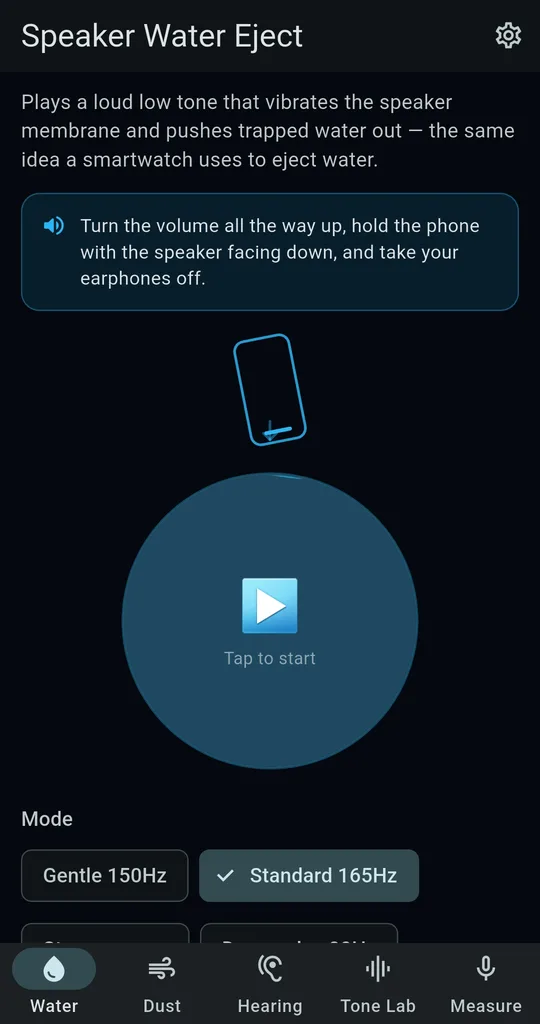
Read the mode note
Tap a mode chip and a one-line note below explains how it moves the speaker. Locked modes show a padlock.
Split it into repeats
Two or three 20-second runs with a wipe in between work better than one long run, and they’re easier on the speaker.
Which to use
- A few raindrops or a splash → Gentle 150Hz once
- Clearly muffled → Standard 165Hz, 20 s × 2
- Standard didn’t clear it → Strong sweep, then Deep pulse
FAQ
Can the eject tone damage my speaker?
The tones stay within what a phone speaker can play, but they run at max volume. Keep runs short, and if the sound starts to distort, turn it down a little.
How is this different from a water eject video?
Same principle. The app works offline, warns you if earphones are connected, and stops on its own if the earphones are unplugged or another app takes over the audio.
SonicKit - Speaker Water Eject
No sign-up, and it works without an internet connection. Free on Android.