Presbyopia is not lost acuity
The lens inside the eye thickens to pull focus onto close objects. With age it stiffens and stops thickening as readily. Distance vision is untouched; only the near end of the range goes.
The National Eye Institute puts the usual onset after about age 45, with the change continuing until roughly 65 and then levelling off. The hallmark symptom it lists is needing to hold reading material farther away, along with eye strain and headaches. Early on, larger print and brighter light are enough; later, reading glasses or a prescription are needed.
Sources: National Eye Institute, Presbyopia
Early signs
| Situation | What presbyopia looks like |
|---|---|
| Restaurant menu | You stretch your arm out before it sharpens |
| Phone | You have bumped the text size up a step or two |
| Dim rooms | Print that was fine at noon is not fine at nine |
| Looking far then near | It takes a moment to settle |
| Late afternoon | Long reading leaves the eyes dry and the head heavy |
If you are short-sighted you may notice it late, because taking your glasses off still works for reading. If you are long-sighted it tends to bite earlier.
Checking it at home
- Settle on your usual reading distance, typically 40 cm — roughly where your hand sits with the elbow bent.
- Work under good light. A newspaper body text, a medicine leaflet or a nutrition panel is a fine target.
- Check one eye at a time. The two often differ.
- If you use reading glasses, do a pass with them on to see whether the current strength still fits.
- Move the page in and out and note the distance where it is sharpest. Whether that distance keeps retreating is the real signal.
Reading J, N and M
Near vision does not use 20/20. Three notations circulate.
| Notation | What it is | How to read it |
|---|---|---|
| J1 to J16 | Jaeger numbers | Lower means you read smaller print |
| N3, N5, N8 … | British point notation | Type size in points; lower is better |
| M units | The optotype size itself | 1 M is the size subtending one arcminute at 40 cm |
J1 is the smallest, and newspaper body text lands somewhere around J5 to J7. Jaeger numbering grew out of printers’ type, so it is not perfectly standardised between charts. Trust the direction your own record moves more than the label itself.
Near vision in the app
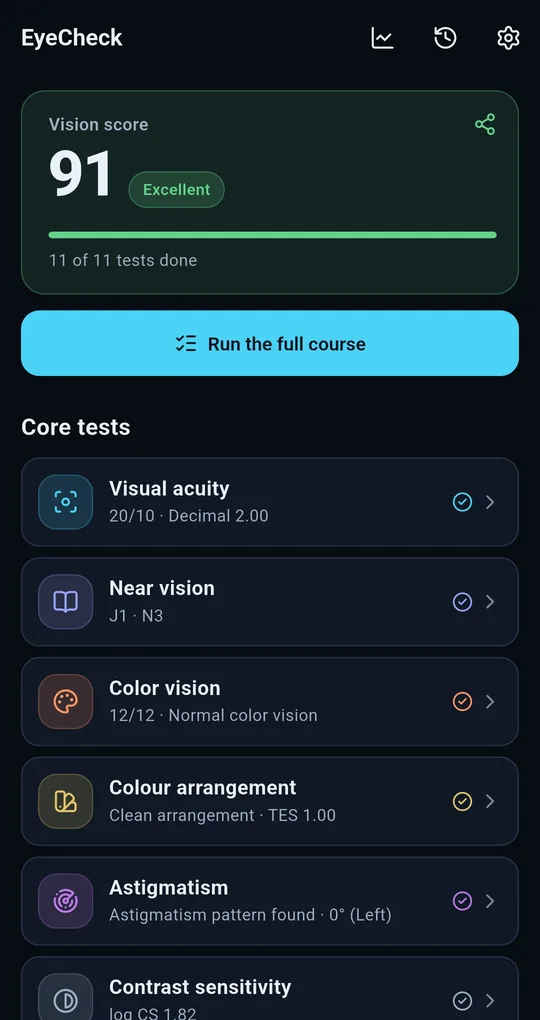
Pick Near vision
EyeCheck lists “Near vision” in the Core tests on the home screen. The distance can be 30, 35, 40 or 45 cm, with 40 cm as the default for a presbyopia check. If you wear reading glasses, keep them on and switch the eyewear flag on.
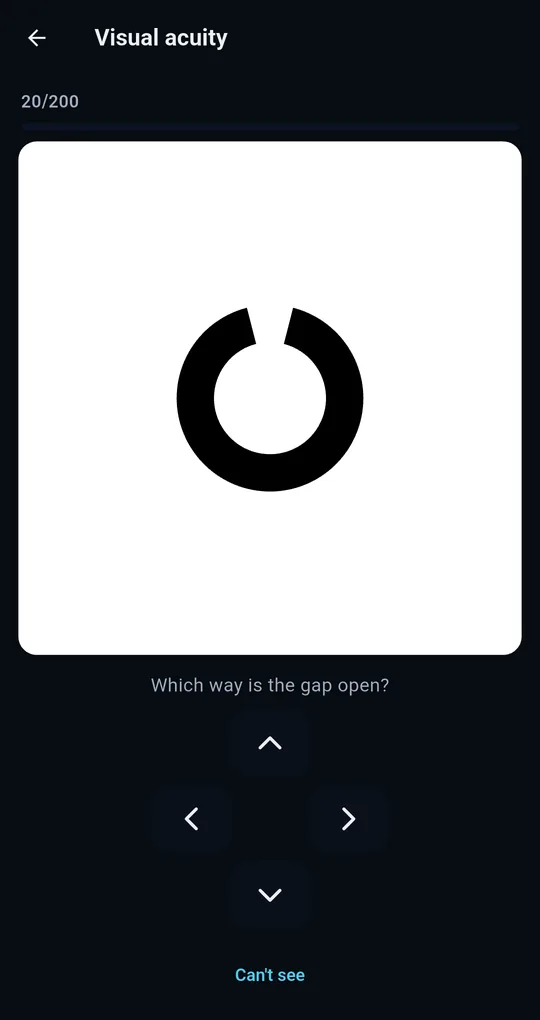
One eye at a time, same distance
Cover the eye you are not testing. The optotype grows and shrinks until it settles on your limit, and the result is reported with a J number and an N point size. Left and right are stored separately, so one eye tiring first shows up.
Come back in a few months
Presbyopia does not move in weeks. Set the re-test reminder in Settings to 90 or 180 days and compare then. A trend means something; a single reading does not.
FAQ
Can an app tell me which reading glasses to buy?
No. Lens power comes from a refraction with real trial lenses. Treat the app result as a prompt to get checked.
Can I just keep increasing the font size?
For a while. But larger text fits less on screen, and printed material and dim rooms stay just as hard. If your eyes tire often, get it looked at.
My two eyes give different results.
Common enough. If the difference repeats or is new, read the one weak eye guide, check again, and raise it at your next exam.
EyeCheck: Vision & Color Test
No sign-up, fully offline. A free Android eye self-check app that tests and records your left and right eye separately.