It all starts with one arcminute
An eye test is not a reading test. It measures the smallest angle you can resolve, and the reference is one arcminute — one sixtieth of a degree.
- When the gap in a Landolt C subtends one arcminute and you can still say which way it faces, that is reference acuity.
- The whole ring is drawn five times the gap. That ratio is what makes optotypes comparable worldwide.
- The smallest angle you can resolve is called MAR (minimum angle of resolution), measured in arcminutes.
MAR of 1 is the reference, 2 is half as good, 0.5 is twice as good. Every notation below is just a different way of writing MAR.
The four notations
| Notation | Where you see it | Definition |
|---|---|---|
| 20/20 (Snellen) | United States | Numerator is the test distance in feet; denominator is the distance at which a reference eye reads the same line |
| 6/6 (metric) | UK, Europe, much of Asia | The same fraction written in metres |
| Decimal 1.0 | Japan, Korea and others | 1 ÷ MAR. Bigger is better |
| logMAR 0.0 | Research and clinical trials | Base-10 logarithm of MAR. Smaller is better |
So 20/40 means “a reference eye reads this line from 40 feet; I have to be at 20 feet”. The bigger the denominator, the worse the acuity. The StatPearls entry on visual acuity describes the fraction the same way, with the test distance on top.
Sources: StatPearls, Visual Acuity (NCBI Bookshelf)
logMAR exists because its steps are evenly spaced on a ratio scale — each line is about 1.26 times smaller than the last — so you can average it and subtract it meaningfully. Decimal notation is more intuitive day to day, but the gap between 1.0 and 0.9 is nothing like the gap between 0.2 and 0.1.
Conversion table
| logMAR | Decimal | Snellen (feet) | Metric |
|---|---|---|---|
| 1.0 | 0.1 | 20/200 | 6/60 |
| 0.7 | 0.2 | 20/100 | 6/30 |
| 0.5 | 0.32 | 20/63 | 6/19 |
| 0.3 | 0.5 | 20/40 | 6/12 |
| 0.2 | 0.63 | 20/32 | 6/10 |
| 0.1 | 0.8 | 20/25 | 6/8 |
| 0.0 | 1.0 | 20/20 | 6/6 |
| −0.1 | 1.26 | 20/16 | 6/5 |
| −0.2 | 1.58 | 20/13 | 6/4 |
| −0.3 | 2.0 | 20/10 | 6/3 |
Rounding differs between charts, so you will also see 20/60 for 20/63 and 0.3 for 0.32. Treat them as the same step.
Does 20/10 mean eagle eyes?
Decimal 2.0, or logMAR −0.3, means resolving twice the reference angle. It is uncommon but real. A 20/10 measured at home, though, deserves a second look.
- The optotype has to be physically drawable at that size. Pixel density and test distance set a hard floor; below it the chart cannot render the step at all.
- A four-choice test has a 25% chance of a lucky guess. A run of luck is worth a line or two.
- Sharp is not the same as healthy. Contrast sensitivity, visual field and colour vision are separate measurements.
The numbers the app shows
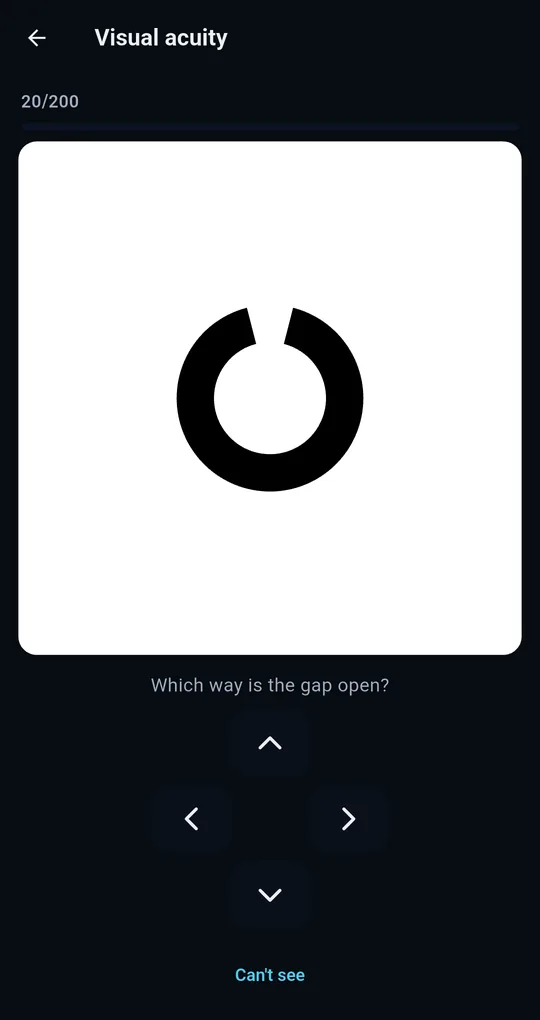
Two notations on one screen
During the test EyeCheck shows the current step in Snellen notation in the top left. The result screen and the home list print Snellen and decimal together — for example 20/10 · Decimal 2.00 — so whichever notation you grew up with, you can read it.
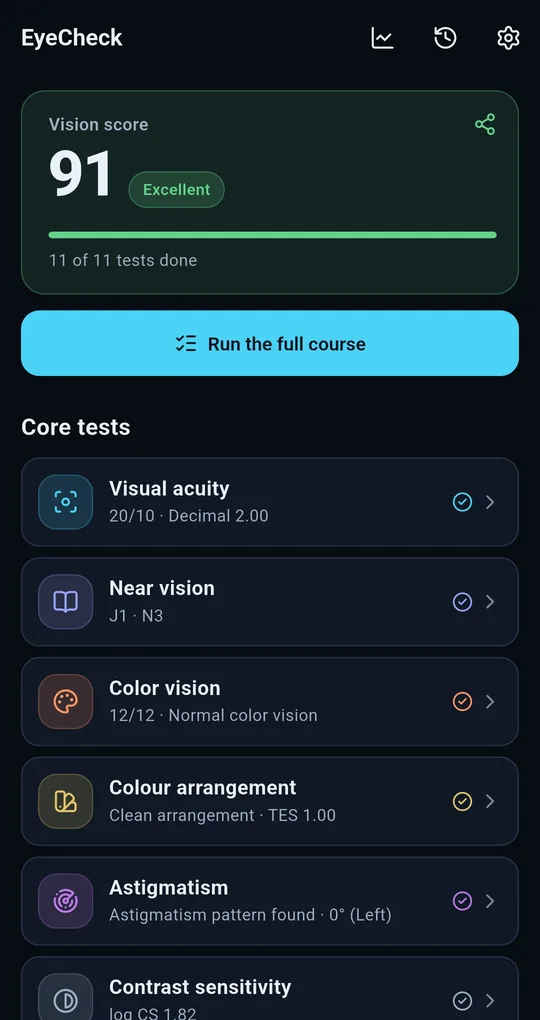
One scale underneath
Each row of the home list carries your latest result, and the chart icon opens the trend. Internally everything is stored on one scale, so switching how you read the number never breaks the history.
FAQ
Is 1.0 with glasses the same as 1.0 without?
The number is the same, the meaning is not. One is corrected acuity, the other is uncorrected. Mixing the two in one record makes the trend unreadable.
How is vision worse than 20/200 written?
By shortening the distance. If the top line is unreadable at 20 feet, you move to 10 feet and record 10/200. Below that come counting fingers, hand motion and light perception.
Is 20/15 fifty percent better than 20/20?
It means the resolvable angle is smaller by that ratio, not that everyday vision feels that much better. The number only holds for black letters on white in good light.
EyeCheck: Vision & Color Test
No sign-up, fully offline. A free Android eye self-check app that tests and records your left and right eye separately.