Why it goes unnoticed
What you see with two eyes is not two pictures side by side. It is one merged picture. If one eye goes soft while the other stays sharp, your brain leans on the sharp one. No hole appears, nothing turns grey, and the honest answer to “how is your vision?” stays “fine”.
Three things make this worse.
- Slow change. Over months there is nothing to compare today against.
- One-sided change. The good eye keeps covering.
- Change away from the centre. Reading still works, so nothing feels wrong.
In children this matters more. If the two eyes need very different corrections, the brain starts to favour the clearer one, and that can lead to amblyopia. MedlinePlus notes that children treated before age 5 almost always recover vision close to normal, while treatment started after age 10 usually brings only partial recovery.
Sources: MedlinePlus, Amblyopia
Checking one eye at a time
All you need is a hand. The point is one eye at a time, and both turns under identical conditions.
- Pick a fixed target with small print: a wall calendar, a subtitle on the TV, the spine of a book on a shelf.
- Cover your right eye with your palm. Do not press on the eyeball — pressure blurs it for a while and ruins the comparison.
- Note how small the print can get and still be readable with the left eye.
- Swap hands and repeat. Do not move, do not change the lighting.
- Wear glasses for both turns, or for neither. Never one of each.
| Condition | How to hold it steady | What happens if you do not |
|---|---|---|
| Distance | Stand on the same spot both times | The closer turn looks better |
| Lighting | Same time of day, same lamp | Dim light drags both eyes down |
| Eyewear | Both turns with, or both without | Corrected and uncorrected results get mixed |
| Covering | Palm over the eye, no pressure | A pressed eye stays blurry for minutes |
| Timing | Not at the end of a long screen day | Tired eyes read lower than they are |
Signs worth watching
| Situation | What can point to one weak eye |
|---|---|
| Stairs and parking | Depth judgement feels worse than it used to |
| Signs and screens | You have started turning your head to one side |
| Cameras | The viewfinder looks soft through one eye |
| Eye strain | Only one eye feels dry or sore after long reading |
| Children | Squinting with one eye, or moving very close to the page |
None of these proves anything on its own. They are reasons to do the one-eye check, not conclusions.
Testing each eye in the app
the Android app EyeCheck stores every result under the left or right eye. One measurement says little; two or three taken the same way separate a real difference from a bad day.
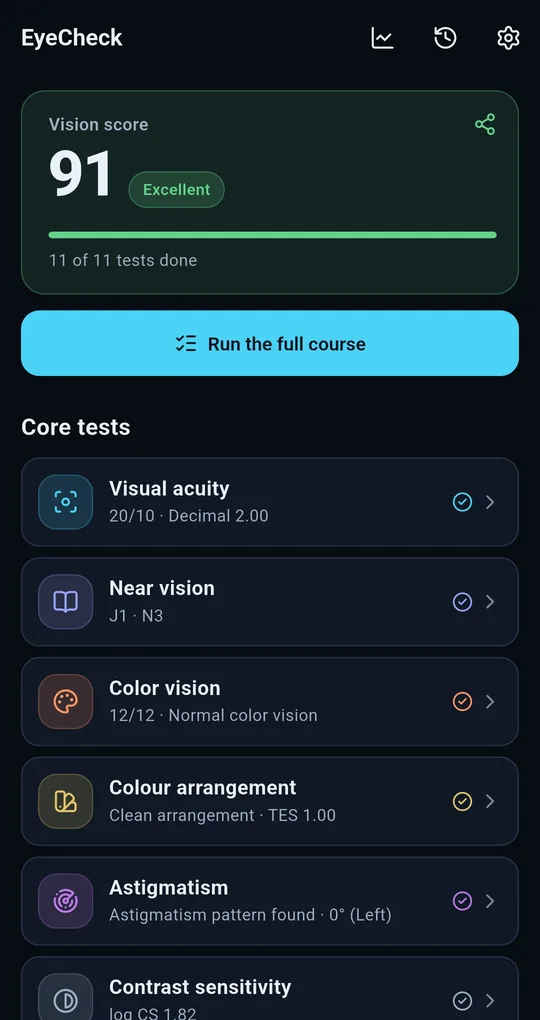
Start from the home screen
The top of the home screen shows a vision score built from the tests you have finished, and below it the list of tests with your latest result on each row, so you can see at a glance what has not been done. When your two eyes come out noticeably different, EyeCheck adds a note to the result screen saying so.
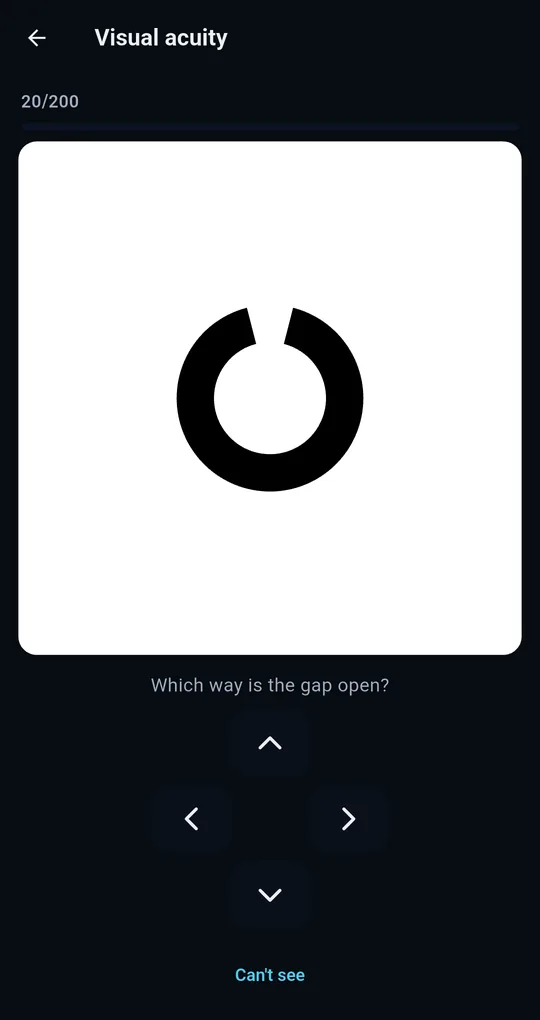
Pick the eye, then swap
On each test’s start screen you choose which eye you are testing and, if you are wearing glasses or lenses, switch on “Wearing glasses or lenses”. That flag is saved with the result, so corrected and uncorrected records never get mixed. Finish one eye, then run the same test again at the same distance for the other.
Read the trend, not the number
The chart icon at the top of the home screen opens the trends. What matters is the direction the line moves. If one eye keeps drifting down while the other holds, that is something to raise at your next eye exam.
When to see an eye doctor
- One eye blurs suddenly, or part of the field looks curtained off
- Straight lines look bent or the centre looks empty (see the Amsler grid guide)
- Eye pain, heavy redness, or haloes around lights come with it
- The same side keeps measuring lower, test after test
- A child covers one eye often, or the eyes look misaligned
A self-check is for noticing that it is time to go. The diagnosis happens in the clinic.
FAQ
How big a difference between eyes is a problem?
Setting your own numeric threshold is not useful. What matters is whether the difference repeats, and whether it is new. Either one is a reason to get checked.
Is a palm as good as an eye patch?
Yes, as long as no light leaks between your fingers and you do not press. Pressure on the cornea leaves the eye blurry for several minutes.
One of my eyes has always been weaker. Does this still apply?
The question is whether it is an old difference or a new one. Without records you cannot tell, so start recording each eye now.
EyeCheck: Vision & Color Test
No sign-up, fully offline. A free Android eye self-check app that tests and records your left and right eye separately.