When to have it examined
The US Preventive Services Task Force recommends vision screening at least once in children aged 3 to 5 years to detect amblyopia or its risk factors (Grade B). For children under 3 it found the evidence insufficient and made no recommendation (Grade I).
Sources: USPSTF, Vision screening in children aged 6 months to 5 years
MedlinePlus likewise says every child should have a complete eye exam at least once between ages 3 and 5, and that children treated for amblyopia before age 5 almost always recover vision close to normal, while treatment begun after age 10 brings only partial recovery. It also notes that specialists have ways to measure vision in children too young to talk.
Sources: MedlinePlus, Amblyopia
Home checking is not a substitute for that exam. It is a way of bringing it forward.
Signs you can see at home
| Situation | What to watch for |
|---|---|
| TV and books | Moving unusually close |
| Bright light | Squinting or shutting one eye |
| Looking straight ahead | One eye drifting in or out |
| Head position | Tilting the head to look at something |
| Covering one eye in play | Strong objection to one side being covered but not the other |
| Photos | A different reflex colour in one eye with flash |
| Movement | Hesitating on stairs, dropping things often |
The cover reaction is the single most useful thing a parent can notice. Cover the good eye and the child protests; cover the weak one and nothing happens.
How to try it at home
- Make it a game. Called a test, it becomes a performance, and performance makes results worse.
- Do one eye at a time. Use a palm or a paper cup, and check nobody is peeking between fingers.
- Mark the distance on the floor. Children drift closer.
- Keep it short — two or three minutes is plenty.
- Do not conclude anything from a bad round. Attention and understanding move the result enormously.
- Keep a child’s records separate from an adult’s, or no trend means anything.
Optotypes for pre-readers
Reading is not required to measure acuity. Only the way of answering changes.
| Optotype | How the child answers | Suits |
|---|---|---|
| Picture symbols | Names a house, circle, square, apple, star or heart | Toddlers who can name the pictures |
| Tumbling E | Points in the direction the E faces | Children who can handle direction |
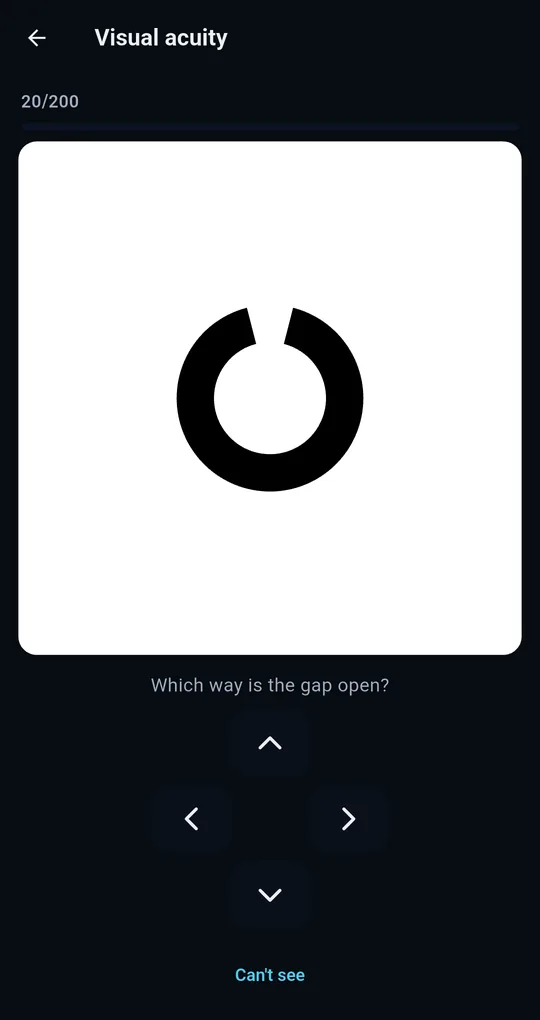
| Landolt C | Picks the side where the ring is open | School age and adults |
| Letters | Reads the letter | Children who know letters, and adults |
Picture symbols only work if the child already knows the names. Going through them once at a large size before you start saves a lot of confusion.
Doing it in the app
Switch the optotype
“Optotype” in Settings offers Landolt C, tumbling E, letters and kid symbols. Choose kid symbols and the child picks a picture from a set of options instead of naming a direction. Spoken guidance can carry the instructions for a child who cannot read yet.
Give the child a profile
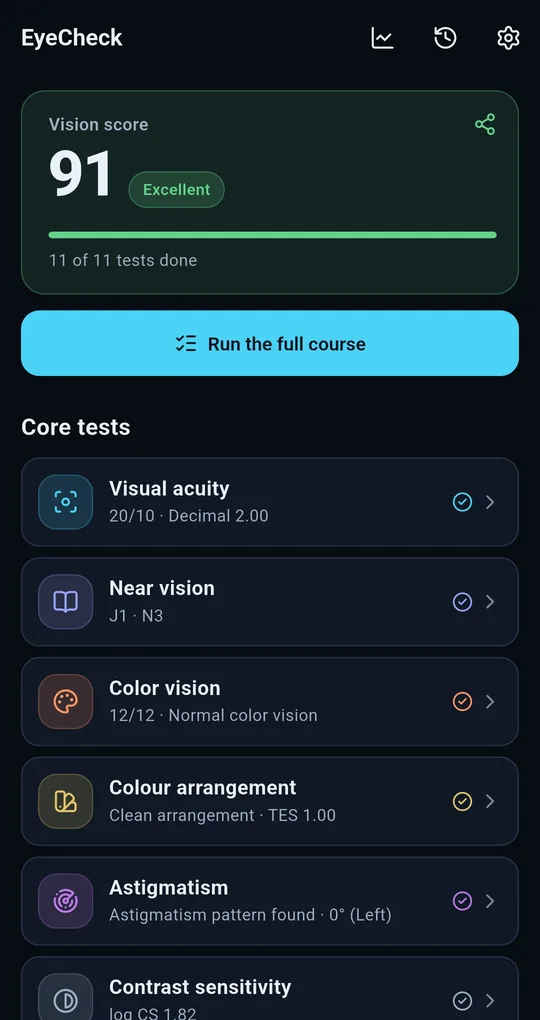
Profiles keep a child’s records apart from an adult’s. A year of birth is optional and is used to read results in context. Everything stays on the device and nothing is uploaded.
Take the record to the appointment
Results export as a PDF report. A few sessions collected over several days make the conversation at the appointment much quicker. It is not a diagnostic document, and a child’s eyes still have to be examined in person.
FAQ
Good results at home — can we skip the exam?
No. A home check cannot find the unequal refraction, misalignment or retinal problems that cause amblyopia. Have the 3-to-5 screening done regardless.
From what age can we try this at home?
Once a child can name pictures or point in a direction, usually around age 3. Younger children need the methods a specialist uses.
My child answers differently every time.
Short attention spans do that. Split it into short sessions, and if it stays erratic, book the appointment instead of trusting the number.
EyeCheck: Vision & Color Test
No sign-up, fully offline. A free Android eye self-check app that tests and records your left and right eye separately.