Two tests, two jobs
Colour vision testing splits in two. One kind screens — is anything off? The other grades — how much, and along which axis?
| Test | What it is for | Limitation |
|---|---|---|
| Pseudoisochromatic dot plates | Quickly flags red-green and blue-yellow problems | Says little about severity or type |
| Arrangement test (D-15) | How far the colour order is scrambled, and in which direction | Can miss mild cases |
| Anomaloscope and other clinical tests | Confirms type and degree | Clinic or test centre only |
MedlinePlus notes that colour blindness is common in men — about 1 in 10 — and rare in women, that the red-green form is the most common, that there is no known cure, and that jobs needing accurate colour discrimination can be harder to get.
Sources: MedlinePlus, Color blindness
Those are population figures, not a diagnosis. Failing a self-test does not pin down a type, and passing one does not certify normal colour vision.
The screen changes the answer
Printed plates have fixed ink. A display does not. Any one of these can flip a result.
- Night mode or a blue-light filter — everything shifts yellow and blue-yellow discrimination falls apart.
- Battery-saver colour modes — some devices desaturate.
- Low brightness — the differences between the colours shrink.
- Screen protectors and reflections — hues wash together.
- Panel-to-panel variation — the same colour value does not look the same on two phones.
Maximum brightness, every colour filter off, and steady light close to daylight are the minimum conditions for a self-test to mean anything.
Checking a requirement properly
Colour vision standards vary by country, by authority and by role, and they are revised. Old figures copied onto forums are not a safe basis. The order that works:
- Find the current official notice or regulation from the body itself — the medical standards in the job posting, or the licensing authority’s fitness criteria.
- Check which test decides it. Some bodies use dot plates alone; others add an arrangement or lantern test, or allow a second-stage test after a failed screen.
- If you need a result on paper, book a formal colour vision test with an eye care professional. A screenshot from an app is not an acceptable document anywhere.
- If you are near the boundary, ask the body directly about retest procedure and tolerances.
As a rule, standards are tightest where colour-coded signals carry safety consequences — transport, electrical work, some uniformed services — but roles within the same field differ. Confirm with the official source, not a summary.
Coping day to day
- For charts and maps, ask for a version that also uses shape, pattern or labels, not colour alone.
- Label or position-code the things that get confused — cables, laundry, medication boxes.
- If you design material yourself, check that nothing depends on colour alone.
- If someone in the family has a deficiency, showing them how it looks explains more than describing it.
Running both in the app
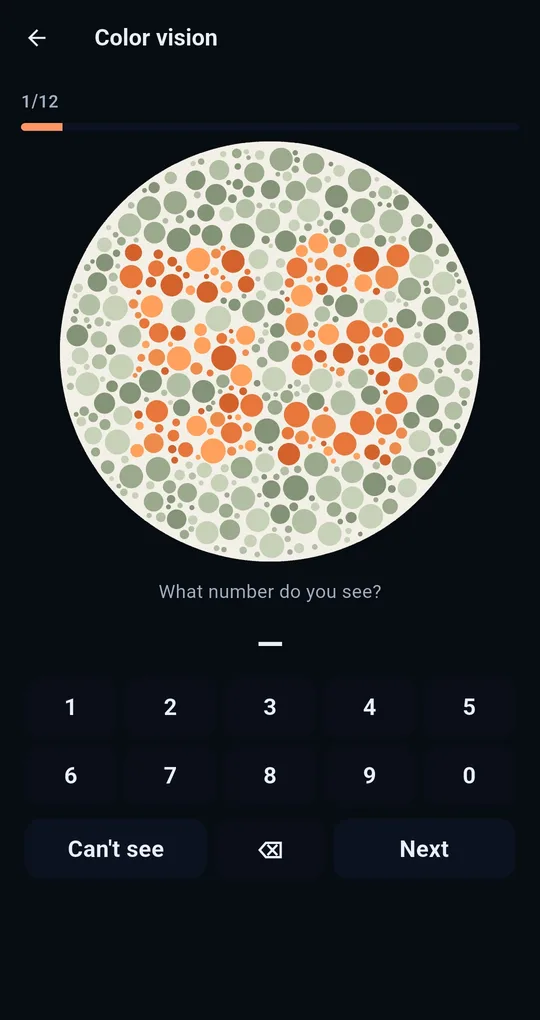
Screen with the dot plates
EyeCheck’s colour vision test shows twelve dot plates and asks for the hidden number. The numbers are generated fresh each run, so they cannot be memorised. Plates everyone should be able to read sit at the start and the end: miss those and the app asks you to retest and check brightness and colour filters first.
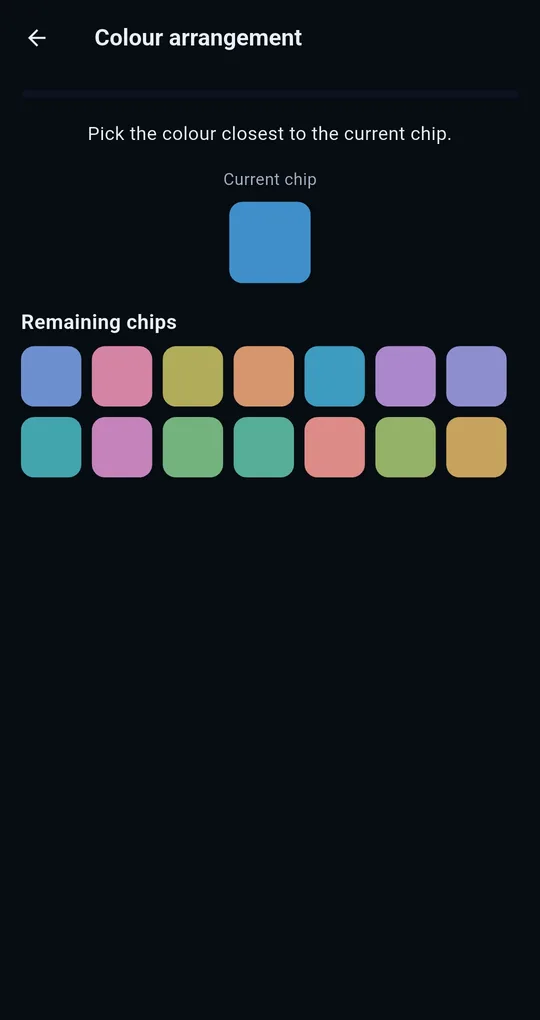
Grade it with the arrangement test
The arrangement test starts from a reference chip and asks you to keep picking the colour closest to the current one. At the end it reports how scrambled the order was as a total error score, and which confusion axis it leans towards. A smooth ring means a clean arrangement; lines cutting across the circle show the axis.
Try the colour filter
Under Eye care, the colour filter loads a photo and shifts hard-to-separate colours apart. Switch on simulation mode and it does the reverse, showing how the image looks with a given deficiency. The filter is built to make colours separable, not accurate.
FAQ
The app says normal. Am I in the clear?
Not necessarily. A mild deficiency can hide on a well-calibrated screen. If a standard has to be met, get a formal test.
Why does the hidden number change every time?
A fixed answer can be memorised, which makes the second run meaningless. EyeCheck generates the digits anew for each test.
Will colour-correcting glasses get me through an exam?
Whether aids are allowed is up to the testing body, and tinted lenses do not restore colour vision. Only the regulation decides.
EyeCheck: Vision & Color Test
No sign-up, fully offline. A free Android eye self-check app that tests and records your left and right eye separately.