Learning goals
- Compute expected value and explain why win rate and expected value differ.
- Distinguish independent events from the gambler’s fallacy.
- Understand how simulation (Monte Carlo) estimates probabilities.
50-minute plan
| Time | Activity | Materials |
|---|---|---|
| 5 min | Explain the Martingale; show of hands: “100 units, base bet 1, 300 spins — will the bankroll grow?” | Board |
| 10 min | Groups flip a coin 20 times and record the longest tails streak | Coins |
| 10 min | Each group runs the app simulator once or twice, recording spins to bust and longest losing streak | App |
| 10 min | Project the Stats tab and compare with the class results | App |
| 10 min | Compute expected value (−2.7% per bet) and demo the Compare tab | App, board |
| 5 min | Wrap-up: “No betting order changes the average.” | Worksheet |
Worksheet questions
- Find the expected value of a 10-unit bet on red on a European wheel.
- With 100 units and a base bet of 1, after how many straight losses do you go bust? What is the chance of that streak starting now?
- Was your group’s actual win rate above 50%? If you still went bust, why?
- How would you answer a friend who says “red came up five times, black is next”?
- What changes when the number of runs goes from 100 to 2,000? What becomes stable?
Answer keys: losing-streak odds and house edge math.
Using each screen
The app shows amounts in Korean won (₩) in every language. Treat them as abstract units; only the ratios matter.
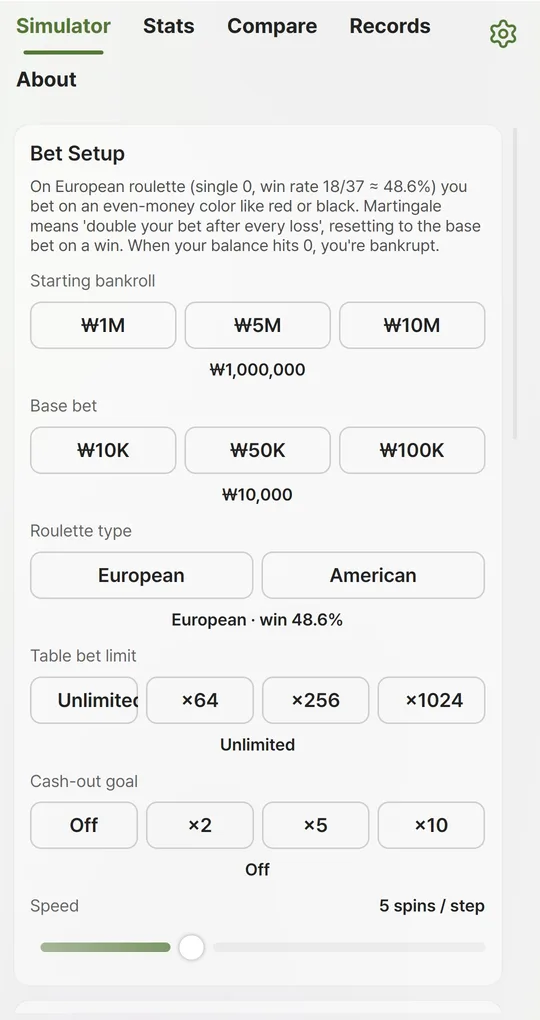
Simulator: individual experience
Groups using identical settings still go bust at very different times. Save results to the Records tab to pool the class data later.
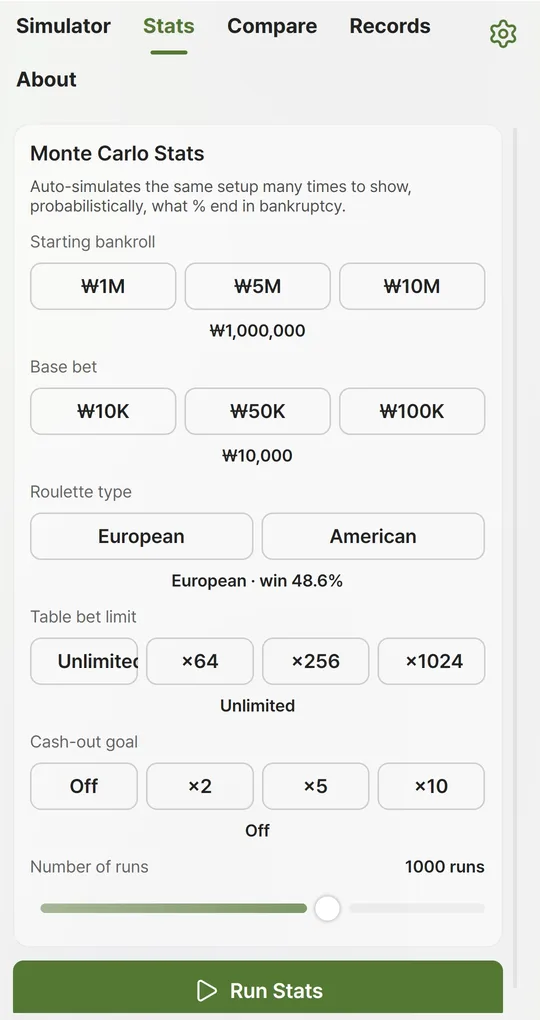
Stats: the power of repetition
The Stats tab repeats a setup up to 2,000 times and shows the bankruptcy rate and a histogram of survival spins. Put a group’s handful of runs next to thousands of runs to explain the law of large numbers.
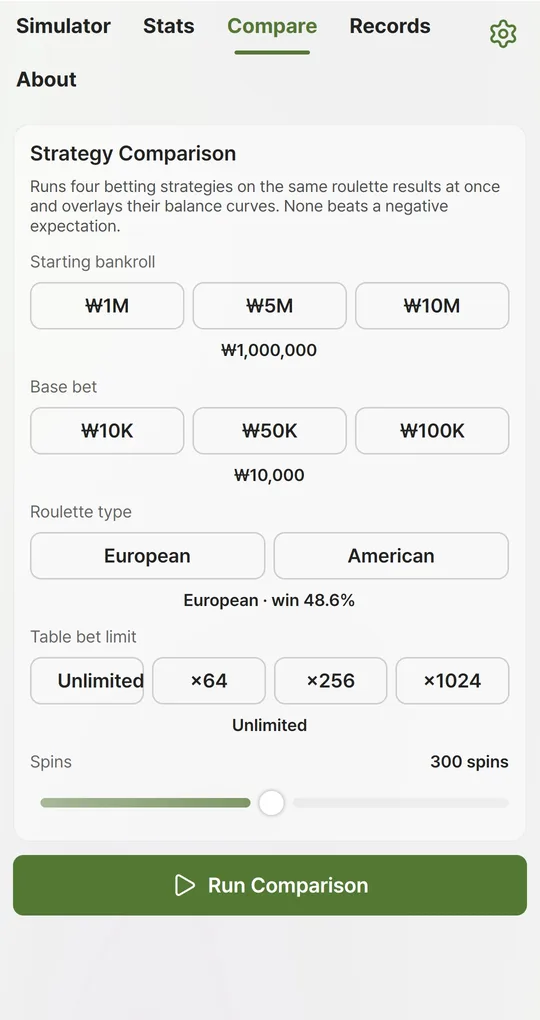
Compare: different systems, same conclusion
When someone asks “what about another system?”, the Compare tab runs four betting systems on the same spins and overlays their balance curves.
Notes for teachers
- End on “every system loses”, not “this system loses less”.
- Tell students up front that all amounts are virtual and the app has no payments or deposits.
- Some students may have family affected by gambling. Avoid personal examples and show helpline information at the end. Background on illegal online gambling is in the risks of unlicensed sites.
FAQ
Does it work in a classroom without internet?
Yes, the simulator runs offline. Ads only appear when the device is online.
Can students use it in Korean?
Yes. The app supports English and Korean; change the language in settings.
Martingale Bust - Roulette Sure-Win Simulator
Every amount is virtual. No sign-up, works offline. A free Android app for learning probability, in English and Korean.