What the fallacy is
The gambler’s fallacy is the belief that past results change the odds of the next independent event. “I have lost so many times, I am due a win” is the classic form. The Martingale adds “so bet bigger” to that belief, which is what makes it dangerous.
“It all evens out” misunderstood
The law of large numbers says the proportion moves toward the probability as trials pile up. It does not say earlier gaps get paid back.
| Stage | Red | Black | Share of red | Red minus black |
|---|---|---|---|---|
| First 10 spins (10 reds) | 10 | 0 | 100% | +10 |
| Next 1,000 spins split exactly evenly | 510 | 500 | about 50.5% | still +10 |
The share approached 50% but the gap of 10 never closed. Black did not come up “extra”; the later spins simply diluted the early run. (Zero is left out to keep the example simple.)
The night black came up 26 times
A roulette wheel at the Monte Carlo Casino in 1913 reportedly landed on black 26 times in a row, and it is the most quoted example of the fallacy: gamblers kept betting on red because red “had to” come next, and lost heavily. Twenty-six of the same color in a row has a probability of (18/37)25, roughly 1 in 67 million on a European wheel, but with enough wheels spinning worldwide rare things happen somewhere. On the 26th spin, red was still 18/37.
The same mistake in daily life
- Picking lottery numbers that “haven’t come up lately”.
- Believing that after three boys, a fourth child is more likely to be a girl.
- The opposite error, the “hot hand”: assuming a winner will keep winning. In a game with no skill involved, like roulette, that has no basis either.
Check it with recent spins
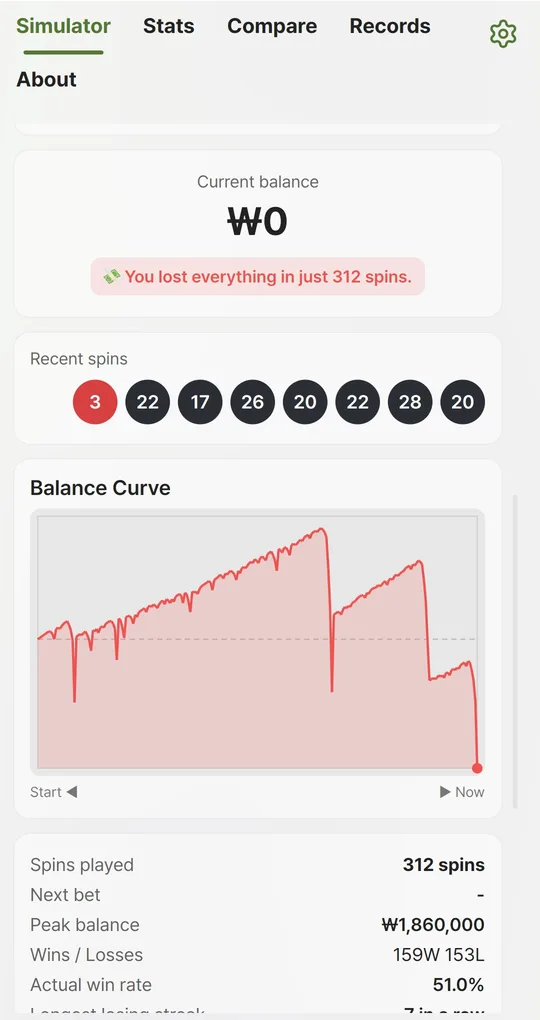
Watch the recent-spins chips
As the simulator runs, the latest numbers line up as red, black and green chips. Count what follows a long run of one color. Over many spins, the share of red after a streak just wobbles around 18/37.
Read the About tab
The About tab sums up what the Martingale is, why it ends in ruin, and a short entry on the gambler’s fallacy. It works well as a handout before a class or a talk.
FAQ
What if a wheel is tilted and favors some numbers?
A faulty wheel breaks the equal-and-independent assumption, but casinos inspect and replace wheels, and a player cannot detect a bias from a short record. The app uses a uniform random number generator.
I can see patterns in an online game’s history.
Human eyes find patterns in random data too. Raising your stake based on them leads to the same ending as the Martingale.
Sources: Wikipedia, Gambler’s fallacy (Monte Carlo 1913)
Martingale Bust - Roulette Sure-Win Simulator
Every amount is virtual. No sign-up, works offline. A free Android app for learning probability, in English and Korean.