What each one asks
- Sudoku — the digits 1 to 9, once each per row, column and box. The work is elimination: ruling out what cannot go in a cell.
- Nonogram (Picross) — the numbers beside a line are the lengths of the blocks you must fill. The work is sliding those blocks as far left and as far right as they go and keeping the overlap.
- Minesweeper — each opened cell tells you how many mines sit in the eight around it. The work is relating neighbouring numbers to each other.
- Tents and Trees — one tent per tree, tents never touch, line numbers count tents. The work is matching, and that makes it the odd one out.
Because it is a matching problem, Tents and Trees has deductions the others do not. “Every tree touching this cell already has its own tent, so a tent here would have no partner” rules out a cell by relationship rather than by count.
Side by side
| Sudoku | Nonogram | Minesweeper | Tents and Trees | |
|---|---|---|---|---|
| Clues | Pre-filled digits | Block lengths per line | Mine count around a cell | Tree positions + line counts |
| You fill in | Digits 1–9 | Filled / blank | Mine / safe | Tent / grass |
| Core thinking | Elimination | Overlapping ranges | Simultaneous neighbours | One-to-one matching |
| Typical board | 10–30 min | 10 min to hours | 1–10 min | 1–20 min |
| Rules take | A line or two | A paragraph | A line or two | Three lines |
Measured by how long the rules take to learn, Tents and Trees sits close to Minesweeper. The depth, though, keeps scaling with board size.
Must you ever guess?
This is where the four part ways.
- Sudoku is published with a single answer by convention. Worth knowing: it was proved by exhaustive search in 2012 that no Sudoku with 16 or fewer clues can have a unique answer. The minimum is 17.
- Nonograms are normally set with a unique answer too.
- Minesweeper is the exception. With mines scattered at random, positions genuinely arise where the remaining cells cannot be told apart and you have to call a coin flip. Variants that generate only guess-free boards exist precisely because of this.
- Tents and Trees is normally set with one answer, so you never hit “but my answer also follows the rules”.
If forced guessing is what made you quit Minesweeper, Tents and Trees is the one to try. Why a unique answer matters is covered in this guide.
Choosing one
| If you | Try | Because |
|---|---|---|
| Are tired of reading digits | Nonograms, Tents and Trees | Numbers are only used for counting |
| Want several short boards | Minesweeper, small Tents and Trees | A board takes a few minutes |
| Want one long sitting | Nonograms, big Tents and Trees | Time scales with board size |
| Refuse to guess | Sudoku, Tents and Trees | Set with a unique answer |
| Like a picture at the end | Nonograms | The finished grid is pixel art |
Where Tents and Trees came from
Tents (also published as Tents and Trees) is credited to Léon Balmaekers of the Netherlands, who created it in 1989 for the puzzle magazine Breinbrekers. That makes it a late arrival next to Sudoku and Nonograms, and it is used as an event at international puzzle championships.
The name changes by country — Tents in English, Zelte in German — but the rules are the same everywhere.
In the app
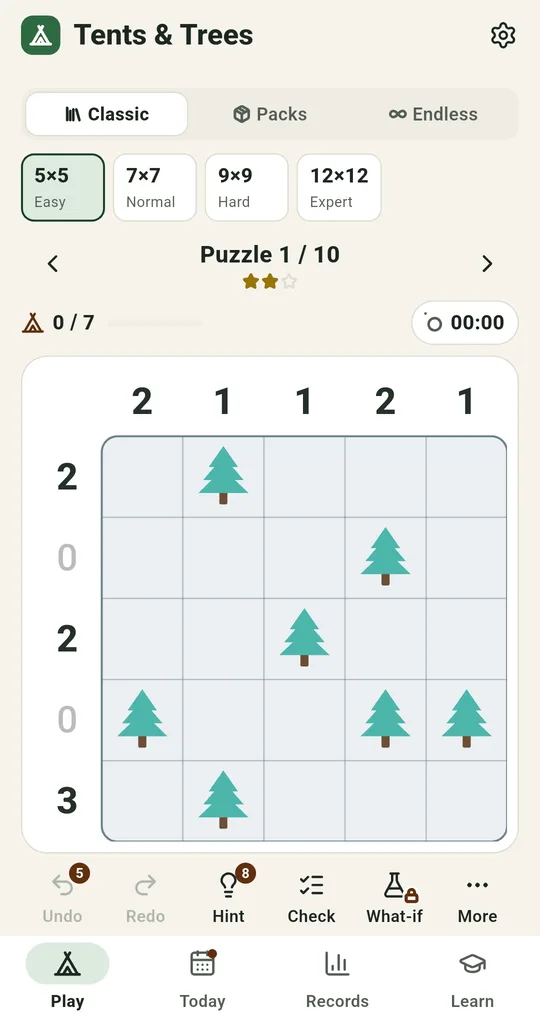
Five steps to the rules
If the genre is new to you, open the Learn tab in the Tents and Trees app and tap Replay the tutorial. One tent per tree, tents may not touch, the numbers outside, marking grass, and then a real 5×5 to finish on — five steps, and the last one puts it straight into your hands.
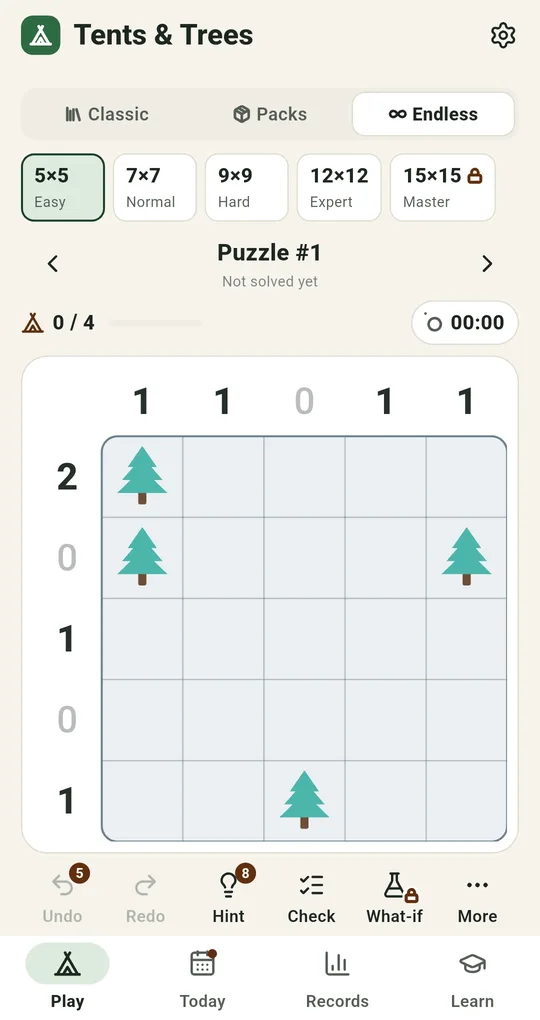
Compare sizes for yourself
Same rules, but 5×5 and 12×12 feel like different games. A 5×5 falls to one or two sweeps; from 12×12 you are counting whole lines and running what-ifs. Play one of each and settle on the size you actually enjoy.
FAQ
Is Tents and Trees easier than Sudoku?
The rules are simpler, but the difficulty is set by board size. A 5×5 is under a minute; a 15×15 often takes longer than a hard Sudoku.
Does a picture appear like in a Nonogram?
No. The answer here is an arrangement, not an image. The trees, tents and grass are drawn, so a finished board looks like a campsite, but it is not pixel art.
Can I play it on paper?
Yes — graph paper and a pencil is all it takes. Setting your own is covered in making puzzles on graph paper.
Tents & Trees: Logic Puzzles
No sign-up, fully offline, and every board is verified to have exactly one solution. Free on Android.