The three rules
The grid has trees drawn in some cells. You place tents in empty cells, and only three things matter.
- One tent per tree — a tent stands directly above, below, left or right of its tree, never diagonally. So there are always as many tents as trees.
- Tents never touch — not side by side, and not corner to corner.
- The numbers outside — the number to the left of a row, or above a column, is how many tents that line holds.
Trees may touch each other, and a tree may touch a tent that is not its own. The only thing under constraint is the tents. A single tent can sit next to two trees, but the pairing still has to come out one tree, one tent.
Marking a paper board
On a newspaper or puzzle-book grid, two marks are enough.
| Mark | Means | When |
|---|---|---|
| A triangle | Tent, confirmed | You have proved this cell holds a tent |
| A dot or a cross | Not a tent (grass) | You have proved a tent cannot go here |
| Small dots | Candidate | A tree still has two or more possible spots |
The mistake beginners make most is not marking the grass. Without those crosses you keep re-reading the same cells. Record every conclusion the moment you reach it.
The first five moves
This order works on any board. Steps 1 to 3 need almost no thought, and what is left feeds steps 4 and 5.
| Step | Do this | Why |
|---|---|---|
| 1 | Cross out every row and column numbered 0 | That line holds no tents at all |
| 2 | Cross out every cell with no tree above, below, left or right | A tent only stands next to a tree |
| 3 | If a line’s empty cells equal the tents it still needs, they are all tents | Nothing can be removed |
| 4 | Place a tent for any tree down to one possible spot | That is the only partner it can have |
| 5 | Every time you place a tent, cross out the eight cells around it | Tents cannot touch, not even diagonally |
Steps 4 and 5 come as a pair. Placing one tent clears eight cells, which can cut another tree down to a single spot, which sends you back to step 4. Loop until it stops, and an easy board is already finished.
Then re-read the line numbers. Any line that has all its tents is grass the rest of the way. After that sweep the board is visibly smaller.
Where people get stuck
- Two trees facing each other across one cell. Putting a tent in the middle makes both trees share it, which leaves one of them without a partner. Count trees against tents.
- A tree with two candidates. Even without knowing which one it is, any cell that touches both candidates can be crossed out — whichever spot gets the tent, it would touch that cell. If the tree’s right and lower cells are the candidates, the lower-right diagonal cell is the one.
- Losing track on a big board. Tick a line’s number as soon as that line is finished and you will never count it twice.
If it still will not move, you need a technique that counts a whole line at once. That continues in counting runs of empty cells.
Trying it in the app
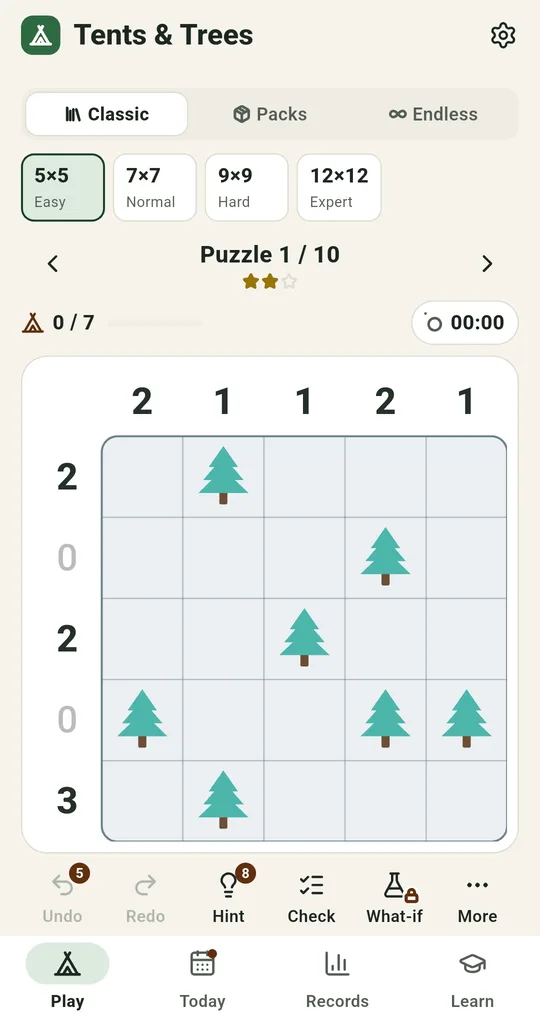
Start with a 5×5
In the Tents and Trees app, open the Play tab, choose Classic and start at 5×5 Easy. Tapping a cell cycles empty, tent, grass; a long press jumps straight to grass. Swiping paints grass across several cells at once, which makes steps 2 and 5 above much faster.
Auto grass and the Check button
Turn on Auto grass fill in settings and the app marks grass on finished lines and around every tent for you — step 5, done automatically. Check does not compare your board against the answer. It only marks the cells that break a rule, and says nothing about cells you have left empty.
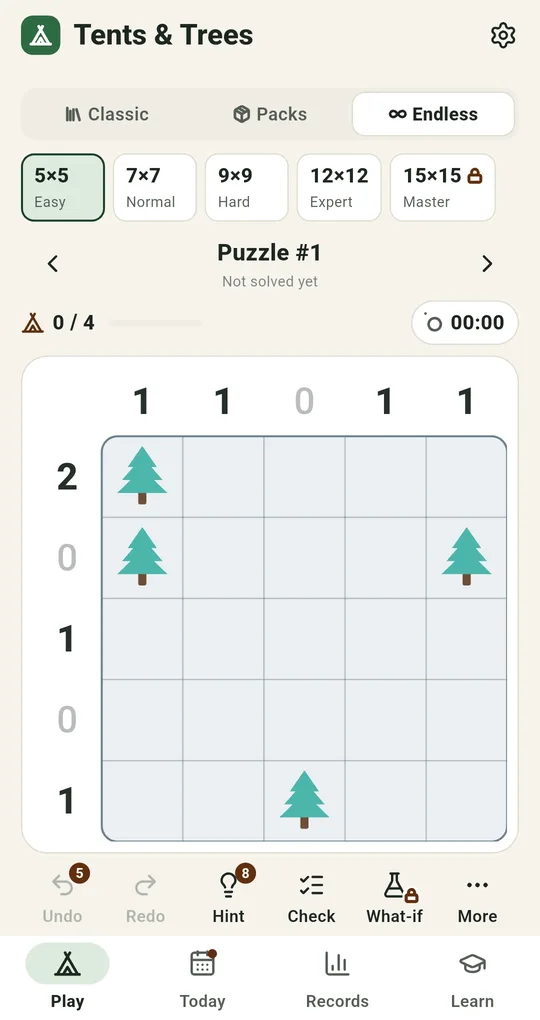
Repeat the same size
The Endless tab builds a fresh board at whatever size you pick, over and over. Once the ten Classic boards are done, the quickest way to make the opening sequence automatic is to stay at one size here and run it until your hands know it.
FAQ
Can one tent sit next to two trees?
Placing it is legal. But every tree needs its own tent, so if two trees share one, one of them ends up without a partner — which means the board needs another tent somewhere.
What about trees standing right next to each other?
Perfectly normal; trees have no restrictions. It does mean their candidate cells overlap, so the technique of crossing out cells that touch every candidate comes up often.
Are there boards that need guessing?
Tents and Trees is written to have exactly one solution. Every board in this app is verified that way, so logic alone always finishes it. How that check works is in building a puzzle with one solution.
Tents & Trees: Logic Puzzles
No sign-up, fully offline, and every board is verified to have exactly one solution. Free on Android.