Why one answer
With two or more answers, there comes a point where logic cannot narrow anything further. At the cell where the answers diverge, the rules simply do not say which it is, so you guess. Guess right and that was luck, not skill; guess wrong and everything you deduced afterwards collapses.
That is why most grid logic puzzles treat “exactly one answer” as a condition of publication. The promise is what makes “if this cell were not a tent, we would get a contradiction” valid in the first place — see what-if reasoning. With several answers no contradiction arrives, and the whole method stops working.
It helps the solver too. Knowing the answer is unique unlocks shortcuts like “either way, the result here is the same, so it does not matter”.
What produces a second answer
In Tents and Trees there are shapes that reliably split the answer in two.
- Two trees and two tents diagonal to each other inside a 2×2 area. There are two ways to lay them out and both give the same line numbers. Unless some other clue reaches in from outside, that is two answers.
- Two trees placed symmetrically along an edge. Mirror the arrangement and the numbers do not change.
- Too few trees. Wide open space leaves several complete ways to place the tents.
What they share is a pair of tents you can swap without changing any line number. When you suspect a second answer, look for that pair first.
Checking by hand
If you are setting on paper, go in this order.
| Step | Check | If it fails |
|---|---|---|
| 1 | Are there as many tents as trees? | If not, the board already breaks a rule |
| 2 | Does every tree pair with its own tent? | Two trees must not share one tent |
| 3 | Do any tents touch, including diagonally? | That breaks a rule |
| 4 | Erase your answer and solve it from the numbers | If you have to guess anywhere, suspect a second answer |
| 5 | Is there a swappable pair as described above? | Move or add one tree |
Step 4 is the real test, and also the hardest to do honestly — you remember your own answer. Leave it a few days, or hand it to someone else.
What a generator does
A program works in the opposite order from a human setter.
- Draw the answer first. Scatter tents on an empty grid so that none touch, then attach one tree in an adjacent cell to each tent. That alone guarantees a board with at least one answer.
- Count the line numbers. Purely mechanical.
- Count the solutions. Run a search from the trees and the numbers alone — and stop the moment a second answer turns up. There is no need to count them all. If two exist, throw the board away and go back to step 1.
- Sort by difficulty. Small boards get one extra test: can they be finished by plain propagation, with no what-if? Boards that fail are discarded too.
Plenty of boards get thrown away, but each attempt is cheap, so in practice a board appears almost instantly.
In the app
Every board has passed the check
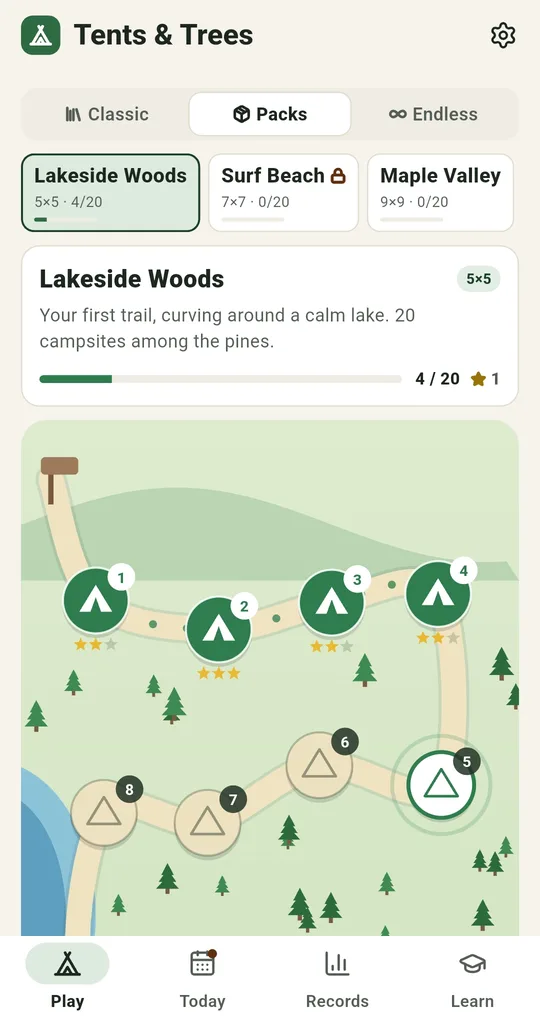
Every board the Tents and Trees app serves — built in or generated on the spot — has been verified to have exactly one answer. That is why any board can be finished without guessing. The small sizes, 5×5 and 7×7, get the extra test as well: only boards that fall to plain propagation are kept.
It checks the boards you make, too
In the Learn tab, Make a puzzle lets you place trees and tents and tap Check. It looks at whether the counts match, whether tents touch, whether any tree is left unpaired, and finally whether more than one answer exists. If two do, it tells you to move or add a tree.
When the check cannot finish
Place too few trees and the board is so open that the solution count never terminates, so you get “the board is too open to finish checking”. That is not an error — it means the number of cases exploded. Add a few more trees and it passes immediately.
FAQ
What is wrong with solving a board that has two answers?
Nothing, if all you want is to finish it. But there will be a point where you must guess, and everything after that rests on “assuming the coin landed right”. The worst part is that if it did not, you have no way of knowing how far back to go.
Do more trees make an easier puzzle?
Generally yes. More trees narrow where tents can stand and push the board towards a single answer. Few trees leave wide gaps, which is exactly where second answers come from.
Is the daily puzzle the same board on every device?
Yes. The board is built from a value derived from the date, so it does not depend on the device or when the app was installed.
Tents & Trees: Logic Puzzles
No sign-up, fully offline, and every board is verified to have exactly one solution. Free on Android.