The idea
When a claim is hard to prove directly, assume it is false. Push that assumption through the rules until you reach something that cannot be. The assumption must have been wrong, so the original claim is true.
The standard school example is that the square root of two cannot be written as a fraction. Assume it can, assume the fraction is fully reduced, and you end up proving that both the top and the bottom are even — which contradicts “fully reduced”.
Described in words it stays abstract. On a grid, “pushing it through” becomes cells you can see.
How it looks in a puzzle
When a cell in Tents and Trees could be either, do this.
- Assume it is a tent.
- Follow the rules. The eight cells around it become grass, the line needs one tent fewer, which cuts some other tree down to a single spot, and so on.
- Somewhere a contradiction appears: a tree with nowhere left to put its tent, a line whose number can no longer be met, or two tents forced to touch.
- So the cell is not a tent. Mark it grass.
It works the other way round too. If assuming the cell is empty breaks a rule, the cell is a tent.
One condition matters: this only works if the board is guaranteed to have exactly one answer. On a board with two, no contradiction arrives and both branches survive to the end. That is why a unique solution is the premise.
Doing it on paper
| Task | How |
|---|---|
| Mark the assumed cell | A second colour, or a circle around it — you will need to erase it |
| Mark what follows from it | The same colour, so the whole branch can be wiped at once |
| Mark where it broke | A small exclamation mark — you should be able to say why later |
| If the assumption holds | Redraw only the confirmed cells in your normal colour |
Undoing is the painful part on paper. Erase carelessly and you lose cells you had already proved. So assume only on cells where the branch will be short — pick a spot where a contradiction should land within three or four moves.
When an assumption runs long
If you are ten or twenty moves in and nothing has broken, it is one of two things.
- The cell really is a tent, so no contradiction can appear — in which case the board just solves itself.
- You picked the wrong cell and should back out and try another.
Avoid assuming inside an assumption. One layer is about all anyone can hold in their head, and when a second layer looks necessary, there is usually a simple move you missed earlier. Recount the line numbers first.
And treat what-if as a last resort. Exhaust the techniques that confirm cells outright — such as counting runs — before reaching for it.
In the app
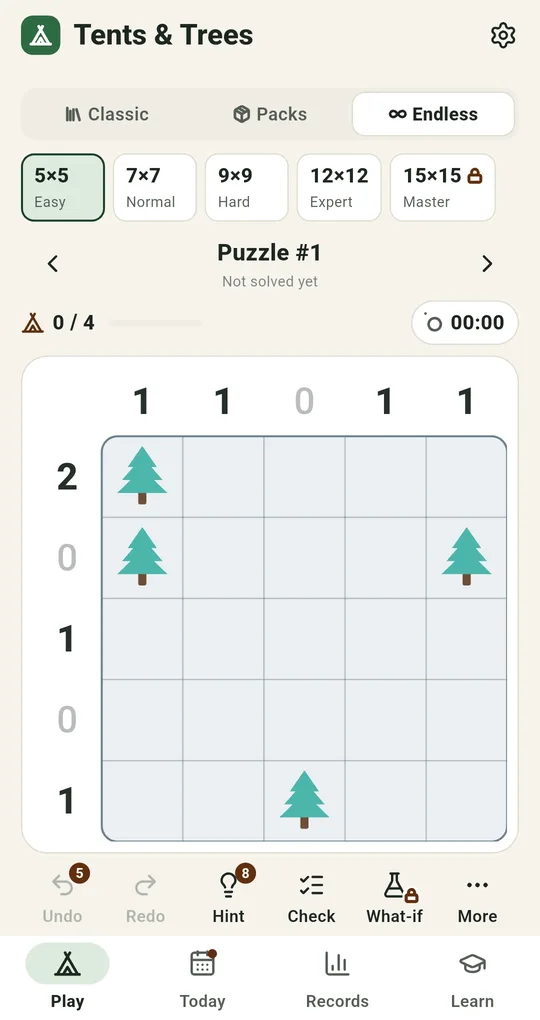
A what-if layer with no erasing
Tap What-if under the board in the Tents and Trees app and you enter what-if mode. Cells you place from then on are marked in purple, with a bar at the top counting them. End it with Keep to make them permanent, or Discard to throw the whole branch away. The worst part of doing this on paper simply disappears.
When a hint points at a contradiction
One of the reasons a hint can give is “putting a tent here breaks a rule right away”. That is this exact argument. The mirror image, “leaving this empty breaks a rule right away”, means the cell is a tent. If the hint reaches for this technique, the simpler ones had nothing left to offer.
Small boards never need it
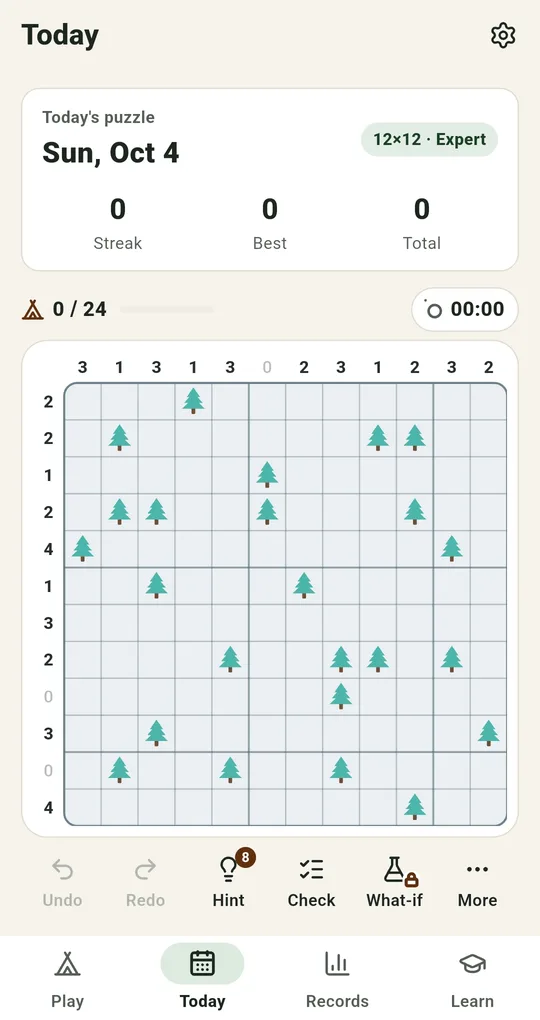
Only boards solvable by plain propagation are served at 5×5 and 7×7, so what-if never comes up there. It starts to be necessary from 9×9. When teaching a child, the same order works well: learn the rules on small boards, then introduce what-if on bigger ones.
FAQ
Is what-if just guessing with extra steps?
No. A guess is a choice you cannot verify. An assumption is a choice you then test against the rules, and a contradiction settles the opposite as proved. What is left at the end is an argument, not luck.
If nothing breaks, does that mean the assumption was right?
On a board with one answer, if you reach a complete, rule-abiding board, that is the answer. But if you simply stall halfway, nothing has been proved — drop the assumption and look at a different cell.
Does this help with school maths?
Running the structure by hand many times does help. Writing a proof in sentences is a separate skill, though, so the useful step is to make the solver say out loud why a cell is settled.
Tents & Trees: Logic Puzzles
No sign-up, fully offline, and every board is verified to have exactly one solution. Free on Android.