What a run is
Read one row from left to right. Break it at every tree and every cell you have already crossed out. What is left are blocks of consecutive empty cells — call each one a run.
In a nine-cell row reading empty, empty, grass, empty, empty, empty, grass, empty, empty, the runs have lengths 2, 3 and 2. The important part is that runs do not interfere with each other: grass sits between them, so a tent in one run can never touch a tent in the next.
The most a run can hold
Inside a run, tents cannot touch, so they must sit with a gap between them. A run of length L holds at most (L+1)÷2 tents, rounding down. Start at one end and take every other cell and you reach that number.
| Run length | Most tents | Where they go (○ is a tent) |
|---|---|---|
| 1 | 1 | ○ |
| 2 | 1 | ○· or ·○ |
| 3 | 2 | ○·○ |
| 4 | 2 | ○·○· and others |
| 5 | 3 | ○·○·○ |
| 6 | 3 | ○·○·○· and others |
| 7 | 4 | ○·○·○·○ |
The maximum does not go up with every extra cell — it goes up every two cells. An even length holds no more than the odd length just below it. That asymmetry is what the next step lives on.
When the total lands exactly
Work out the maximum for every run in a line and add them up. If that total is exactly the number of tents the line still needs, then every run has to be filled to its maximum — short-change any one of them and the line cannot reach its number.
That is where cells get decided.
- An odd-length run has exactly one way to hit its maximum: from both ends, every other cell. The 1st, 3rd and 5th cells are all confirmed tents.
- An even-length run can be filled several ways, so nothing is settled inside that line. What is settled is that each pair of cells holds exactly one tent.
That “one per pair” is stronger than it looks. Since a tent stands somewhere in the pair either way, any cell in the neighbouring line that touches both cells of the pair can never be a tent. A whole row of cells above and below gets crossed out at once.
Odd runs and even runs
| Run length | What you get when the total matches | Where to use it |
|---|---|---|
| Odd | The run is fully determined (1st, 3rd, 5th are tents) | Place tents right there in that line |
| Even | One tent per pair — the cells stay open | Cross out cells in the lines above and below |
If the total is larger than the tents needed, nothing is determined. If it is smaller, the board is already unsolvable, which means you crossed out something you should not have. Go back and check.
Anything you learn in a row changes the columns and the other way around. Finish a line, then immediately re-read the lines that cross it.
In the app
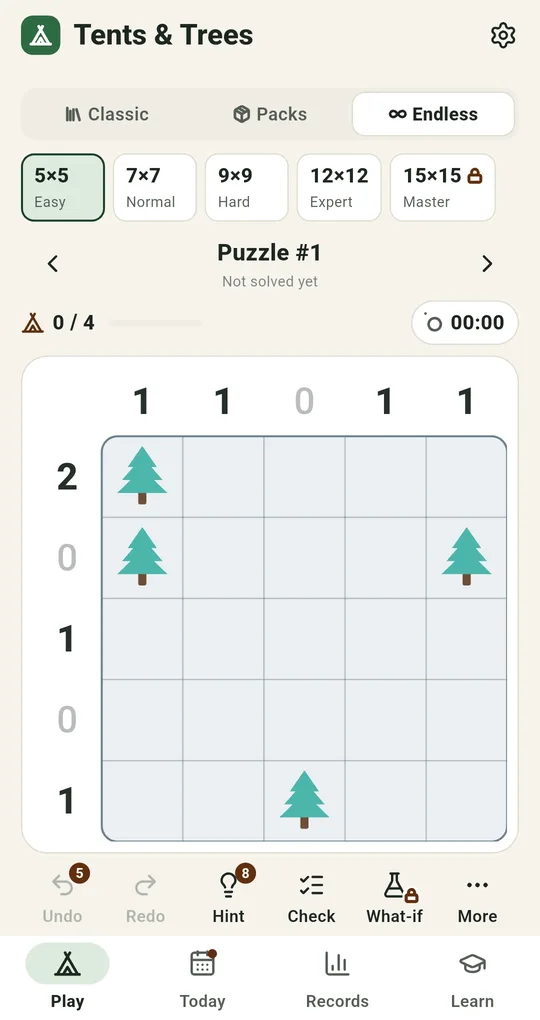
When the hint names this technique
Hints in the Tents and Trees app try the easy techniques first, so if a hint cites counting runs, that technique was genuinely needed at that moment. The wording reads something like “this line still needs so many tents, and the most each run of empty cells can hold adds up to exactly that”.
Reading it again in the technique guide
The Learn tab has a technique guide listing, in order, cells with no tree beside them, line numbers, the cells around a tent, trees with only one spot, trees already paired, squeezed cells, counting runs and what-if. The harder ones sit further down, and the hint engine only reaches them when nothing simpler applies.
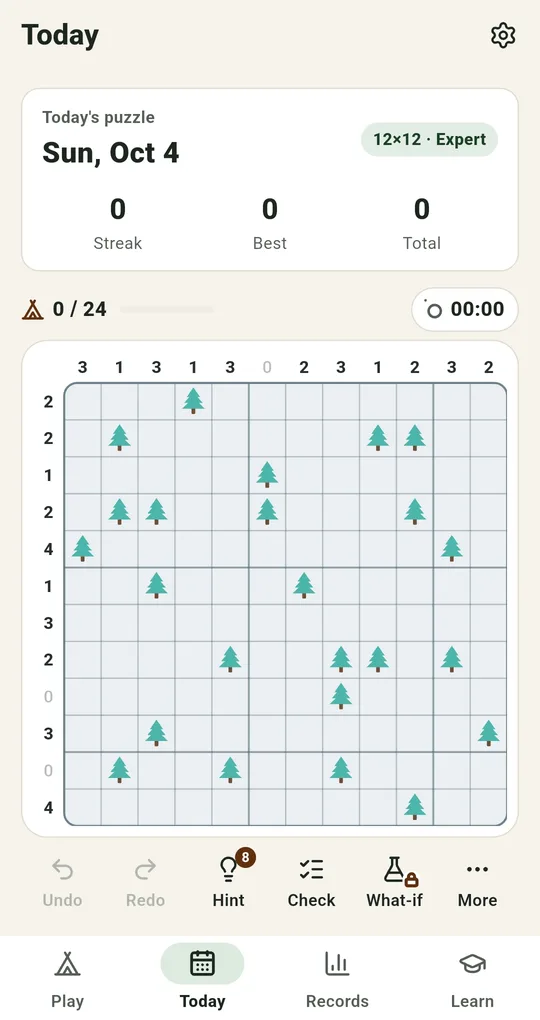
Reading numbers on a big board
From 12×12 up, pinch to zoom and work one line at a time — you will miscount far less. A heavier gridline every five cells gives you something to count runs against.
FAQ
Why is (L+1)÷2 the maximum?
Starting at the first cell of the run and skipping every other cell is the tightest possible packing. Think of each tent as taking its own cell plus the one to its right: L cells fit L halved, and if L is odd one last cell fits on the end. So it is L divided by two and rounded up, which in integer arithmetic is (L+1)÷2.
Do cells with trees count as part of a run?
No. A tent cannot go on a tree, so the run breaks there — same as at a cell you have already crossed out.
Can I solve without this technique?
On small boards, usually. This app only ships 5×5 and 7×7 boards that fall to plain propagation, with no run counting or what-if needed. From 9×9 up, boards that need run counting or what-if reasoning start appearing.
Tents & Trees: Logic Puzzles
No sign-up, fully offline, and every board is verified to have exactly one solution. Free on Android.