Why volume does not work
Picture settling into a comfortable difficulty and running the moves you know. Your hands get faster, but the techniques you lack stay missing. You stall, you tap the hint, you look at the cell it filled, you think “ah, of course”, and on the next board the same situation stops you again.
Practice that actually builds a skill tends to have three parts: a task slightly beyond your current level, feedback that tells you what went wrong, and isolating the weak piece and repeating it. In puzzles it is the third that goes missing first.
Log the type, not the count
“Made a lot of mistakes today” is useless. What is useful is the kind. On paper, this much beside the board is enough.
| Log | Example |
|---|---|
| Kind of error | Tents touching / line number exceeded / no tree beside |
| Technique you missed | Squeezed cell / counting runs / what-if |
| Where you stalled | Board edge / a line with a large number / a cluster of trees |
After about ten boards the marks pile up on one or two entries. That is the one to drill. Trying to fix three at once changes nothing.
The three slips that repeat
In Tents and Trees people go wrong in a small number of fixed ways, and each has its own fix.
| Slip | Why it happens | Habit that fixes it |
|---|---|---|
| Tents touching, usually diagonally | You check the four sides and forget the corners | Paint all eight neighbours as grass the moment you place a tent |
| Line number exceeded | You finish a line and leave the rest of it open | Clear the remaining cells the moment a line hits its number |
| A tent with no tree beside it | You skipped the opening sweep | At the start, cross out every cell with no tree above, below, left or right |
All three come from postponing a tidy-up on the assumption that you will check later. The single habit of marking grass as you go removes most of them.
Repeat only the weak one
Once you know the weak spot, do several boards in a row that genuinely require that technique. Random boards dilute the practice, because the technique does not come up on most of them.
- One at a time. If this week is squeezed cells, it is only squeezed cells.
- Small boards. To focus on the technique you want fewer other variables; big boards add counting errors.
- One sentence after each solve. “This cell touches both candidates, so it is grass.”
- Come back in a few days. Five boards on each of three days beats twenty in one sitting.
The techniques themselves are set out in counting runs and what-if reasoning, and using hints as practice rather than rescue is covered in how to use hints.
In the app
The notebook collects it for you
At the top of the Learn tab in the Tents and Trees app sits the Mistake notebook. Every hint you use is filed by the technique it used, every rule you break is filed by type, and the page splits them into techniques you missed and common slips. The log above builds itself.
Build a set of boards that need it
Tap Practise beside a weak technique in the notebook and the app builds a set of boards where that technique is actually required to finish. Not random boards — boards that jam without it. Clear the set and it tells you so.
Check it in the stats
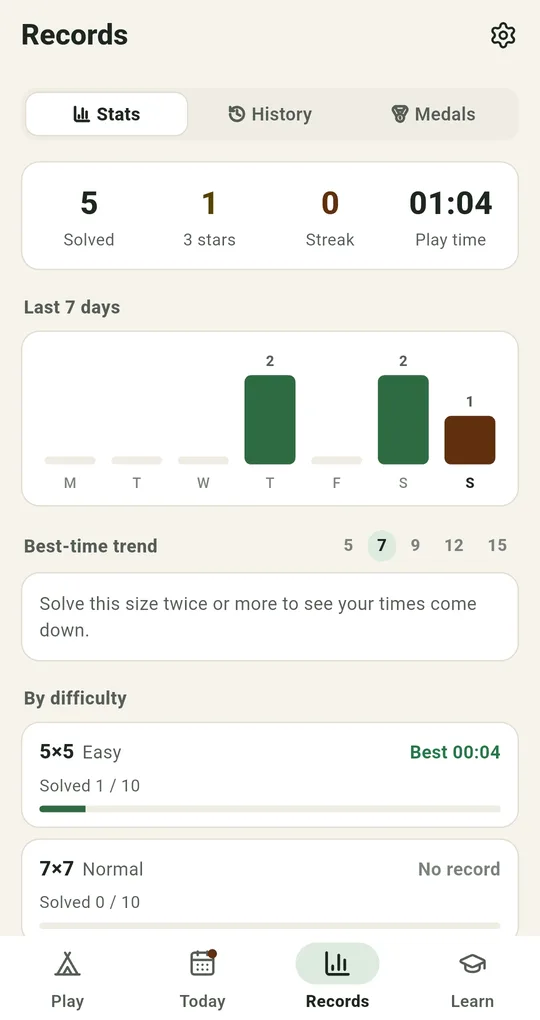
The Records tab has solves and best times by difficulty and a best-time trend chart; solve one size twice or more and you can watch the times come down. Detailed stats add the average solve time and the share of boards solved with hints. That share falling is a far better measure of progress than the number of boards.
Replay the same board
Pick a board from your history and choose Play this board again to start it from scratch. Since you already know it, all that is left is how quickly you run the tidy-up — a clean way to see whether the habit has stuck.
Use the daily puzzle as a warm-up
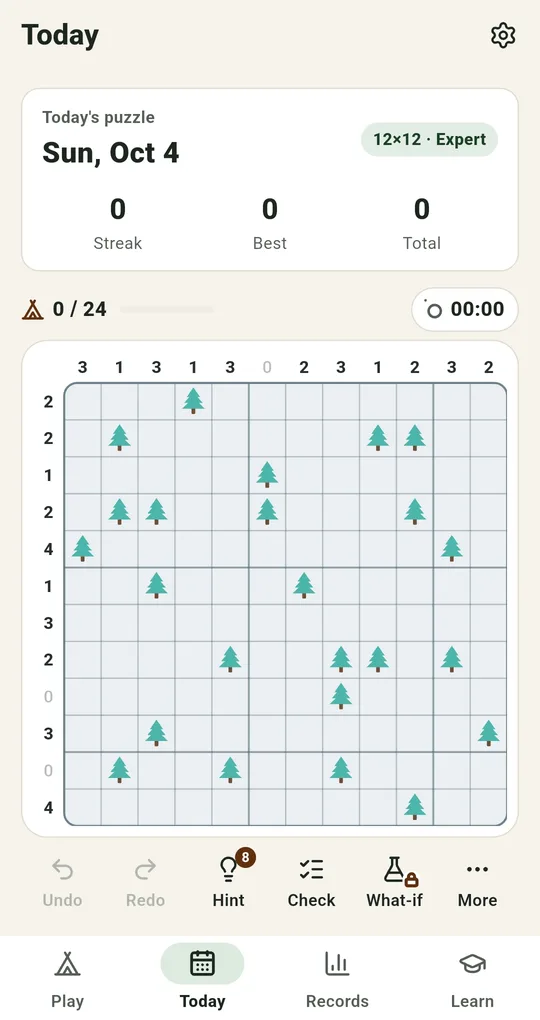
The daily puzzle in the Today tab is fixed by the date, so everyone gets the same board. Its size varies by day of the week, and the largest Master size never appears there. Treat it as loosening up rather than the main work, and run your practice sets separately.
FAQ
Is a board a day not enough?
It does help. But doing the same size the same way every day plateaus. Once a week, mix in a size above your usual or a practice set.
Accuracy or speed first?
Accuracy. Speed follows once the tidy-up habits are automatic. Chase speed first and you make more mistakes, which costs more time than it saves.
I finished the practice set and still get it wrong.
Knowing a technique and recognising the situation are different skills. Run the set again, but this time, before you touch the board, look for where that technique is likely to apply.
Tents & Trees: Logic Puzzles
No sign-up, fully offline, and every board is verified to have exactly one solution. Free on Android.