How common it is
Congenital colour vision deficiency is not rare. A 2025 meta-analysis pooling more than 1.7 million people from 56 studies across 21 countries, covering 1932 to 2022, put the overall prevalence at about 2.6% — roughly 4.4% of males and 0.6% of females. That is about one person in an average classroom.
The commonest form makes reds and greens hard to separate, which is exactly why the most common design convention — red for wrong, green for right — fails most often. It is not that the colours vanish; they blend when their brightness is similar, so a difference in lightness can be enough to rescue a design.
Where puzzle games go wrong
- Error marking — a rule-breaking cell shown only as a red outline. If the shape is identical and only the hue changes, it is invisible.
- Cell states — empty, marked and confirmed painted in tones that differ in hue but not in lightness.
- Line completion — a finished line’s number fading out is fine, since that is a lightness change. Flagging an over-filled line in red alone is not.
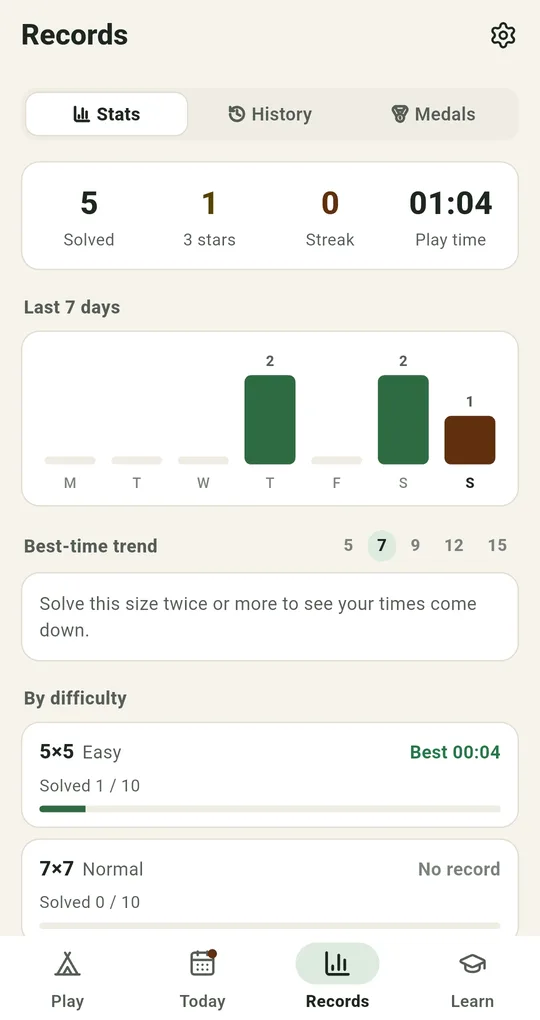
- Charts — statistics screens that separate series by colour only.
Put the other way: if any one of those four carries a second cue besides colour, the problem mostly disappears. A symbol, a thicker border, a fill pattern or a word will all do.
Checking before you install
| Do this | How |
|---|---|
| Greyscale the store screenshots | Save one and push a photo app’s black-and-white filter to maximum — if the states are still readable, it passes |
| Search the description | colour-blind, colorblind, accessibility, high contrast |
| Check that it is free | Then you can decide in a minute and back out at no cost |
| Open settings first | Right after installing, look for a colour-blind mode |
The first one is the most reliable. A screen that still tells you what state everything is in when stripped of colour is simply well designed. The same test works for anyone choosing an app on behalf of a family member.
What the device can do
When an app has not bothered, the device can partly compensate. Android has colour-adjustment features under Settings → Accessibility. Manufacturers name and place them differently, so search the accessibility screen for “colour”.
- Colour correction — pick a deficiency type and the whole display is shifted to widen the separation.
- High-contrast text and themes — these work on lightness rather than hue, which is the more dependable lever.
- Switching to dark mode — changing the background changes the contrast of the same reds and greens. Things invisible in light mode sometimes appear in dark.
The catch is that these apply system-wide, so photos and every other app shift too. An in-app colour-blind mode is better when one exists.
In the app
Turn on colour-blind mode
The Tents and Trees app has a Colour-blind mode in settings. With it on, symbols do the work colour was doing: grass is drawn as an X instead of blades, and a cell that breaks a rule gets an exclamation mark alongside the red outline. You can tell which cell is the problem without seeing the colour at all.
Try the board skins and themes
There are several board skins, and Mono uses almost no colour at all. If hue is hard work, Mono with the dark theme is often the easiest combination to read. Light, dark and automatic are all in settings.
The cues that were never colour
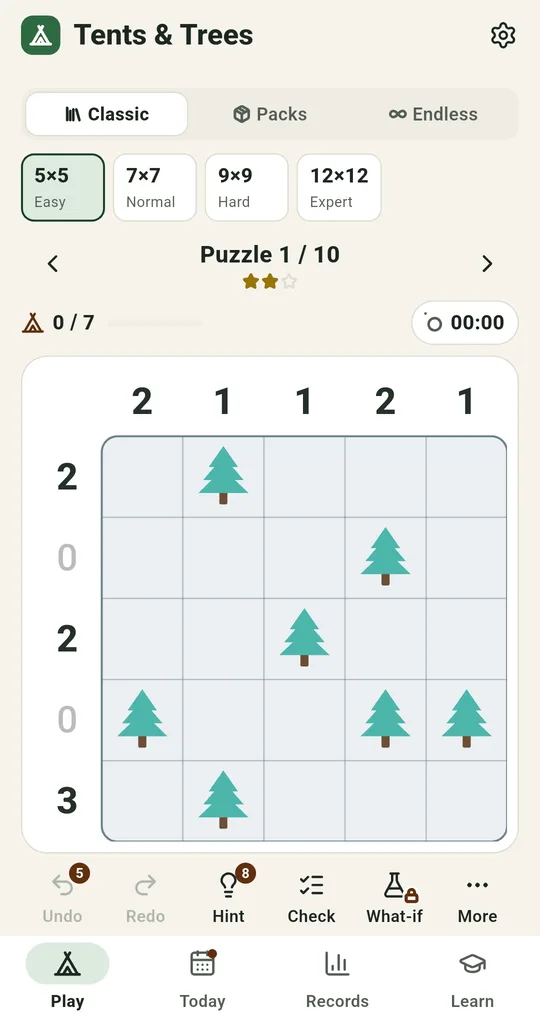
Some signals do not depend on the mode at all. A line that has all its tents has its number faded, and the progress row at the top spells out tents placed / tents total in digits. Those two alone tell you where the board stands.
FAQ
Does colour-blind mode turn everything grey?
No. The colours stay and symbols are added — an X for grass, an exclamation mark for a rule violation. For a near-colourless board, combine it with the Mono skin.
My child has a colour vision deficiency. Are puzzle games a problem?
Not if the game gives cues beyond colour. Grid logic puzzles are among the safer genres, since they are solved by position and number. Choosing one for a child is covered in grid logic puzzles with a child.
Do you need a test to know you have it?
Many people go years without realising. Only an eye-care professional can diagnose it properly, so if colours regularly trip you up it is worth getting checked. This article is not medical advice.
Tents & Trees: Logic Puzzles
No sign-up, fully offline, and every board is verified to have exactly one solution. Free on Android.