Pick the size first
In a grid logic puzzle the difficulty does not come from the rules. It comes from how much you have to hold in your head at once. That is why the rules stay the same and the board suddenly gets hard.
| Board size | What it asks | Rough time |
|---|---|---|
| 4×4 (drawn by hand) | Check one rule at a time; usually visible at a glance | 1–3 min |
| 5×5 | Cross out, then find the tree with one spot — two or three steps | 1–5 min |
| 7×7 | Line numbers alongside everything else — four or five steps | 3–10 min |
| 9×9 and up | Counting whole lines, what-if reasoning | 10 min and up |
Age is a poor guide here; two children in the same class can differ completely on whether “obey three rules at once while crossing out cells” is doable yet. If they can count and reliably tell above, below, left and right apart, a 4×4 is usually fine. A better signal than age is simply whether they finished one board on their own.
Paper before an app
Two reasons. A pencil makes “this can be undone” physical, and you get to watch exactly where their hand stops.
- Draw a 4×4 grid on squared paper.
- Draw the answer yourself first — three tents that do not touch, and one tree directly beside each of them.
- Count the tents in each row and column and write the numbers around the edge.
- Erase the tents. What is left — trees and numbers — is the puzzle.
There is no harm in letting them watch you build it. Learning that a puzzle is made backwards from its answer usually makes a child want to set one. The details are in making puzzles on graph paper.
One rule at a time
All three rules at once goes straight past them. Introduce them in this order.
| Order | Rule | The question that lands it |
|---|---|---|
| 1 | One tent per tree, right beside it | “Where could this tree’s tent go?” |
| 2 | Tents never touch, not even at a corner | “If you pitch it here, does it touch that one?” |
| 3 | The number outside is how many tents in that line | “How many do you need in this row?” |
Rule 1 alone finishes some 4×4 boards. When it does, stop there and save rule 2 for next time. There is no need to force a board that uses all three.
What to ask when they stall
Instead of the answer, give them somewhere to look. A good hint is a direction, not a solution.
- “This row says zero. So what can go in it?”
- “Is there a tree next to this cell? Check above, below, left and right.”
- “How many places can this tree put its tent?”
- “You just pitched a tent — what happens to the cells around it?”
- And when they answer: “Why there?” — ask it even when they are right.
That last one matters most. Saying the reason out loud is what brings the same thought back on the next board, and it is also how you find out whether they guessed.
When to stop
The commonest mistake is insisting on finishing the board. Stop when you see any of these.
- They start filling cells that break the rules — they are filling space, not thinking.
- They stop answering the same question.
- You are talking more than they are thinking.
Leave the board out and come back tomorrow; it often falls apart in a minute. One board a day is plenty.
Moving to the app
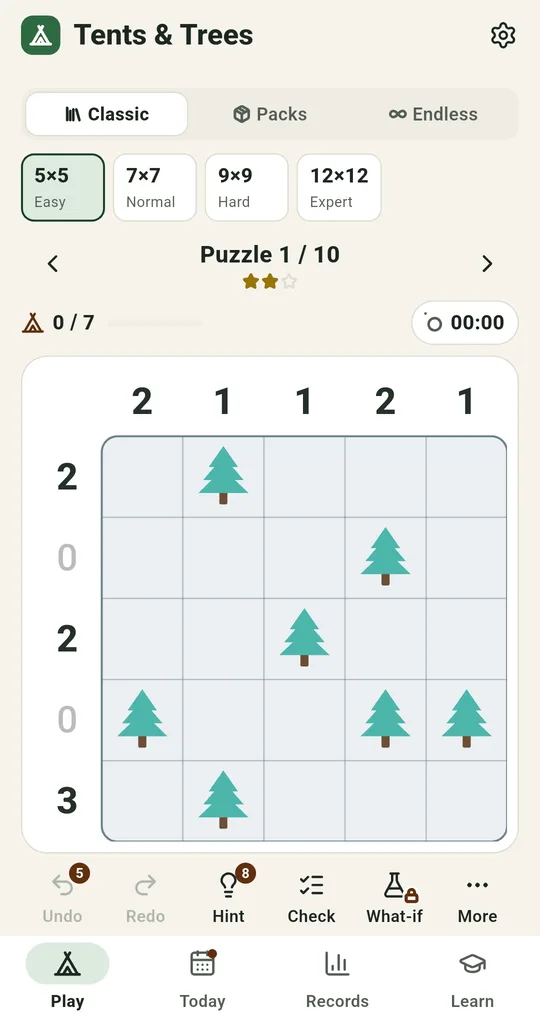
The five-step tutorial
After a few paper boards, the Learn tab of the Tents and Trees app and its Replay the tutorial make a good recap: one tent per tree, tents may not touch, the line numbers, marking grass, and a real 5×5 at the end.
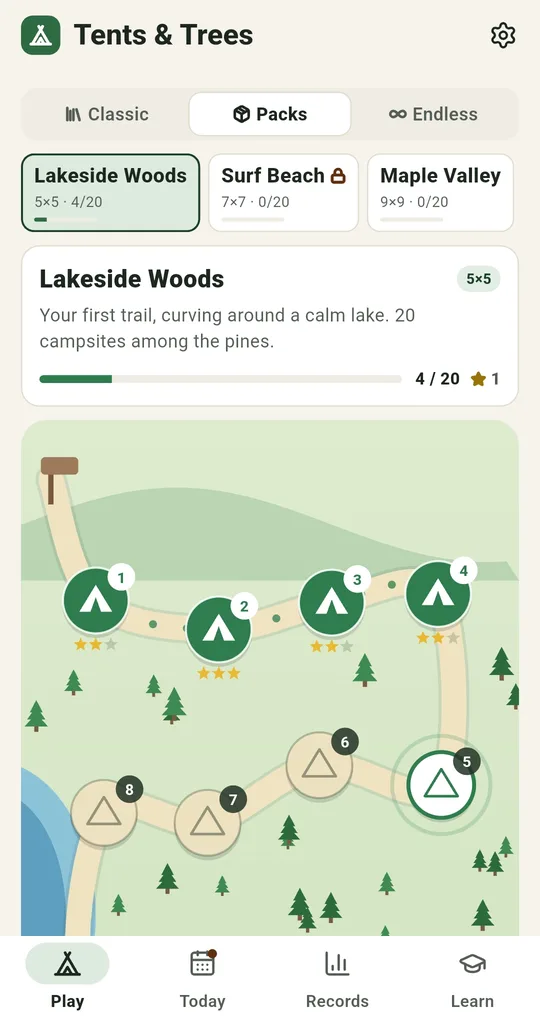
The campsite map gives them a reason
The Packs tab is a map of 20 campsites joined by a trail. Each solve colours a campsite in and leaves footprints, so a child gets a visible “just to the next one”. Finish a map and the next one has slightly bigger boards.
The hint does not hand over the answer
The usual worry about handing a child an app is the hint button. Here the hint first tells them only where to look; a second tap fills the cell and explains why that cell is settled. It plays the same role as the questions above, so they can use it unsupervised. The daily allowance is limited, which also keeps it from being spammed.
Turn the sound off
Sound effects and vibration can be switched off in settings, and the screen can be set to light or dark. Before bed, both off is the better setting.
FAQ
What age can start?
Capability beats age here. Counting to ten, telling above, below, left and right apart, and being able to judge “a tent cannot go here” — with those three, a 4×4 is a reasonable start.
My child keeps guessing and getting it right.
Ask “why there?” every time. If they cannot explain it, erase that cell and look again. It feels slow at first, but skipping this stage means they cannot solve anything once the boards grow.
Are puzzles good for brain development?
Doing lots of puzzles reliably makes you better at those puzzles. Whether it transfers to other abilities is a question research disagrees on, so it is not worth promising. Aim for “they want to keep playing” instead.
Tents & Trees: Logic Puzzles
No sign-up, fully offline, and every board is verified to have exactly one solution. Free on Android.