Work backwards
The classic beginner mistake is to draw trees on an empty grid. Do that and nothing guarantees every tree can even get a tent, so you often end up with a board that has no answer at all.
Go the other way. Draw the answer, then strip the puzzle out of it. A board built this way comes with “at least one answer exists” for free. All that is left is checking whether that answer is the only one.
Building one board
- Draw the grid. 6×6 is a good start. Smaller boards slide into having two answers; bigger ones are hard to check.
- Place the tents so that none touch, diagonals included. Six to eight on a 6×6 is about right. Spread them out rather than clustering.
- One tree per tent. For each tent, pick an empty cell directly above, below, left or right and draw a tree. Cells already holding a tent or tree are out. Trees may touch each other.
- Count the numbers and write them around the edge, as below.
- Erase the tents. Trees and numbers are the puzzle. Copy the answer onto a separate sheet before you erase.
Step 3 is where the difficulty really gets set. A tree pushed against an edge has fewer directions for its tent, which makes the board easier; a tree out in the middle has four candidates and makes it harder.
Counting the numbers
Mechanical work, but an error here produces an unsolvable board.
| Check | How |
|---|---|
| Row numbers | To the left of each row, write how many tents it holds |
| Column numbers | Above each column, write how many tents it holds |
| Cross-check 1 | The row numbers and the column numbers add to the same total |
| Cross-check 2 | That total equals the number of tents, which equals the number of trees |
Those two cross-checks catch almost every counting slip. Always write the zeros in — a blank reads as “unknown” to the solver.
Testing for a second answer
This is the hard part. Doing it properly means exhausting every case, but by hand these three catch most of them.
- Look for a swappable pair of tents. If swapping two tents keeps the rules and leaves every line number unchanged, there are two answers. The usual culprit is two trees and two tents arranged diagonally inside a 2×2 area.
- Solve your own board from the numbers. If you reach a point where “either of these would do”, that is where the answers split. Leaving it a few days, or handing it to someone else, makes the test far more honest.
- Check you have enough trees. Below roughly one tree per six cells, the open space tends to allow several answers.
When there are two answers, moving or adding a single tree usually fixes it. Why it matters is in exactly one solution.
Tuning the difficulty
| To make it easier | To make it harder |
|---|---|
| Put trees against the edges and corners | Put trees in the middle of the board |
| Include one or two lines numbered 0 | Give every line at least 1 |
| Spread the tents evenly | Cluster them so some line numbers get large |
| Use more trees | Use as few trees as you can |
For something you will pass around on paper, 6×6 to 8×8 is the sweet spot. Beyond that the solver tires of counting and the setter cannot verify it.
In the app
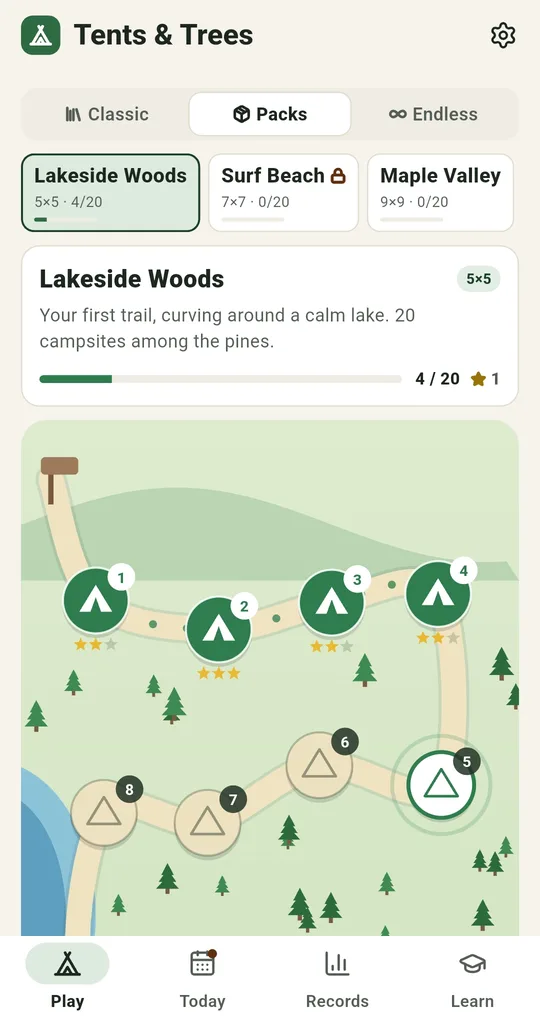
A setting screen that runs the check for you
Make a puzzle in the Learn tab of the Tents and Trees app is steps 1 to 5 above, on screen. Place trees and tents and the line numbers are calculated for you; tap Check and it tests the counts, whether tents touch, whether a tree is unpaired, and finally whether more than one answer exists — the one test that is nearly impossible by hand.
Pass a board along as a code
A board that passes can be saved to My puzzles and copied out as a short text code. Whoever receives it pastes it into Learn → Get a puzzle by code and the same board opens. No account and no internet connection involved.
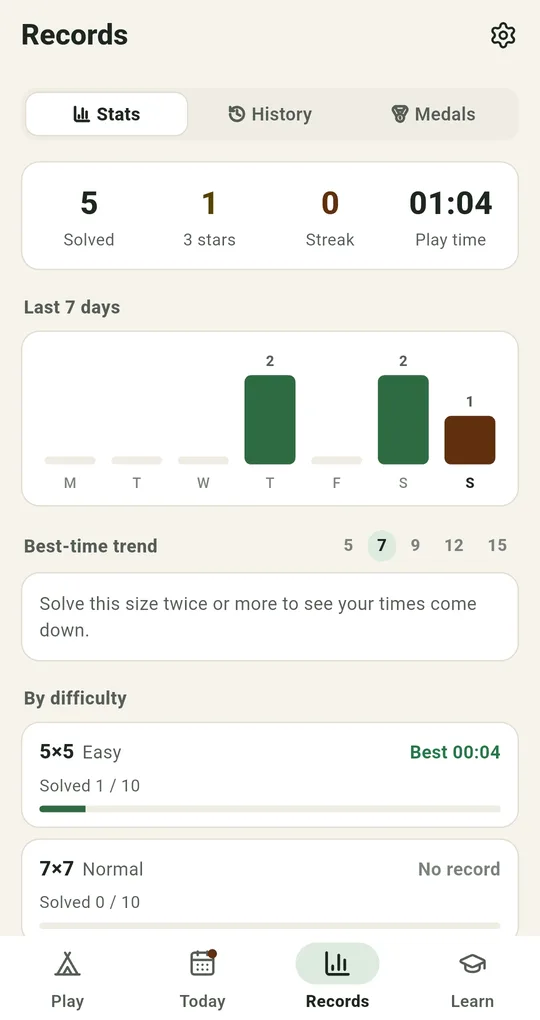
Solve your own board later
Boards saved to My puzzles stay marked as unsolved. Come back to one of your own a few days later and you will see immediately where it jams and whether you judged the difficulty right. Your time goes into the records like any other board.
FAQ
Can I draw the trees first after all?
You can, but then you have to verify separately that every tree can be paired with its own tent. Starting from the answer removes that step entirely.
Can two trees share one tent?
A tent touching two trees is legal. When setting, though, every tree needs its own tent, so keep the counts equal and confirm the whole pairing works out.
How many trees should a board have?
Between about one sixth and one quarter of the cells. On a 6×6 that is six to nine. Too few and you get several answers; too many and it is trivial.
Tents & Trees: Logic Puzzles
No sign-up, fully offline, and every board is verified to have exactly one solution. Free on Android.