Why diagrams mislead
The Sun is about 1.39 million km across and Earth about 12,700 km: a factor of 109. But the Earth–Sun distance, about 150 million km, is more than 100 Sun diameters. Draw both on the same scale and the planets vanish on a sheet of paper, so most diagrams cheat.
30 cm Sun scale table
With the Sun as a 30 cm (12 in) ball — a large beach ball — the scale is about 1 : 4.6 billion.
| Object | Real | Model size | Model distance from the Sun |
|---|---|---|---|
| Sun | 1.39 million km across | 30 cm (12 in) | - |
| Earth | 12,742 km across | 2.7 mm (a sesame seed) | 32 m (105 ft) |
| Moon | 3,474 km across | 0.75 mm | 8.3 cm (3.3 in) from Earth |
| Jupiter | 139,820 km across | 3 cm (1.2 in) | 168 m (550 ft) |
| Neptune’s orbit | ~30 AU | - | ~970 m (0.6 mi) |
| Proxima Centauri | 4.24 light-years | - | ~8,600 km (5,400 mi) |
Calculated with 1 AU = 149,597,870.7 km. Even in the model, the nearest star is an intercontinental flight away.
How to build it
- Get a ball for the Sun, a sesame seed for Earth, a grain of sand for the Moon and a marble for Jupiter.
- Place the Sun at one end of a park or sports field.
- Pace out the distance (an adult stride of about 70 cm, or 2.3 ft, means roughly 46 strides to Earth).
- Put the Moon 8 cm from Earth — the Earth–Moon gap is bigger than most people expect.
- Walk to Jupiter (168 m) and look back at how small the Sun looks.
Changing the scale
Scale = real Sun diameter ÷ model Sun diameter; model distance = real distance ÷ scale. With a 10 cm Sun every distance shrinks to one third: Earth at about 10.7 m (35 ft), Neptune’s orbit at about 320 m. For a living room you need a Sun under 1 cm, which puts Earth about 1 m away as a 0.1 mm dot.
In the game
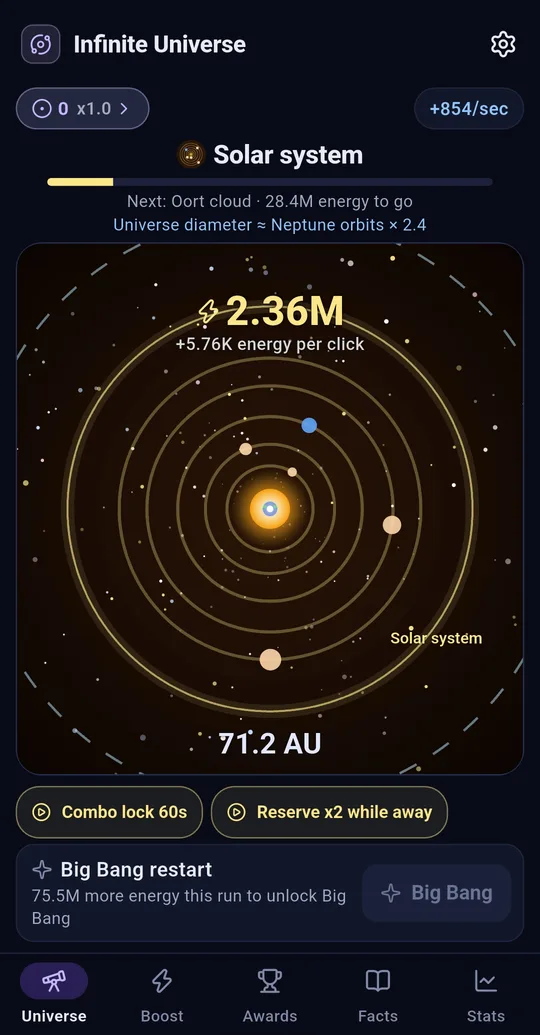
The real-size comparison line
The Universe tab in Infinite Universe keeps updating a line like “Universe diameter ≈ object × multiple”, swapping between a football, the Eiffel Tower, Everest, the Earth–Moon distance, Earth’s orbit and Neptune’s orbit, so you keep a sense of distance as you pass the Solar system stage.
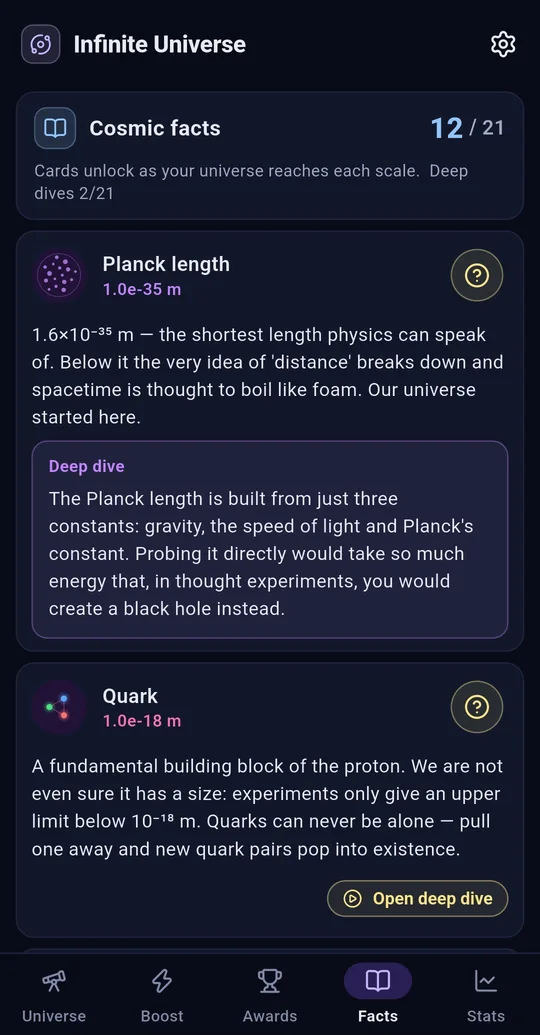
The Sun and Solar system cards
After building the model, read the Sun card (“109 Earths across”) and the Solar system card (“all planets side by side fit between the Sun and Earth”) in the Facts tab.
FAQ
Do all the planets really fit between Earth and the Moon?
The seven other planets add up to about 380,000 km across, which just fits within the average Earth–Moon distance of about 384,400 km. When the Moon is at its closest (about 360,000 km), they do not fit.
What scale works best with kids?
With a field, a 30 cm Sun. Indoors, a 1–2 cm Sun is realistic; at that scale Earth is small enough to draw as a dot.
Infinite Universe: Idle Space Clicker
No sign-up, start playing right away, and every record stays on your device. Free on Android.