Working out a light-year
Light travels 299,792.458 km per second. Multiply by one year (365.25 days = 31,557,600 s) and you get about 9.4607 trillion km (about 5.88 trillion miles). That is more than 230 million trips around Earth’s equator.
Light travel times
| Route | Distance (approx.) | At light speed |
|---|---|---|
| Earth → Moon | 384,400 km | ~1.3 s |
| Earth → Sun | 149.6 million km (1 AU) | ~8 min 19 s |
| Sun → Neptune | ~30 AU | ~4 hours |
| Sun → Proxima Centauri | 4.24 ly | about 4 years 3 months |
| Across the Milky Way | ~100,000 ly | ~100,000 years |
| Milky Way → Andromeda | ~2.5 million ly | ~2.5 million years |
Voyager 1 and one light-day
Launched in 1977, Voyager 1 is the most distant human-made object. According to NASA, on November 18, 2026 (US Central Time) it reaches one light-day from Earth — the distance light covers in a day, about 25.9 billion km (16.1 billion miles). A command from Earth takes a full day to arrive, and the reply another day. After almost 50 years of flight, that is still 1/365 of a light-year.
Source: EarthSky, Voyager 1 to reach 1 light-day from Earth (citing NASA’s June 17, 2026 announcement)
Starlight is the past
The Sun you see is the Sun of about 8 minutes ago; Andromeda is shown as it was about 2.5 million years ago. The farther you look, the further back in time you see, which is why distance and time go together in astronomy.
In the game
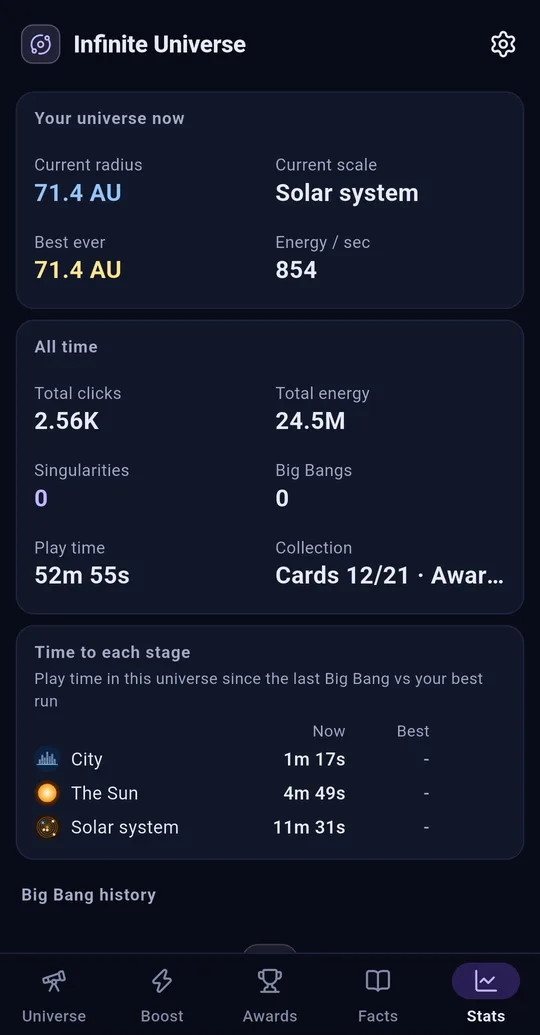
When the radius unit changes
The radius in Infinite Universe switches units as it grows: m → km → AU → ly → kly → Mly → Gly. The Solar system stages use AU, and from the Nearest star stage on it switches to light-years. Current radius and Best ever on the Stats tab use the same units.
The Nearest star card
The Nearest star card covers the distance to Alpha Centauri and the more than four years light needs to get there; its deep dive is about the planet Proxima b.
FAQ
How does a parsec compare?
One parsec is about 3.26 light-years. It is the distance unit most astronomy papers use.
When will Voyager 1 reach another star?
Voyager 1 is not headed for any particular star. At its current speed it will take tens of thousands of years just to pass near one.
Infinite Universe: Idle Space Clicker
No sign-up, start playing right away, and every record stays on your device. Free on Android.