The numbers
| Item | Value |
|---|---|
| Age of the universe | ~13.8 billion years (13.787 ± 0.020) |
| Observable universe radius | ~46.5 billion light-years (~4.4×10²⁶ m) |
| Observable universe diameter | ~93 billion light-years (~8.8×10²⁶ m) |
Source: Wikipedia, Observable universe (values based on Planck 2018 results)
Why it is farther
When the oldest light we see set off, its source was much closer to us. During the nearly 13.8 billion years that light spent travelling, space itself expanded, so that source is now about 46.5 billion light-years away. The 46.5 billion figure is the distance to where that matter is today.
Relativity’s speed limit applies to things moving through space. The stretching of distant space is not bound by it.
The rubber band picture
- Mark two dots on a rubber band: A (us) and B (a distant galaxy).
- An ant walks from B to A at a steady pace (the light).
- While the ant walks, someone keeps stretching the band (cosmic expansion).
- When the ant reaches A, B is much farther away than when the ant set off.
The current A–B distance is longer than walking time × walking speed. That is the gap between 13.8 billion years and 46.5 billion light-years.
Common wording mistakes
| Wording | Better understanding |
|---|---|
| “The universe is 46.5 billion light-years big” | That is the radius of the observable part. The whole universe may be larger, or infinite |
| “We can see the edge of the universe” | We see a horizon: the limit from which light has had time to reach us |
| “The universe is 13.8 billion light-years across” | Mixes up age and distance. 13.8 billion years is the light’s travel time |
In the game
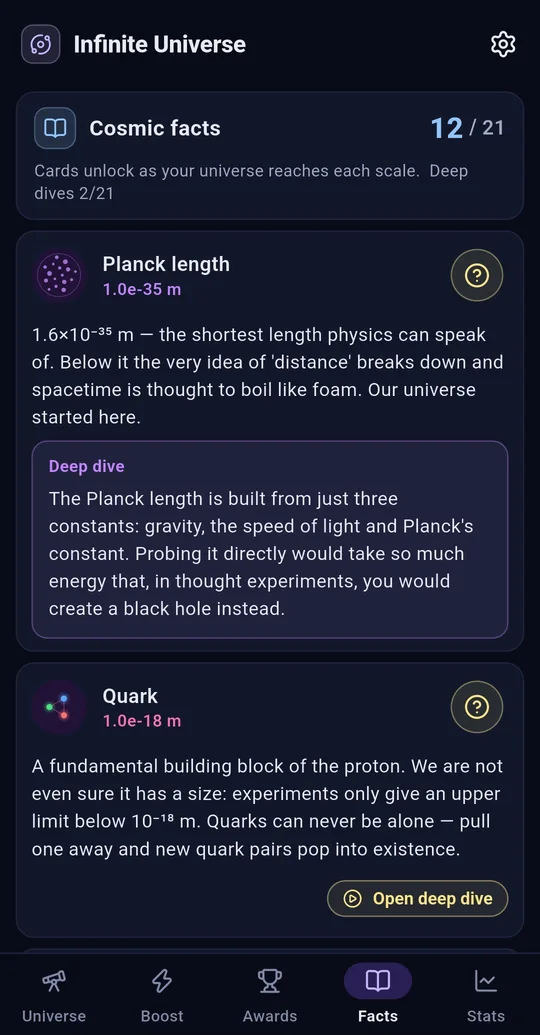
The observable universe stage, and beyond
In Infinite Universe the observable universe is one of the late stages among 21, followed by Beyond inflation and Infinity. Its card quiz, “The radius of the observable universe is 13.8 billion light-years”, is exactly this guide’s topic.
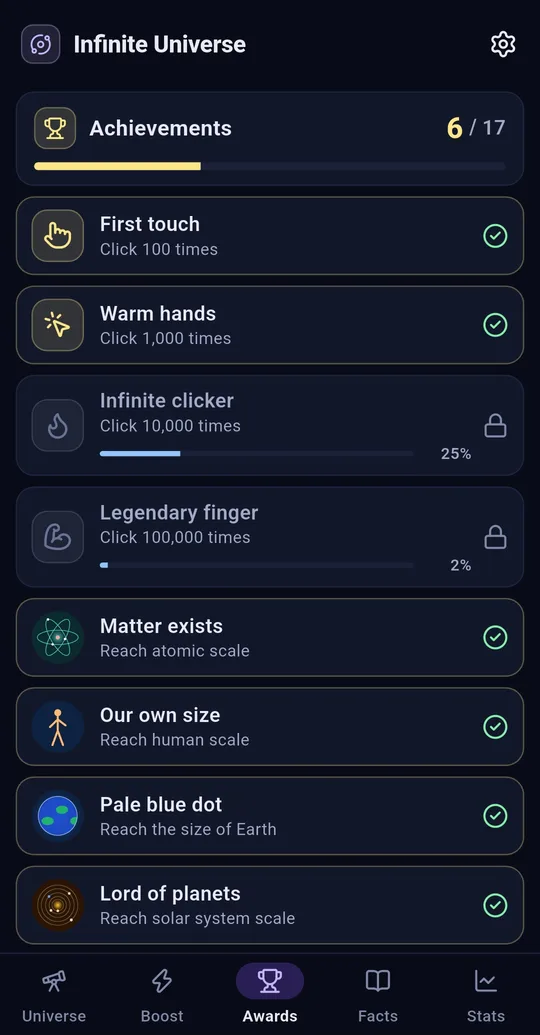
Stage achievements
In the Awards tab, one achievement unlocks when you reach the observable universe and another when you reach the final stage.
FAQ
Is there more universe beyond the observable universe?
We cannot observe it, but measurements show space is very flat, which suggests the whole universe is much larger than the observable part, or even infinite.
Where is the center of the universe?
Expansion happens everywhere at once, so there is no special center. Every observer sits at the center of their own observable sphere.
Infinite Universe: Idle Space Clicker
No sign-up, start playing right away, and every record stays on your device. Free on Android.