What a log scale is
On an ordinary ruler, equal gaps mean equal lengths: 1 cm, 2 cm, 3 cm. On a log scale, equal gaps mean equal ratios (10×): 1 m, then 10 m, then 100 m. It is the only practical way to put the whole universe on one line.
Computing the middle
The middle of a log scale is the geometric mean: multiply the two ends and take the square root.
- Smallest end: Planck length, 1.6×10⁻³⁵ m
- Largest end: observable universe diameter, 8.8×10²⁶ m
- √(1.6×10⁻³⁵ × 8.8×10²⁶) ≈ 1.2×10⁻⁴ m, about 0.12 mm
The two ends are about 62 orders of magnitude apart, and the middle is about 0.1 mm — the thickness of a fine hair or a very fine grain of sand. On a calculator, average the log10 values: (−34.8 + 26.9) ÷ 2 ≈ −3.9, so 10⁻³·⁹ m.
Size ladder
| Metres (power of ten) | Typical size |
|---|---|
| 10⁻³⁵ | Planck length |
| 10⁻¹⁵ | Proton |
| 10⁻¹⁰ | Atom |
| 10⁻⁵ | Human cell (10–30 μm) |
| 10⁻⁴ | Middle of the log scale (~0.1 mm) |
| 10⁰ | A person |
| 10⁷ | Earth’s diameter (~1.27×10⁷ m) |
| 10⁹ | The Sun’s diameter (~1.39×10⁹ m) |
| 10¹⁶ | One light-year (~9.46×10¹⁵ m) |
| 10²¹ | Milky Way diameter (~100,000 ly) |
| 10²⁷ | Observable universe diameter |
Where humans sit
A person (around 10⁰ m) is about four orders of magnitude above the midpoint. Four steps out of 62 is close enough to say “roughly in the middle”, but the precise middle is something you can barely see with the naked eye. Switch from diameters to radii, or start from the proton instead of the Planck length, and the middle shifts. Whenever you read this claim, check what the two ends were.
In the game
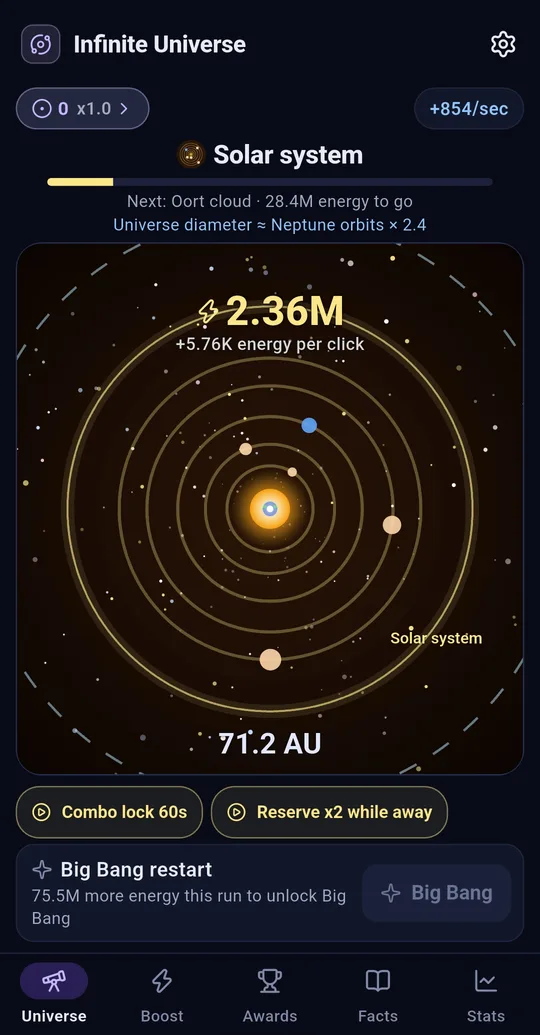
Stages on a log scale
The 21 stages of Infinite Universe sit on a log scale. The bar at the top shows progress to the next stage, and stages you pass shrink toward the center in true size ratio. Compare how long atom-to-human takes with human-to-Earth in Time to each stage on the Stats tab, and you feel the log scale.

The human card
The Human stage card says we sit “almost exactly halfway” on a log scale. Reading it next to this calculation shows the difference between a rounded statement and an exact one.
FAQ
Why the geometric mean and not the ordinary average?
The ordinary average, (8.8×10²⁶ + almost 0) ÷ 2 ≈ 4.4×10²⁶ m, sticks to the large end. On a ratio-based log scale, the geometric mean is the middle.
Can I use this in class?
The values are approximations, so pair them with a textbook or agency source. The size ladder works well as an exercise where students compute the geometric mean themselves.
Infinite Universe: Idle Space Clicker
No sign-up, start playing right away, and every record stays on your device. Free on Android.