The short answer
| Thing | Estimate | From |
|---|---|---|
| Grains of sand on Earth’s beaches | ~7.5×10¹⁸ | Researchers at the University of Hawaii |
| Stars in the observable universe | ~7×10²² (some estimates up to 10²⁴) | A 2003 Australian National University estimate, among others |
That is a gap of at least four orders of magnitude: thousands of stars for every grain of sand.
Sources: NPR, Which Is Greater, The Number Of Sand Grains On Earth Or Stars In The Sky? (2012) · Wikipedia, Observable universe
Estimating sand
- One grain: about 0.5 mm across → several thousand to ten thousand grains per cm³
- Beach sand volume: world coastline length × beach width × sand depth
- Multiply: volume × grains per cm³
Each assumption can swing the result tenfold, which is why sand estimates range from 10¹⁸ to 10¹⁹. Add deserts and it grows further.
Estimating stars
- Stars in the Milky Way: about 100–400 billion (10¹¹)
- Galaxies in the observable universe: hundreds of billions or more
- Multiply: 10¹¹ × 10¹¹–10¹² ≈ 10²²–10²³
Reading the error
- A Fermi estimate aims for the right number of digits. Being off by 2× or 3× is within the noise.
- Look at how many digits apart the two answers are. One or two digits can flip with different assumptions; four or more rarely do.
- Drop the words “observable universe” and the sentence becomes wrong. Nobody knows how many stars the whole universe holds.
In the game
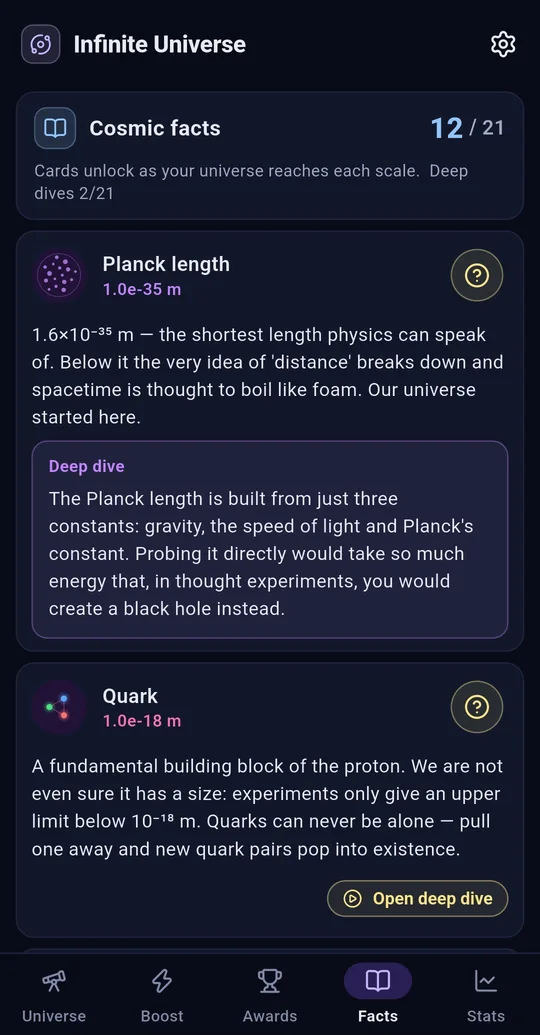
The Grain of sand card
The Grain of sand stage card and its deep dive in Infinite Universe cover this comparison. The two use slightly different rounded figures (around 10¹⁸ and around 10¹⁹), which makes a good real-life exercise in reading estimate error. There is also a quiz on what sand is mostly made of.

Big-number notation
Energy in the game goes K (thousand), M (million), B (billion), T (trillion), then aa, ab, ac and so on. Reading numbers in groups of three digits connects nicely with the 10¹⁸ and 10²² scales in this guide.
FAQ
How many stars can you see with the naked eye?
Under a dark sky, a few thousand at a time. Far fewer from a city.
What about water molecules?
A single teaspoon (about 5 mL) of water holds about 1.7×10²³ molecules — similar to or more than the star estimates. In big-number contests the winner depends on what you count.
Infinite Universe: Idle Space Clicker
No sign-up, start playing right away, and every record stays on your device. Free on Android.