Seven answers at a glance
| Statement | Answer | Why |
|---|---|---|
| You can see the Great Wall from space with the naked eye | False | It is narrow and similar in color to its surroundings; astronauts say it is very hard to spot even from low orbit |
| Andromeda will definitely merge with the Milky Way | Uncertain | 2025 study: about a 50% chance within 10 billion years |
| Bacteria outnumber human cells 10 to 1 | False | 2016 recalculation: about 1.3 to 1 |
| The observable universe has a radius of 13.8 billion ly | False | About 46.5 billion ly; space expanded while light travelled |
| The solar system is at the center of the Milky Way | False | About 26,000 ly from the center, in a spiral arm |
| The Sun holds over 99% of the solar system’s mass | True | About 99.8%; most of the rest is Jupiter |
| The Oort cloud has been photographed | False | Never observed directly; inferred from long-period comet orbits |
The Great Wall
NASA explains that even from International Space Station altitude (about 400 km) the Great Wall is very hard to pick out with the naked eye, and that it is not visible from the Moon. China’s first astronaut, Yang Liwei, said in 2003 that he could not see it. Telephoto photos can capture it.
Source: NASA, China’s Wall Less Great in View from Space
The Andromeda collision
For years the standard answer was that the Milky Way and Andromeda would collide in about 4–5 billion years. A study published in Nature Astronomy in June 2025 (Sawala et al.) ran 100,000 simulations using Hubble and Gaia data and put the chance of the two galaxies merging within the next 10 billion years at about 50%. The chance of a collision within 4–5 billion years came out at around 2%. The pull of the Large Magellanic Cloud was a key factor. Andromeda is still approaching us.
Sources: ESA/Hubble heic2508; Nature Astronomy (2025), “No certainty of a Milky Way–Andromeda collision”
The 10-to-1 bacteria claim
The idea that bacteria outnumber our own cells 10 to 1 came from a rough 1970s estimate. A 2016 recalculation by Sender, Fuchs and Milo at the Weizmann Institute revised it to about 1.3 to 1 — roughly even.
Source: PLOS Biology (2016), Revised Estimates for the Number of Human and Bacteria Cells in the Body
Quiz yourself in the game
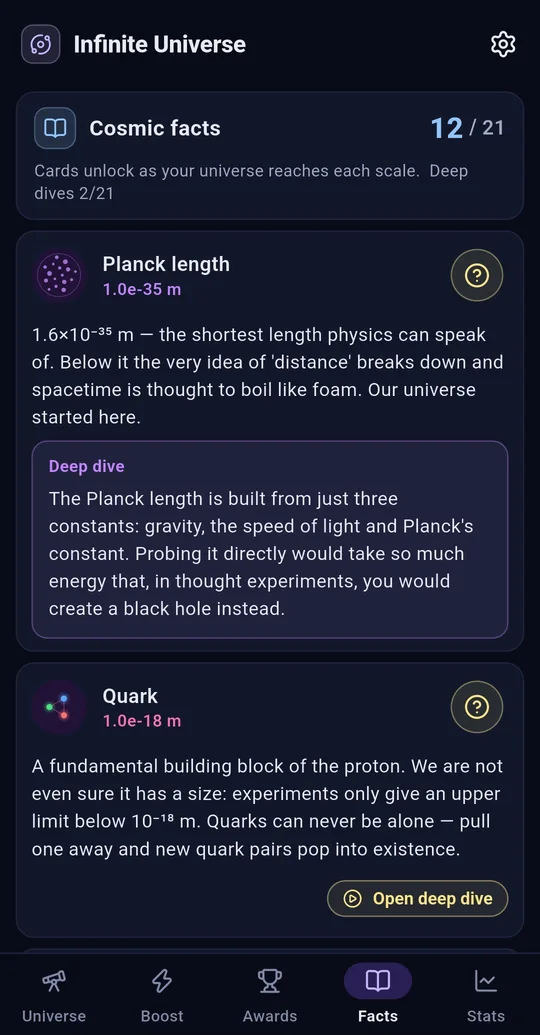
A true-or-false quiz for every stage
The Facts tab in Infinite Universe has one true-or-false quiz per stage, 21 in all. Most of the statements above appear, and a correct answer earns energy. Wrong answers show an explanation, and you can retry after an ad. The in-game Andromeda card still uses the older view (a collision in about 4 billion years), so read it alongside the newer study above.
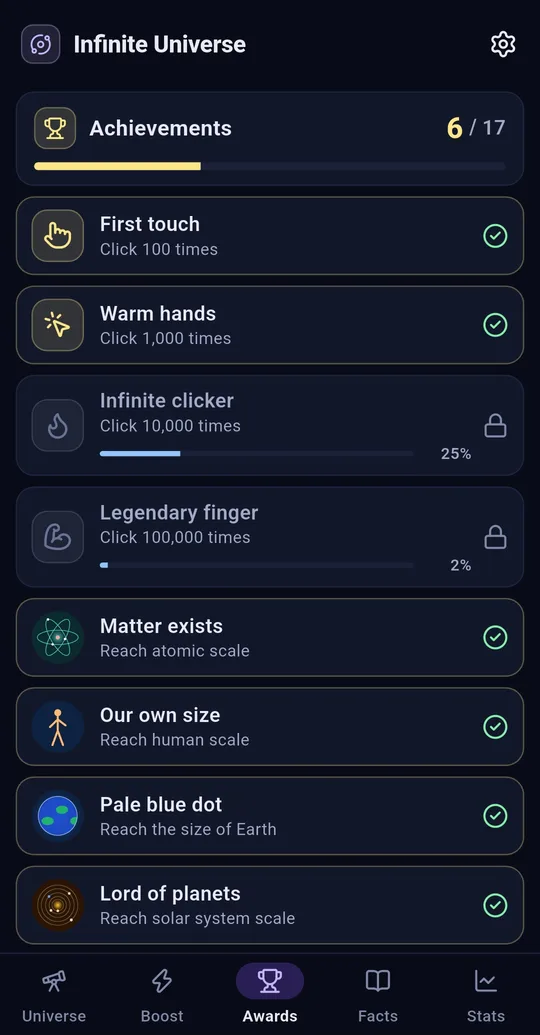
Collecting cards
Collection on the Stats tab counts your cards and achievements together. Cards unlock when you reach their stage, so locked ones open as your universe grows.
FAQ
Is any human-made structure visible from space?
From low orbit, astronauts report seeing city lights at night, large airports and big greenhouse complexes — things that are wide or high-contrast. The Great Wall is long but narrow.
Would an Andromeda merger endanger Earth?
Stars inside galaxies are so far apart that direct star collisions are thought to be extremely unlikely. Long before then, the brightening Sun is expected to change Earth’s environment.
Infinite Universe: Idle Space Clicker
No sign-up, start playing right away, and every record stays on your device. Free on Android.