The main limits
| Source | Limit | Exchange rate |
|---|---|---|
| US OSHA (legal limit) | 90 dBA averaged over 8 hours; hearing conservation program required from 85 dBA | 5 dB |
| US NIOSH (recommendation) | 85 dBA over 8 hours | 3 dB |
| EU Directive 2003/10/EC | Lower action value 80 dB(A), upper 85 dB(A), limit 87 dB(A), daily exposure | 3 dB basis |
South Korea uses 85 dB over 8 hours to define noise work and 90 dB for 8 hours (95 dB for 4, up to 115 dB for 15 minutes) for intense noise work. Your employer’s duties depend on where you work, so check your national safety agency.
Time halves as level rises
| Level | OSHA (5 dB rule) | NIOSH (3 dB rule) |
|---|---|---|
| 85 dBA | 16 hours | 8 hours |
| 90 dBA | 8 hours | 2.5 hours |
| 95 dBA | 4 hours | About 47 minutes |
| 100 dBA | 2 hours | 15 minutes |
The two approaches diverge fast: at 100 dBA the NIOSH recommendation allows an eighth of OSHA’s time.
Everyday workplaces
- A common rule of thumb: if you have to raise your voice to talk to someone at arm’s length, the level may be around 85 dB or more.
- Ringing or muffled ears after a shift are a sign of a big dose.
- Note the loudest periods (rush hour, machines running) and how long they last; that is what drives exposure.
A rough check with the app
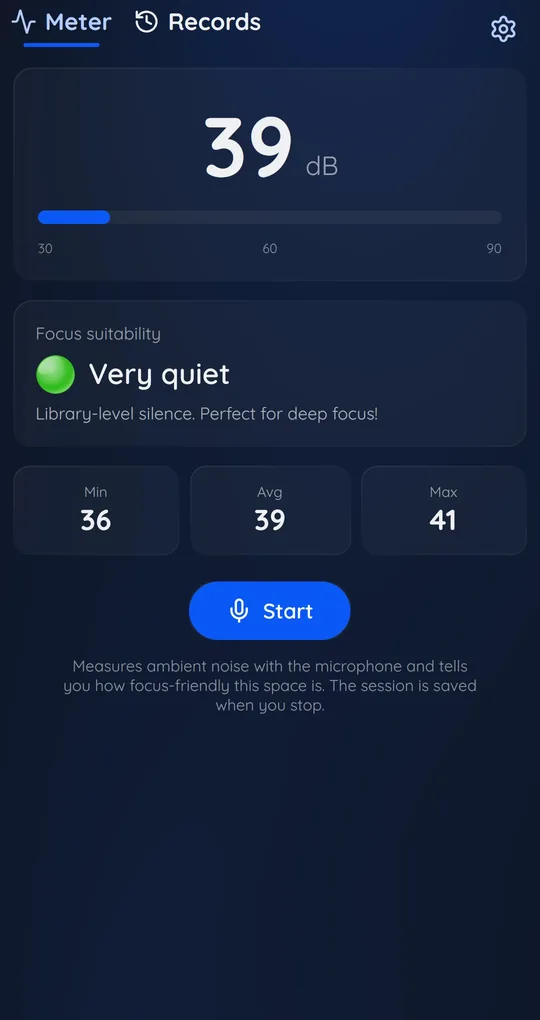
Measure at your work position
Place Focus Noise Meter near where you work. 75 dB and above shows as Very noisy. The display goes up to 130 dB, but phone mics are less accurate at high levels.
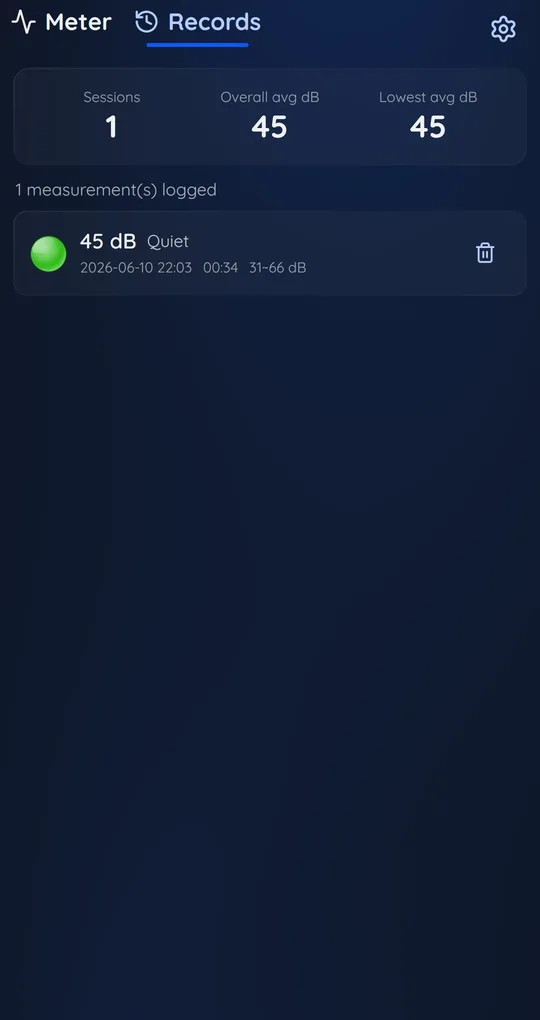
Split sessions by time of day
Measuring busy and quiet periods separately lets you compare averages and peaks in Records. If readings often sit near 85 dB, that is a reason to ask your employer for a proper noise assessment.
FAQ
My phone shows 85 dB. Am I over the limit?
You cannot tell from a phone. Exposure is assessed with a sound level meter or noise dosimeter over the shift. Use the phone reading as a reason to ask.
Do the same limits apply to headphones?
Personal listening has separate WHO guidance. See safe earphone volume.
Focus Noise Meter - dB Sound Level
It never records audio, only calculates dB levels, and your history stays on your phone. Free on Android.