Everyone does "what if"
Psychologists call imagining what did not happen counterfactual thinking. It is a very common way of learning from mistakes and preparing for next time. So instead of trying to stop "what if" altogether, it is more realistic to change how you use it.
Two kinds of regret
Research by Thomas Gilovich and Victoria Medvec at Cornell (1994–1995) separated regrets of action from regrets of inaction. They reported that in the short term people tend to regret what they did, but looking back over a lifetime they regret what they didn’t do for longer.
| Regret of action | Regret of inaction | |
|---|---|---|
| Example | Taking that job, saying that thing | Not asking them out, never starting that course |
| How it feels | Hot and short | Lingering, the "what if" grows |
| Where to take it | What did I learn from it? | What small version can I still do now? |
Later replications (for example Yeung and Feldman, 2022) found the pattern weaker than the original, and in some conditions it did not replicate. Treat it as "a common tendency", not a rule.
Upward and downward
"What if" has a direction. "It could have been better" (upward) stings but tells you what to change; "At least it wasn’t worse" (downward) comforts. A well-known study of 1992 Olympic broadcast footage (Medvec, Madey and Gilovich, 1995) found bronze medalists looked happier than silver medalists. The usual reading: silver compared themselves to gold, bronze to no medal at all.
The three-column sort
- What I knew then — only what you knew at the time, not what you know now
- What I wanted from the other path — not the job or place, but what was inside it (freedom, recognition, people)
- A small way to get some of it now — sized to fit this month
Column 1 lets you treat your past self fairly; columns 2 and 3 turn regret into material for the next choice.
Trying it lightly in the app
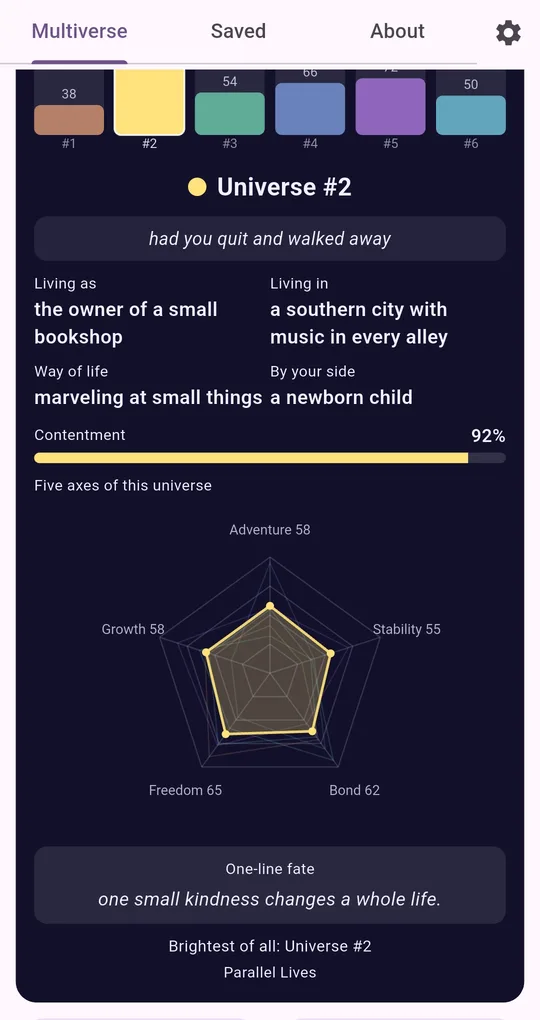
Open six "other yous"
Enter a name (or nickname) and birth date in Parallel Lives and six universes appear, each with a fork such as "had you quit and walked away". Each one shows what you live as, where you live, your way of life, who is by your side and a contentment score.
The sample name in the screenshots is a placeholder; you can enter any name or nickname.
Fill column 2
Pick the universe that pulls at you and write one word for what looks good about it. If it is a way of life such as "marveling at small things" rather than the job, that is something you can try in this life too.
FAQ
Is regretting a lot a personality flaw?
"What if" is something everyone does. If you replay the same scene and the distress keeps going, talk it through with someone you trust or a professional rather than carrying it alone.
The app gave me a low-contentment universe and it bothered me.
The score is just a number generated from your name and birthday; it means nothing. Enjoy the "loneliest" universe as one more branch of the story.
Parallel Lives: The Other You
No sign-up, fully offline. A free Android app made for fun and reflection.