It began with a 1957 paper
Hugh Everett III, then a Princeton graduate student, published a "relative state" formulation of quantum mechanics in Reviews of Modern Physics in 1957. The name "many-worlds interpretation" was popularized by physicist Bryce DeWitt in lectures, articles and a book from the late 1960s to the early 1970s.
The one key idea
In quantum mechanics, tiny particles are calculated as if several states overlap until they are measured. The common textbook story says measurement "picks one". Everett dropped that special moment. Instead, every possible outcome carries on, and the observer splits into branches paired with each outcome. Call those branches "worlds" and you have many-worlds.
Science vs fiction
| Many-worlds in physics | Parallel worlds in films |
|---|---|
| Branches form at the level of quantum outcomes | The world splits at each big life decision |
| No way to travel between or contact other branches | You meet and talk to the other you |
| One interpretation among several, not yet experimentally distinguished | Taken as fact by the story |
Physicists are divided: some accept many-worlds, others prefer different interpretations. Saying "parallel universes have been proven" is not accurate.
"Multiverse" means several things
Cosmological multiverse ideas (regions beyond what we can observe, bubble universes from inflation theory and so on) start from different places than many-worlds. When a headline says "parallel universe", first work out which idea it means.
The universes in the app
A story, not physics
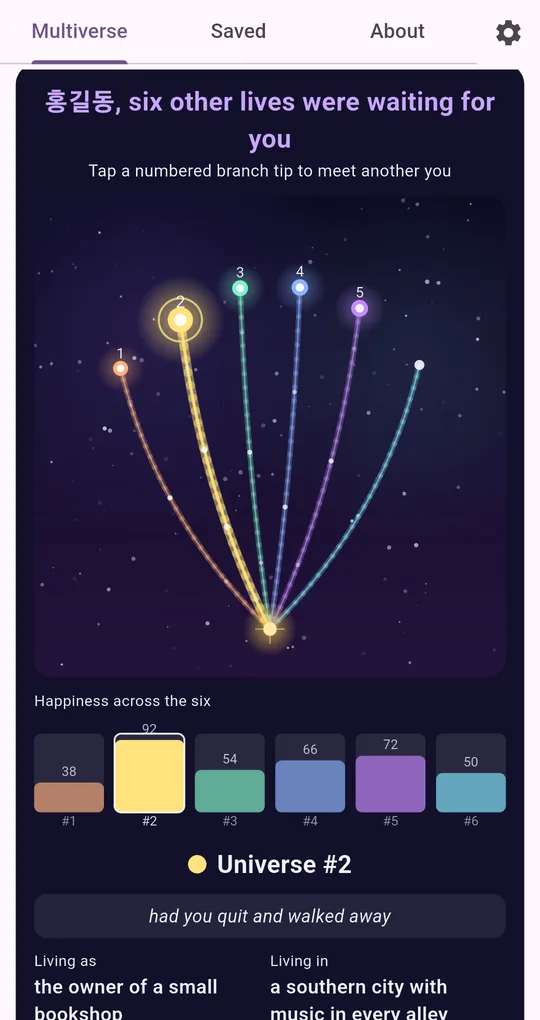
The six universes in Parallel Lives are not a physics calculation. They are a creative device that picks prepared forks, jobs and places from your name and birthday, showing the movie-style "what if life split at every fork" as a single tree.
Tap a branch number
Tap the number at a branch tip to open that universe. "Zoom into this universe" shows one branch large, and there are three card themes: Night, Neon and Film.
FAQ
Can I contact the me in another world?
Not even in many-worlds: there is no way to travel or send information between branches. That part belongs to novels and films.
Do quantum computers prove many-worlds?
Quantum computers work according to the same quantum mechanics whichever interpretation you prefer, so they are not evidence for one in particular.
Parallel Lives: The Other You
No sign-up, fully offline. A free Android app made for fun and reflection.