Reading the rate table
| Taxable base | Rate | Progressive deduction |
|---|---|---|
| Up to 14M KRW | 6% | - |
| 14M – 50M KRW | 15% | 1.26M KRW |
| 50M – 88M KRW | 24% | 5.76M KRW |
| 88M – 150M KRW | 35% | 15.44M KRW |
| 150M – 300M KRW | 38% | 19.94M KRW |
(Above 300M: 40%, 42%, 45%. These are the 2025 tax-year rates built into the app.) Brackets apply to the taxable base, after the earned-income deduction, personal deduction, pension contributions and card deduction. A 50M KRW salary has a taxable base in the 30M range, so it sits in the 15% bracket.
Final tax by gross salary
Single, no card, housing or medical items, from the app (local tax excluded).
| Gross salary | Taxable base | Final income tax |
|---|---|---|
| 40M KRW | about 25.45M | about 1.74M KRW |
| 50M KRW | 34.0M | 3.05M KRW |
| 60M KRW | about 43.05M | about 4.41M KRW |
| 70M KRW | 52.1M | about 5.95M KRW |
| 80M KRW | about 61.42M | about 8.35M KRW |
A 10M KRW raise from 50M to 60M adds about 1.36M KRW of income tax, around 13–14% of the raise (local tax and social insurance on top).
Where the jump feels bigger
From 70M to 80M the tax rises by about 2.4M KRW. The taxable base enters the 24% bracket and the earned-income tax credit cap falls quickly above 70M gross, from 660,000 to 500,000 KRW. Above 70M the card deduction cap also drops from 3M to 2.5M KRW, and the housing-savings deduction disappears. Still, the extra tax is far smaller than the raise.
A raise in the middle of the year can cause a February bill because early months were withheld at the old level. That is a catch-up, not a loss.
Compared with the 19% flat rate
Eligible foreign employees can choose a flat 19% instead (see first settlement in Korea). Using the app’s simplified numbers for a single worker, normal final tax is about 6% of gross at 50M KRW, about 13% at 100M and about 20% at 150M. So the flat rate tends to win only at high salaries, and deductions you would give up move that point. Get the exact comparison from HR.
Comparing before and after
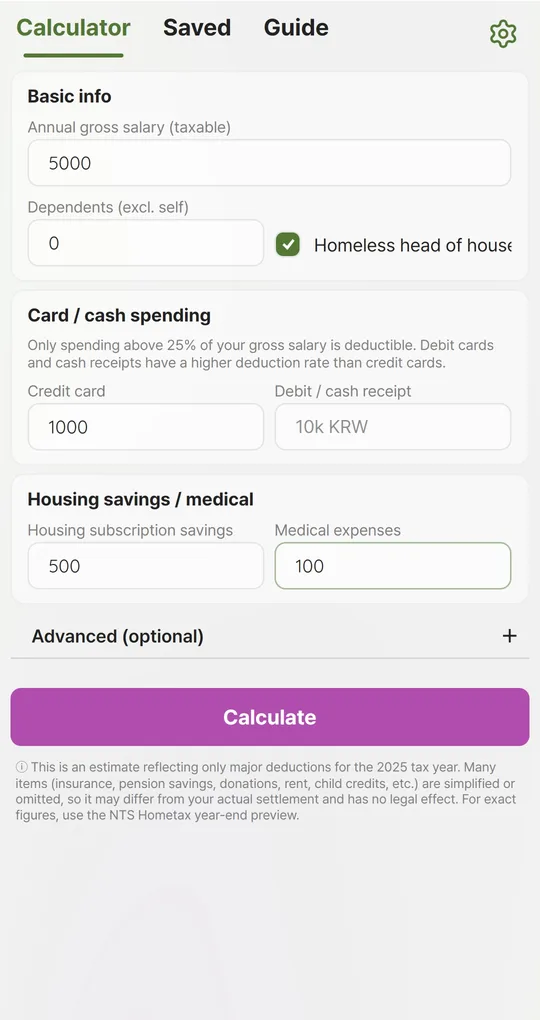
Calculate and save the current salary
Calculate with your current gross salary and save it as “before raise”.
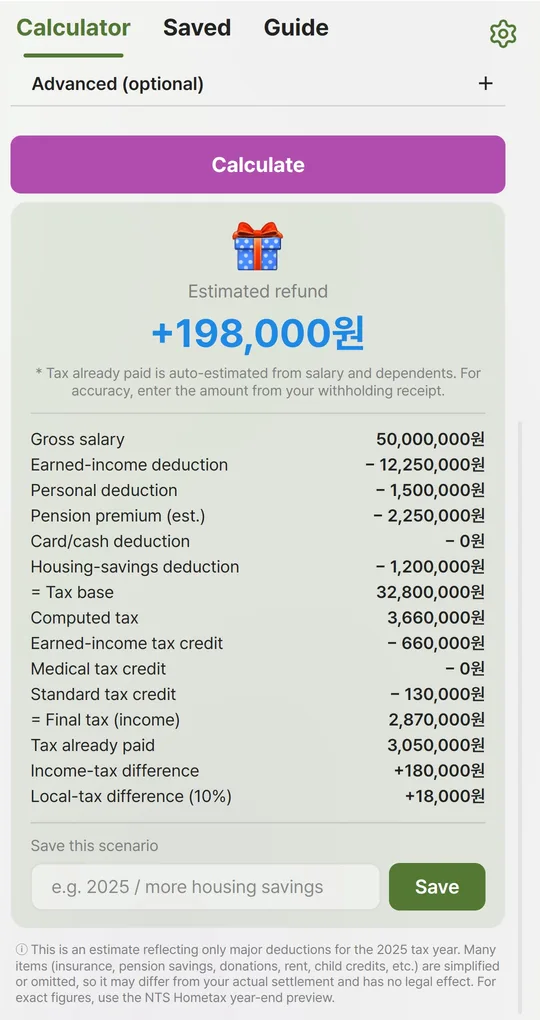
Recalculate with this year’s real total
Enter this year’s actual total (months before plus months after the raise) and compare the Tax base, Computed tax and Earned-income tax credit lines.
The app’s English screens show amounts with the Korean won sign, and the saved-scenario card keeps a few Korean labels in the current version.
FAQ
Is it ever better to refuse a bonus?
Not for tax. The tax on a bonus is always less than the bonus. Crossing lines such as 70M KRW can remove some deductions, though.
Why don’t take-home pay tables match?
Take-home pay also loses social insurance, and monthly withholding follows the simplified table, not the final settlement.
Sources: Restriction of Special Taxation Act, Art. 18-2 (Korean) · NTS Hometax
Year-End Tax Calculator
No sign-up, works offline, and your salary data stays on your phone. Free on Android, in English and Korean.