Why mid-year starters get money back
Monthly withholding assumes you earn that salary all year. If you start in July, your actual annual gross is half a year’s pay, but the earned-income deduction, personal deduction and earned-income tax credit still apply at their full annual amounts.
| Gross salary for the year | Final income tax (app) |
|---|---|
| 12M KRW | 0 |
| 18M KRW | about 79,000 KRW |
| 24M KRW | about 209,000 KRW |
(No dependents, 3M KRW card spending, no other deductions.) The app’s automatic estimate of tax already paid assumes a full year, so in your first year enter the income tax total from your payslips instead.
Resident or non-resident
Korean tax law treats you as a resident if you have a domicile in Korea or have stayed for 183 days or more; your employer and the NTS make the call from your facts. As reported from NTS guidance, foreign residents can claim most deductions that Korean nationals can (the housing-savings deduction is an exception), while non-residents cannot claim dependents, special income deductions or the child tax credit.
The 19% flat-rate option
- Foreign employees can choose to pay a flat 19% on their earned income instead of the normal progressive calculation.
- Under the law in force for 2026, it applies to foreign workers who first start work in Korea on or before 31 December 2026, for up to 20 years from that start.
- If you choose it, the usual deductions, exemptions and tax credits do not apply.
- You apply through your employer, which can also withhold at 19% each month.
For most salaries the normal calculation is cheaper. In the app’s simplified model (single, no extra deductions), the normal tax only reaches 19% of gross pay at around 150 million KRW. Compare both with HR before choosing. The app does not calculate the flat-rate option, but you can compare its “Final tax” line against 19% of your gross pay.
January–February timeline
- Mid-January: the Hometax simplified service opens (15 January in 2026, with final data from 20 January).
- By your employer’s deadline: submit the simplified-service PDF and the deduction form.
- Usually February pay: refund or amount due.
The NTS provides English-language manuals and a dedicated phone line for foreign workers during the settlement season; see its English site.
Using the app in your first year
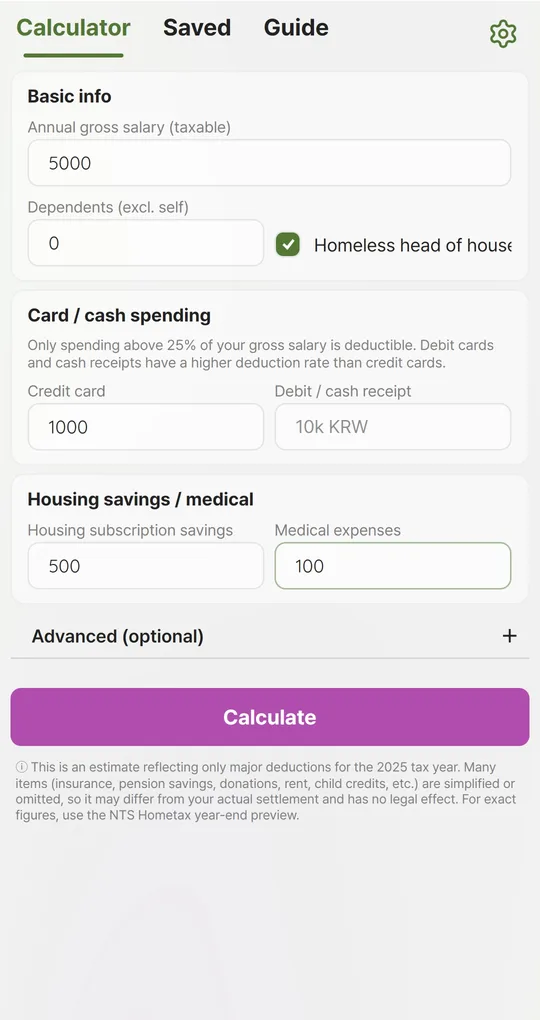
Enter only what you earned in Korea this year
For “Annual gross salary (taxable)”, enter what you actually received (or will receive) from your start date, minus non-taxable allowances. Not your annual contract salary.
Enter tax already paid
Under “Advanced (optional)”, fill in “Enter tax already paid” with the income tax total from your payslips (include December). The note under the result changes to “Calculated using the tax-paid amount you entered.”
The app’s English screens show amounts with the Korean won sign, and the saved-scenario card keeps a few Korean labels in the current version.
FAQ
Is local income tax included in the 19%?
Local income tax is charged separately at 10% of the income tax. Confirm the exact figures with HR.
What if I skip the settlement?
Your employer still settles with basic deductions only. Missed items can be added later; see fixing missed deductions.
Sources: Restriction of Special Taxation Act, Art. 18-2 (Korean) · Korea Tax Times, year-end settlement for foreign workers (Korean) · Korea.kr, simplified service opens Jan 15 (Korean) · National Tax Service (English)
Year-End Tax Calculator
No sign-up, works offline, and your salary data stays on your phone. Free on Android, in English and Korean.