What the chart does not measure
Acuity asks how small a detail you can resolve. Contrast sensitivity asks how faint a detail you can still see. They are different abilities.
- Chart letters are black on white, essentially 100% contrast.
- A pedestrian in the rain, a worn lane marking, a sign in fog — a few percent.
- So “fine on the chart, bad at night” is a perfectly coherent state.
Clinically contrast sensitivity is written as a log value (log CS): higher means you detect fainter edges. Steps are usually spaced 0.15 log units apart, so each step is the same proportional jump.
Glare is a separate problem
Glare is light scattering inside the eye around a bright source, stripping contrast from everything near it. The headlight is not the thing you cannot see. It is the reason you cannot see what is beside it.
The National Eye Institute lists trouble seeing at night, lights and headlights seeming too bright, haloes around lights, and faded colours among the common symptoms of cataract, and notes that lens proteins begin to break down around age 40 with risk rising thereafter.
Sources: National Eye Institute, Cataracts
Why contrast sensitivity drops
| Cause | What tends to go with it |
|---|---|
| Dry eye | Clear only right after a blink |
| Corneal or lens surface | Scratched coatings, a greasy film |
| A wide pupil at night | Peripheral aberrations smear the image |
| Early lens changes | Haloes, colours looking yellowed |
| Fatigue and poor sleep | A temporary drop |
| Retinal or optic nerve disease | Contrast can fall while acuity holds |
Telling these apart is a clinical job. A self-check can only turn “nights are hard” into a number you can watch.
Checking it at home
- Work in a dark room. In bright surroundings a screen cannot reproduce glare at all.
- Keep reflections off the screen.
- Wear the glasses you actually drive in.
- Run the plain contrast test and the glare condition back to back and compare.
- Repeat under the same conditions weeks apart. The change matters more than the figure.
A pre-drive checklist
- Clean the inside of the windscreen. The film there scatters more than the outside does.
- Check your lenses for scratches and worn coatings. Yellow “night driving” tints cut the light reaching your eye and can make things worse.
- Dim the dashboard and cabin lights so your eyes stay dark-adapted.
- Do not look straight at oncoming headlights; steer by the near edge of your own lane.
- Slow down when the night is hard, and get checked if it keeps getting harder.
Measuring it in the app
Contrast sensitivity first
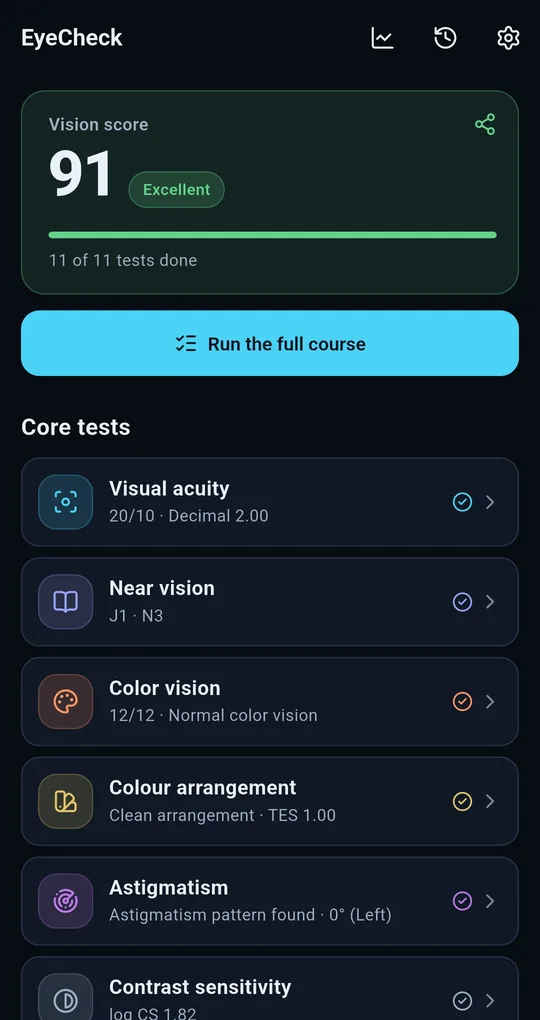
“Contrast sensitivity” sits in the Core tests on the home screen. The ring fades step by step and you answer while you can still see it. The result comes back as a threshold percentage and a log CS value, and lands on the home list. The mode can be Standard, Pelli-Robson or Glare.
Then the glare condition, same session
The glare test puts a bright surround around the same target. The gap between the plain result and the glare result is how much you lose to glare. Run it in a dim room or the number means nothing.
Keep it separate from acuity
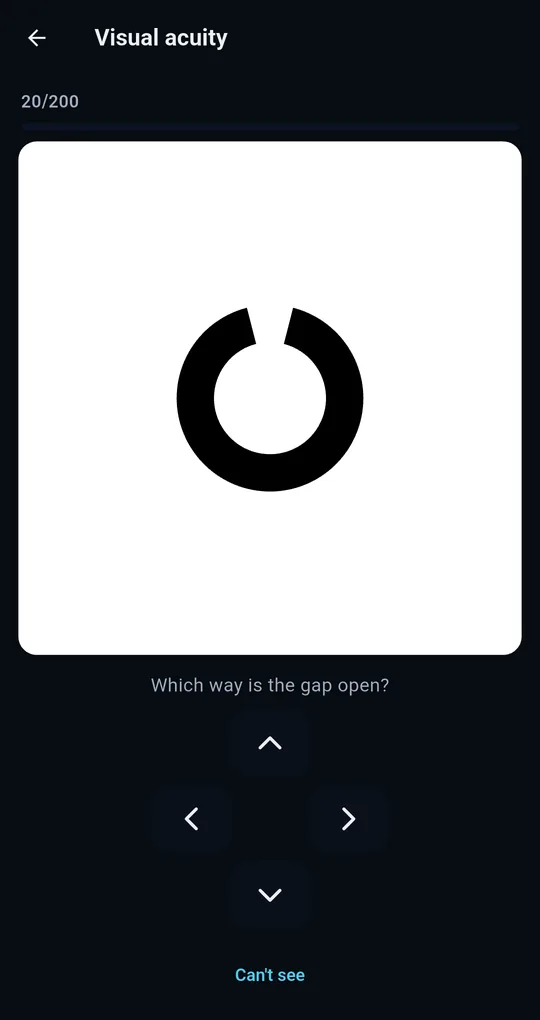
Sharp acuity with low contrast sensitivity happens, and so does the reverse. Recording both turns “I only struggle at night” into something you can show. The vision score only averages the tests you have actually finished, so one test is enough to get a figure.
FAQ
Should I buy night-driving glasses?
Tinted lenses reduce the light that reaches your eye, which is the opposite of helpful in the dark. If glare has got worse, find out why before buying a product.
Can I compare my log CS with a clinic value?
Better not to. Screen brightness, reflections and distance vary by device, so absolute comparison does not hold. Use it to track change on the same phone.
Daytime is fine, night is not.
That pattern is common: a wider pupil at night brings in more peripheral aberration and less contrast. If it has clearly worsened over recent months, book an exam.
EyeCheck: Vision & Color Test
No sign-up, fully offline. A free Android eye self-check app that tests and records your left and right eye separately.