Why one direction looks darker
Astigmatism means the cornea or lens is curved more steeply in one meridian than in the one at right angles to it. Instead of a point of light converging to a point, it converges to two short lines at different depths.
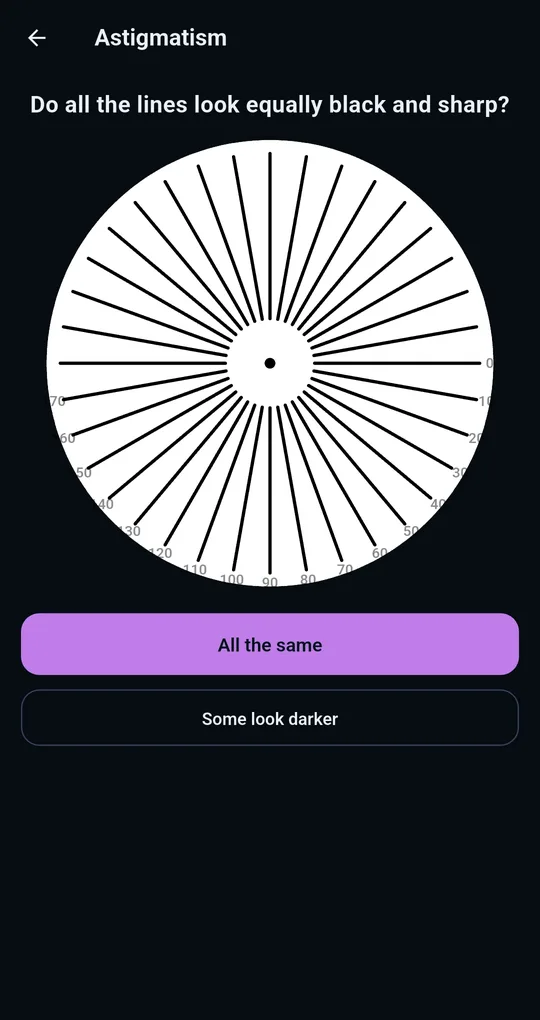
The result is that lines in one orientation land sharply on the retina while lines 90 degrees away do not. A radial fan chart is simply a way of making that visible. Without astigmatism all the spokes look the same.
- No astigmatism: everything looks equally sharp, or equally soft.
- Astigmatism: one direction stands out as darker, and the direction at right angles is the blurriest.
- Already corrected with glasses or lenses: even spokes are the expected result.
The axis, in degrees
The orientation is called the axis and is written from 0 to 180 degrees. It stops at 180 because an orientation has no front and back: 10 degrees and 190 degrees are the same line.
| Written as | Direction |
|---|---|
| 0° or 180° | Horizontal (the 3–9 o’clock line) |
| 45° | From upper right down to lower left |
| 90° | Vertical (the 12–6 o’clock line) |
| 135° | From upper left down to lower right |
Prescriptions usually record the axis in 10-degree steps, so a fan drawn at 10-degree intervals (18 spokes) lines up directly with one. A 12-spoke clock-face version at 30-degree intervals is easier if you think in o’clock terms.
Reading a prescription
Understanding the abbreviations is not the same as deciding your own lenses. Those numbers come from a refraction.
| Abbreviation | Name | Meaning |
|---|---|---|
| OD / R | Right eye | Latin oculus dexter |
| OS / L | Left eye | Latin oculus sinister |
| SPH or S | Sphere | Minus for short sight, plus for long sight |
| CYL or C | Cylinder | The amount of astigmatism; 0 means essentially none |
| AXIS or Ax | Axis | The orientation, 0–180° |
| ADD | Addition | Extra power for near work (presbyopia) |
| PD | Pupillary distance | Distance between the pupils in mm |
A cylinder of −0.75 is mild and larger numbers mean more. How it feels depends on the axis and the sphere as well, which is why a change of prescription is decided in an eye exam rather than from a chart at home.
False positives
| Cause | How to rule it out |
|---|---|
| Fingerprints and oil film | Wipe the screen and repeat |
| Reflections or direct sunlight | Turn away from the light source |
| Tired eyes | Rest, then test again |
| Testing with glasses on | Take them off if you can — if you are already corrected, even spokes are correct |
| Holding it too close | Use arm’s length, about 40 cm |
| Looking at the screen at an angle | Face it squarely; tilt alone can manufacture apparent astigmatism |
Any one of these can produce an “astigmatism” result. Test two or three times under different conditions, and if the same direction keeps standing out, book a refraction.
Checking it in the app
Answer the first question honestly
EyeCheck shows a radial fan and asks “Do all the lines look equally black and sharp?”. Tap “All the same” if they do, or “Some look darker” if one direction stands out. Take your glasses off if you can, hold the phone at arm’s length, and cover one eye.
Tap the darkest spoke
Answer that some look darker and the app asks you to tap the one that looks darkest and sharpest. The angle of the spoke you pick is recorded as the axis. The default fan is 18 lines at 10 degrees, and Settings can switch it to a 12-line clock dial.
Both eyes, then compare over time
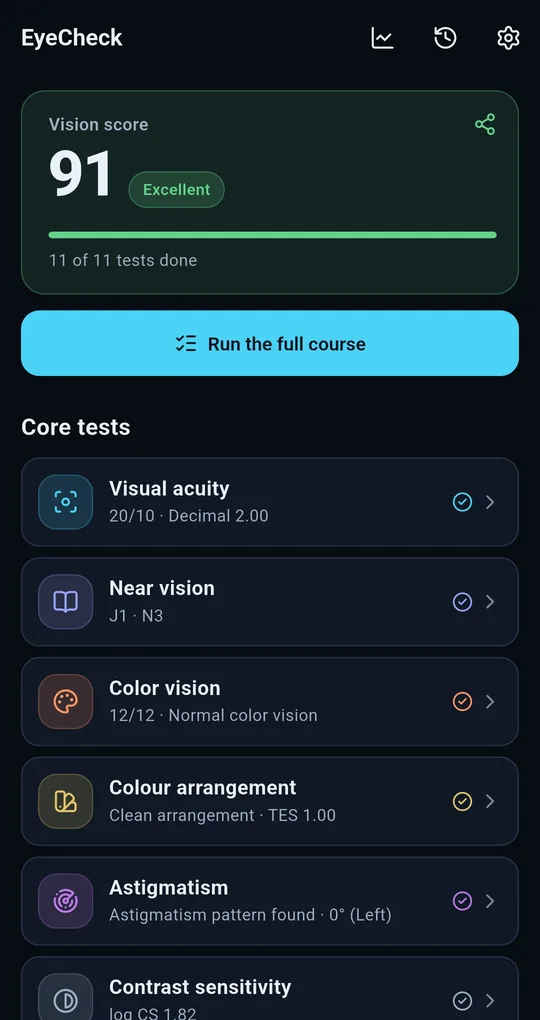
Repeat for the other eye. Results are stored separately for left and right, and the axis appears on the home list. An axis does not normally wander, so if your recorded axis keeps changing, suspect the test conditions before your eyes.
FAQ
Can astigmatism appear suddenly?
It can change when corneal shape changes. A big shift overnight, though, is more likely to be test conditions or a temporary state such as dryness or lid swelling. If it repeats, get it checked.
I wear glasses and one direction still looks darker.
The astigmatic correction in your current lenses may not be quite right; even a small axis error looks like this. Mention it at your next exam.
Is paper more accurate than a screen?
Paper avoids reflections and smears, but printing can scale the chart wrongly. Either way, a consistently repeating direction matters more than the exact angle.
EyeCheck: Vision & Color Test
No sign-up, fully offline. A free Android eye self-check app that tests and records your left and right eye separately.