Why high tones go first
Age-related hearing loss (presbycusis) is most marked at the higher frequencies. Wikipedia notes that even young adults may lose tones above 15 or 16 kHz, and that some deterioration has been found to start from about age 18. Scientific American gives the average adult range as 0.02 to 16 kHz.
The “Mosquito” teen deterrent uses 17.4 kHz for exactly this reason.
Hearing age chart
This is the mapping the Android app SonicKit uses to show results. It’s a for-fun estimate, not a medical standard.
| Highest tone heard | Estimated hearing age | Result label |
|---|---|---|
| 20 kHz | 15 | Razor-sharp ears |
| 19 kHz | 18 | Razor-sharp ears |
| 18 kHz | 21 | Razor-sharp ears |
| 17 kHz | 25 | Younger than average |
| 16 kHz | 30 | Younger than average |
| 15 kHz | 38 | Right around average |
| 14 kHz | 45 | Right around average |
| 13 kHz | 50 | High tones are fading |
| 12 kHz | 55 | High tones are fading |
| 10 kHz | 63 | Mostly the low range |
| 8 kHz | 70 | Mostly the low range |
What changes your result
- Earphones — phone speakers can’t reproduce very high tones, so results come out too low.
- Volume — louder playback lets you hear higher. Keep it the same each time.
- Background noise — test somewhere quiet.
- Expectation — people press “I hear it” because they think they should, more often than you’d guess.
Try it in the app
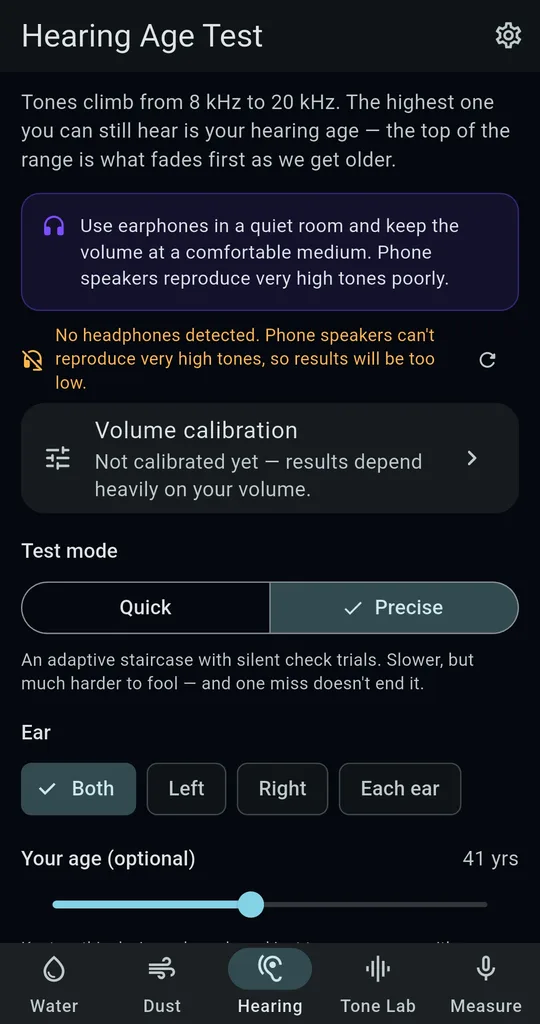
Calibrate, then choose a mode
On the Hearing tab, open Volume calibration, play the 1 kHz tone, set it clear but comfortable and save. Choose Precise: two hits move you up, one miss moves you down, and some steps play nothing at all, so tapping “I hear it” on everything doesn’t earn a good score.
Result and history
Your hearing age comes from the highest of 11 steps between 8 and 20 kHz you could hear. If you answered “I hear it” on a silent step, SonicKit warns that the result may be too optimistic. It keeps your last 30 results and shows a trend chart once you have two.
Add your age, and one ad unlocks a detailed report for 24 hours: left/right balance, an age-group comparison and a sharper share card. The test and basic result need no ads.
How it differs from a real test
Clinical pure-tone audiometry uses calibrated equipment to find the quietest sound you can hear at fixed frequencies, typically 250 Hz to 8 kHz. The app only asks whether you can hear tones from 8 to 20 kHz. That’s a different question from whether you follow conversations, so a good app score is no reason to skip a real test if you’re struggling.
FAQ
I’m in my twenties and can’t hear 17 kHz. Is that bad?
Often it’s the earphones, the volume or the phone’s output. Try other earphones in a quiet room, and if everyday hearing feels harder, get it checked.
Quick and Precise gave different results.
Quick mode ends at your first miss, so it tends to come out lower. Compare results from the same mode.
SonicKit - Speaker Water Eject
No sign-up, and it works without an internet connection. Free on Android.