What the number means
ISO is how fast the film reacts to light. Double the number and you need half the light for the same picture. Photographers call that halving one stop.
| Film | Compared with ISO 100 | Shutter at the same aperture |
|---|---|---|
| ISO 100 | Baseline | 1/60 sec |
| ISO 200 | 1 stop faster | 1/125 sec |
| ISO 400 | 2 stops faster | 1/250 sec |
| ISO 800 | 3 stops faster | 1/500 sec |
| ISO 3200 | 5 stops faster | 1/2000 sec |
A faster shutter means less camera shake and less subject blur. Load ISO 100 indoors and the shutter slows down until every handheld frame is soft.
Speed costs grain
The way to make film react faster is to make the light-sensitive silver crystals bigger. Bigger crystals react to less light, but you can see them in the picture. So the trade is always the same.
- Slower film — fine grain and a long tonal scale, but it needs plenty of light.
- Faster film — it works in the dark, at the cost of coarse grain and harder contrast.
There is one more difference from digital that catches people out. A roll keeps one speed from the first frame to the last. You cannot change ISO shot by shot, so choosing the film is really choosing the conditions you plan to shoot in.
Picking a speed
| Speed | Suits | Character |
|---|---|---|
| ISO 25–100 | Bright sun, tripod work, copying and records | Grain barely visible, long smooth tones |
| ISO 160–200 | Daytime walks, overcast outdoors, everyday | The safe middle, and the most common choice |
| ISO 400 | Indoors near a window, grey days, shooting on the move | The all-rounder; grain starts to show |
| ISO 800–1600 | Evening interiors, city streets at night | Clear grain, contrast stiffens |
| ISO 3200 | Night, stages, rooms with no flash | Grain becomes part of the subject |
For a day that starts outdoors and runs into the evening, 400 forgives the most. You can stop the lens down in daylight and it just about survives after dark.
Pushing film
Shooting an ISO 400 film as if it were 1600 and then extending the development time to compensate is called pushing. At the lab you ask for 400 pushed to 1600. It is not free.
- Contrast rises. Mid greys thin out while blacks and whites grow.
- Grain gets coarser.
- Shadow detail does not come back. Only the brighter tones lift.
So pushing is less a way to shoot in the dark than a deliberate way to make a harsher picture.
Choosing in the app
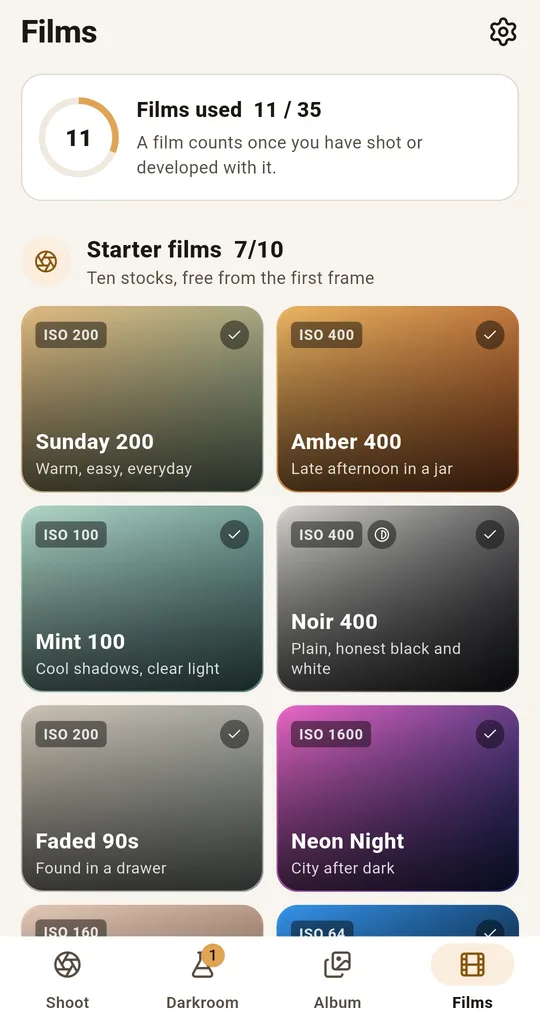
ISO badges in the Films tab
In the Films tab of FilmRoll every card carries an ISO badge in the top corner. The ten starter stocks alone run from ISO 64 to 1600, which makes it easy to shoot the same scene and change only the speed.
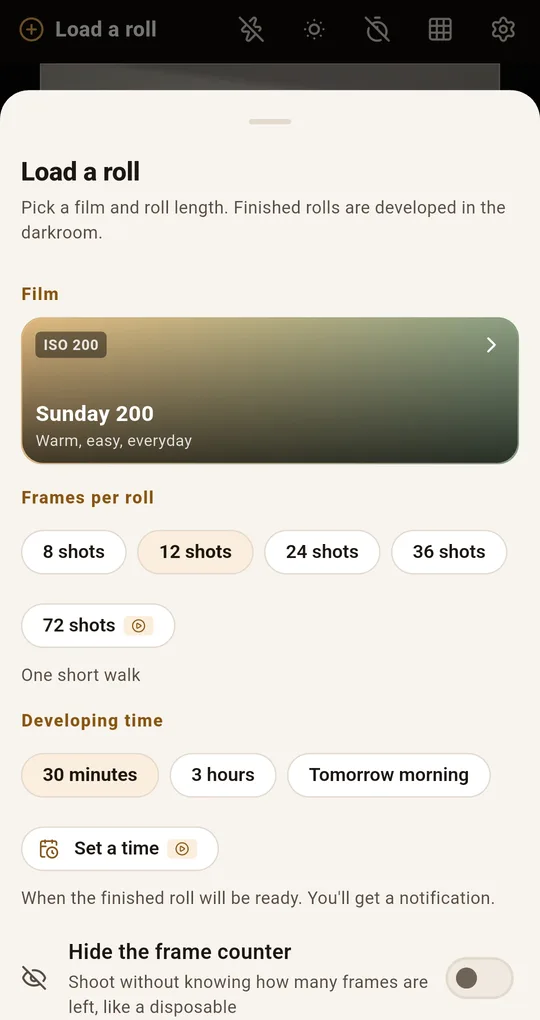
The choice happens when you load
The Load a roll sheet is where you pick the film, the frames per roll and the developing time. Like a real camera it takes one roll at a time, and once a frame has been shot the film for that roll is fixed. So you decide what speed to carry before you start.
FAQ
Does a higher ISO stock make my photos brighter in the app?
No. The ISO shown in FilmRoll describes the character of the stock; the actual brightness is set by your phone camera. What changes with speed is grain, contrast and the way colour behaves. To change brightness directly, use exposure compensation on the Shoot screen.
Is ASA the same as ISO?
Yes. The ASA number printed on older film cans uses the same scale, so ASA 400 and ISO 400 are the same speed.
Is faster film better film?
No, it suits different conditions. Load ISO 3200 on a bright day and neither shutter nor aperture can hold it back; all you gain is grain.
FilmRoll: 35mm Film Camera
No account, no server, and your photos never leave the phone. Shooting and developing both work in airplane mode. Free on Android.