What happens to expired film
Film is a chemical material, so it changes slowly. Three things happen at once.
- It loses speed. The same light produces less response, so pictures come out dark. That is why old film is shot with extra exposure. A rule of thumb of one extra stop per decade gets passed around, but storage changes it far more than age does.
- Base fog rises. Even unexposed areas accumulate a little response, so true black never arrives and the whole frame sits lifted.
- The three layers do not age equally. The red, green and blue sensitive layers decay at different rates, so the colour tilts. Green and magenta casts are common, but the direction depends on the stock.
Storage decides almost everything. A frozen roll long past its date often behaves better than a recent roll left in a warm drawer. Which is why expired film never fails the same way twice — and the unpredictability is part of why people shoot it.
What cross processing is
There are two broad kinds of colour film, and they take different chemistry.
| Film | What you get | Normal process |
|---|---|---|
| Colour negative | An inverted image on the strip | C-41 |
| Slide (reversal) | A positive you can hold up to the light | E-6 |
Cross processing deliberately mismatches the pair. The common version is developing slide film in C-41. The chemistry is not doing the job it was designed for, so you get:
- Contrast way up. Mid greys thin out and the picture heads towards blacks and whites.
- Saturation shooting up.
- Colours crossing over. Cyan shadows with yellow highlights is the combination that turns up most often.
- Coarser grain.
The reverse direction is possible but gives a washed-out result, so it is rarely used.
Telling the two apart
| Expired film | Cross processed | |
|---|---|---|
| Cause | Time and storage | The wrong chemistry |
| Contrast | Down — the blacks lift | Up — the midtones vanish |
| Saturation | Drains away | Shoots up |
| Colour direction | The whole frame tilts one way | Bright and dark tilt opposite ways |
| Impression | A faded old print | A 1990s magazine under a fluorescent tube |
| Repeatability | Different every time | Fairly consistent for the same film and chemistry |
The quickest way to tell them apart is to look at the dark areas. Blacks lifted to grey means expired; blacks going deeper with a cyan cast means cross processed.
If you actually try it
- Cross processing is not accepted everywhere. Some labs decline it over chemistry contamination or charge extra, so ask before you drop the roll off.
- You cannot control the outcome. Keep it away from days you cannot repeat.
- Expired film needs extra exposure as a baseline. Underexpose it and you do not get a colour shift, you get nothing at all.
- Expired slide film stacks both risks. If this is your first attempt, start with expired colour negative.
Seeing both in the app
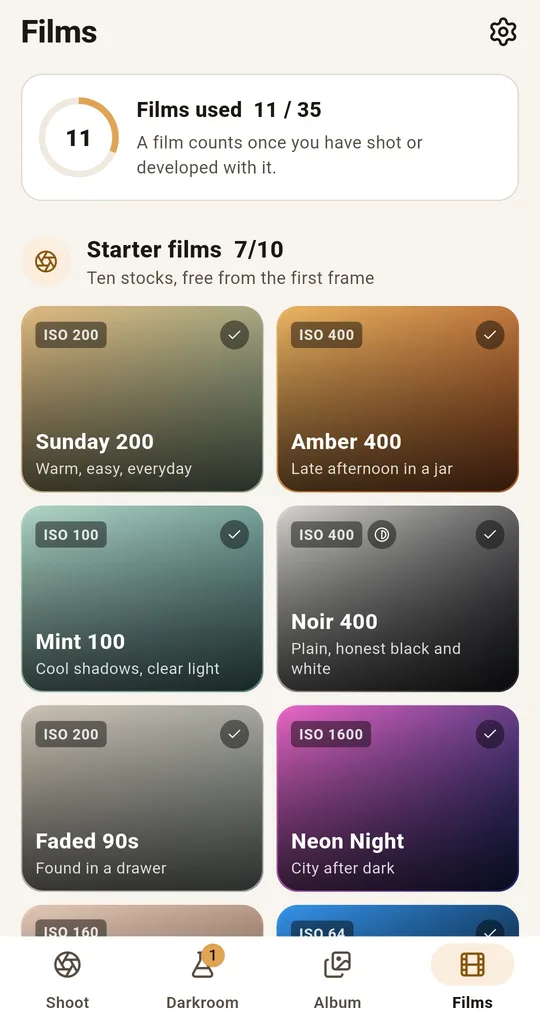
The experimental and slide packs
The Films tab in FilmRoll is divided into packs. The experimental pack holds film loaded backwards, film ten years past its date and stocks that drift violet; the slide pack includes one developed in the wrong chemistry. Tap any card to read what that stock is imitating.
Compare on one photo
Open a photo and tap Compare to see it on four stocks at once. Put an expired-style stock next to a cross-processed one and the difference between lifted and crushed blacks is immediate. Tap the one you like and the photo is re-developed on it.
FAQ
Can I just shoot film that is past its date?
Colour negative is fairly forgiving, and generous exposure usually gets you a picture. Slide film and high-speed film are much more sensitive to age.
Does frozen film still give the expired look?
Well-stored film often behaves like new long after its date. Buying expired film for the look and getting perfectly normal pictures is a common disappointment.
Are the expired and cross stocks in the app real products?
No. All 35 stocks in FilmRoll carry names of their own and are not reproductions of any manufacturer’s product — they model the behaviour of a type, not a specific item.
FilmRoll: 35mm Film Camera
No account, no server, and your photos never leave the phone. Shooting and developing both work in airplane mode. Free on Android.