The journey of one roll
A digital photo is finished the moment you press the shutter. A roll of film has to clear five stages before you can look at it.
- Buy — you pay for the roll before a single frame exists.
- Shoot — the roll stays in the camera until it is finished. That can be days or months.
- Develop — the lab runs it through chemistry. Only now is there a negative.
- Scan or print — turning the negative into files or paper. Often charged separately.
- Collect — pick it up, download the files, or wait for the post.
People are surprised by the total because they only looked at stage one. A large share of the real spend happens in stages three to five.
Where the money goes
When you read a lab’s price list, write down each of these separately. Whether they are bundled or charged individually varies from lab to lab.
| Item | What to check |
|---|---|
| The roll | Colour negative, black and white or slide. Slide film usually costs more |
| Developing | Colour (C-41), black and white and slide (E-6) are priced differently. Fewer labs handle the last two |
| Scanning | Often tiered by resolution — a standard scan and a high-resolution one |
| Prints | Can you pick individual frames, or is it the whole roll? |
| Getting it there | Travel to the lab, or postage both ways |
| Special requests | Pushing, cross processing, extra correction per frame |
And one more thing — the failures cost the same. Out of focus, finger over the lens, it does not matter: developing is charged by the roll.
Cost per keeper
Long-time film shooters use a different arithmetic. They divide the total not by the number of frames but by the number of frames worth keeping.
- Say you finish a 36-exposure roll and pay whatever your lab charges.
- If six frames are worth looking at again, your real cost per picture is six times the naive figure.
- Twelve keepers and it is three times.
Do this once and you see that half of film is expensive is not a price problem but a hit-rate problem. Shooting the same scene three times, or pressing the shutter whenever you are unsure, raises the cost directly.
How long it really takes
| Stage | Realistically |
|---|---|
| Finishing the roll | 36 frames takes longer than you think. Three or four a day is a week and a half |
| Drop-off to developed | A city lab can be quick; mail-in labs take days |
| Scanning or printing | Usually folded into developing, though high-resolution scans take longer |
| Collection | Instant if you walk in, another day or two by post |
Added up, the gap between pressing the shutter and seeing the picture is usually a week to a few weeks. That wait is normally listed as a drawback, but plenty of people find they judge their own pictures differently once the feeling of taking them has worn off.
Rehearsing it in the app
The Android app FilmRoll keeps the shape of this process and removes the money. Load a roll, finish it, wait, then open it in the darkroom.
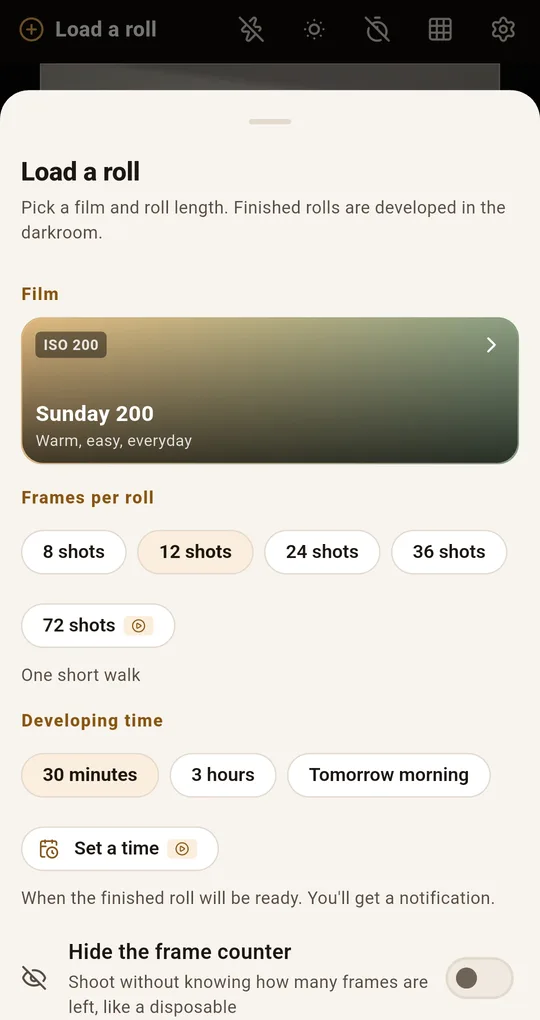
You choose the developing time
On the Load a roll sheet, developing time is 30 minutes, 3 hours, tomorrow morning or a set time. The countdown starts when the roll is finished, and a notification arrives when it is ready. Tomorrow morning means 8 am the next day.
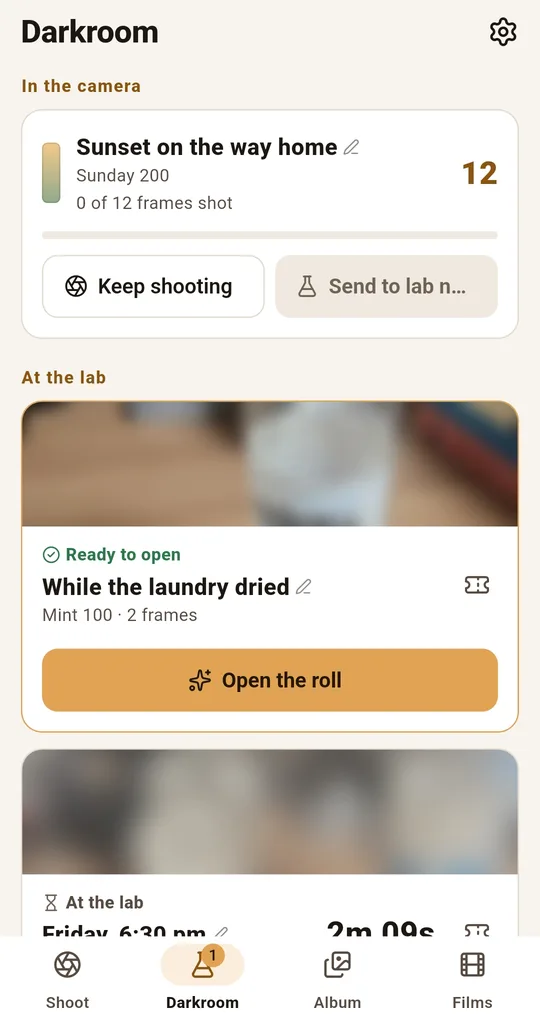
Wait in the darkroom, then open it
The Darkroom tab separates rolls that are still in the camera, rolls at the lab, and rolls ready to open. You can send an unfinished roll in with Send to lab now, but the remaining frames are lost — exactly like winding a roll out early.
Keep the developing ticket
Every roll can produce a developing ticket card showing when it was dropped off, when it is due, the frame count and the film. It stands in for the paper envelope from a lab.
FAQ
Can I have it developed only and scan at home?
Yes. Ask for develop only, take the negatives, and copy them with a dedicated scanner or a camera. There is equipment to buy up front, but the cost per roll falls the more you shoot.
Is it cheaper if the roll is only half shot?
Usually not. Developing is priced per roll, so ten frames costs what thirty-six costs. Finishing the roll is the better value.
Why does the app make me wait at all?
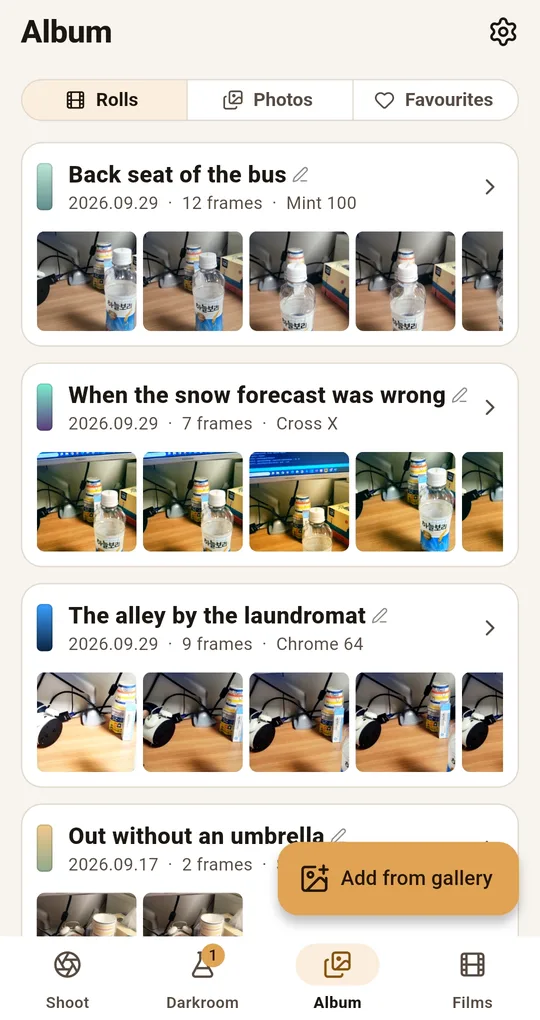
Because the wait is half of shooting film. If you want to see them now, pick the shortest 30 minutes, or use Add from gallery — imported photos are developed immediately.
FilmRoll: 35mm Film Camera
No account, no server, and your photos never leave the phone. Shooting and developing both work in airplane mode. Free on Android.