When a frame became free
On film, pressing the shutter spends something, so you think before you press. Digitally the marginal cost of one more frame is effectively zero, so you press first and think afterwards.
The cost did not disappear. It moved.
| Film | Digital | |
|---|---|---|
| Pressing the shutter | Costs money and a frame | Essentially free |
| Choosing | Choose from 36 | Choose from thousands |
| Where the effort sits | Hesitating before the shot | Never getting round to sorting |
| Outcome | Few pictures, most of them seen | Many pictures, almost none seen |
No time to sort really means the sorting cost has piled up past the point of starting. Choosing from thousands is not slightly harder than choosing from 36; it is the kind of task you never begin.
What a limit actually does
- You look outside the frame. With only one shot you step back or change the angle first.
- You stop shooting the same thing three times. There is no burst of five to choose from later.
- You decide not to shoot. This is the big one. When frames are scarce, saving one becomes a real option.
- The memory sticks. A frame you thought about stays attached to when and why you took it.
A limit has costs too. You will miss things, and on important days it is nerve-racking. So do not apply it to everything — ordinary days are enough.
Five rules you can try
All of these work on a phone alone. Pick one and run it for two weeks.
- A daily count — ten a day, or 36 a week. If counting is a nuisance, make an album and only put pictures in that.
- One press only — never shoot the same scene twice. If it is blurred, it stays blurred.
- One keeper each evening — pick a single frame from the day and file it separately. You do not have to delete the rest; the act of choosing is the point.
- Do not check — do not look at the screen after the shot. Looking is what makes you take it again.
- Pick a subject — shadows this week, doorways next. A subject gives you a clear reason not to shoot something.
The line that makes it findable
Photos go missing because we look for them by date. Nobody remembers September 2026; they remember the day I went out without an umbrella. Attach one short note to a picture and it becomes searchable. Where, who with, what kind of day — a handful of words is plenty.
Doing it in the app
The Android app FilmRoll builds the limit into its structure.
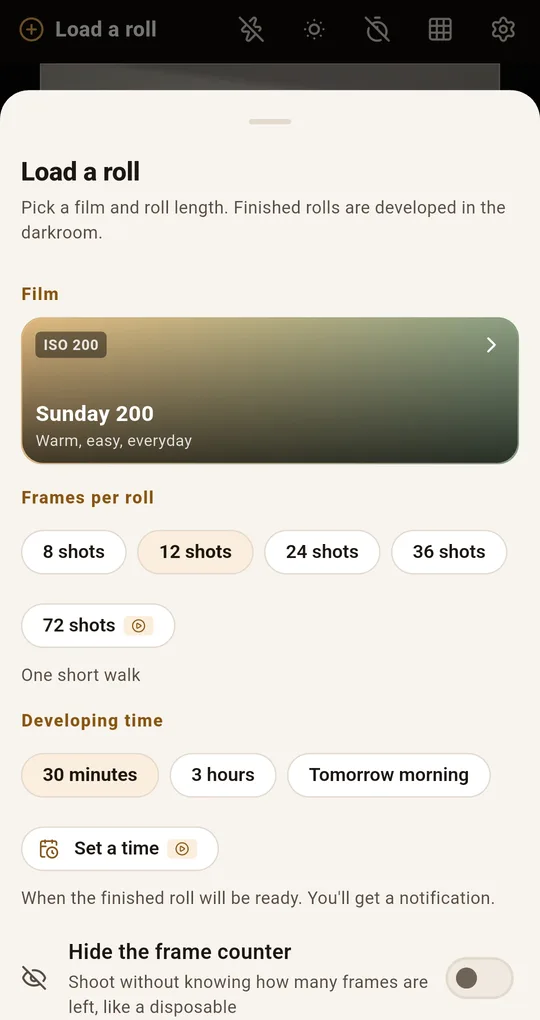
Set the day’s ceiling with the roll length
Frames per roll is where the ceiling is set. In the app 8 shots is a light outing, 12 is one short walk, 24 is just right for a day and 36 is a whole trip. Only one roll fits at a time, so you cannot swap film until it is finished.
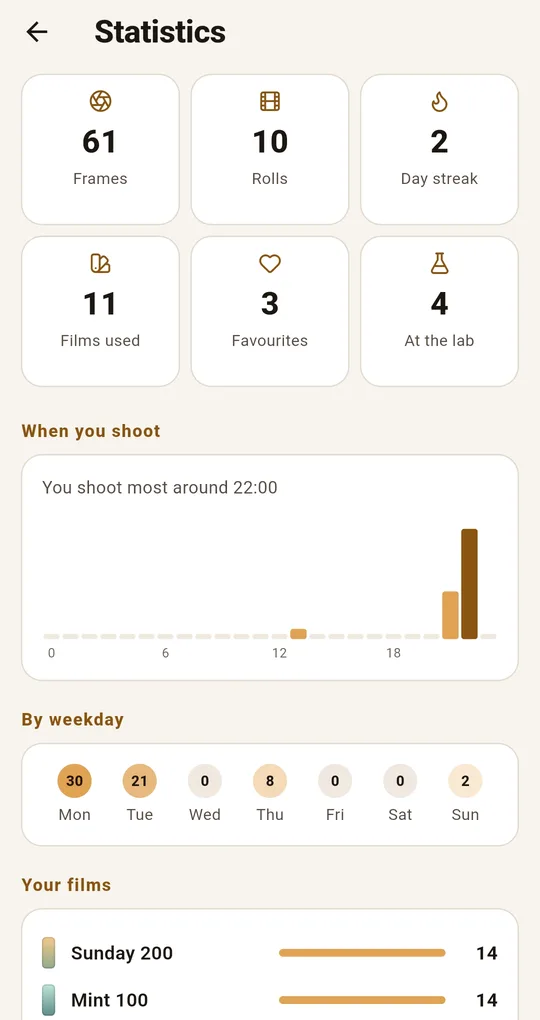
Your habits turn into numbers
The Statistics screen shows frames shot, rolls developed, day streak and films used, plus how your shooting spreads across the hours and the weekdays. A line like you shoot most around 22:00 tells you where a limit would actually bite.
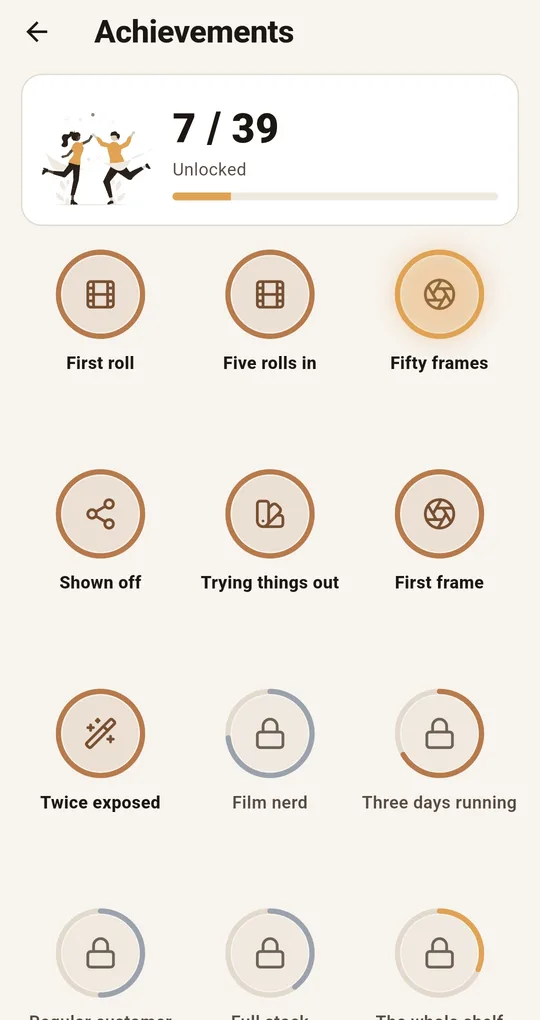
Records add up as achievements
Most of the 39 achievements reward shooting differently rather than shooting more — finishing a 36-frame roll, completing a roll with the frame counter hidden, leaving notes on ten photos, shooting three days in a row.
FAQ
Should I apply the limit on important days?
No. On days you cannot repeat, shoot as much as you like, and save the limit for ordinary days. The point is not to record less; it is to get your eye back.
Isn’t deleting the real way to tidy up?
Deleting works less well than it sounds, because you have to make a keep-or-bin decision thousands of times. Picking only what to keep takes far fewer decisions, so you actually finish.
What if I want to see the roll before the frames run out?
Use Send to lab now in the Darkroom tab. The remaining frames are lost, exactly as if you had wound a real roll out early.
FilmRoll: 35mm Film Camera
No account, no server, and your photos never leave the phone. Shooting and developing both work in airplane mode. Free on Android.