Three factors
- Specifics — "a signal failure held us 20 minutes" beats "transport issues". You can only be specific when it’s true.
- Frequency — how often that type of reason comes up. Often enough and it reads as a habit.
- Follow-up — how you made up for it. Behavior proves the reason for you.
Reasons by type
| Type | Credibility | Watch out |
|---|---|---|
| Transit (official delay) | High | Often verifiable |
| Health | High | Repeats may prompt questions |
| Family | High | Hard to question, so trust matters |
| IT outage | Medium | Colleagues on the same system know instantly |
| Absurd | Low | Good for a laugh, not for attendance |
Excuse Maker is an app made for fun. For real attendance messages, telling the truth is always the safest option. Adapt the example messages here to what actually happened.
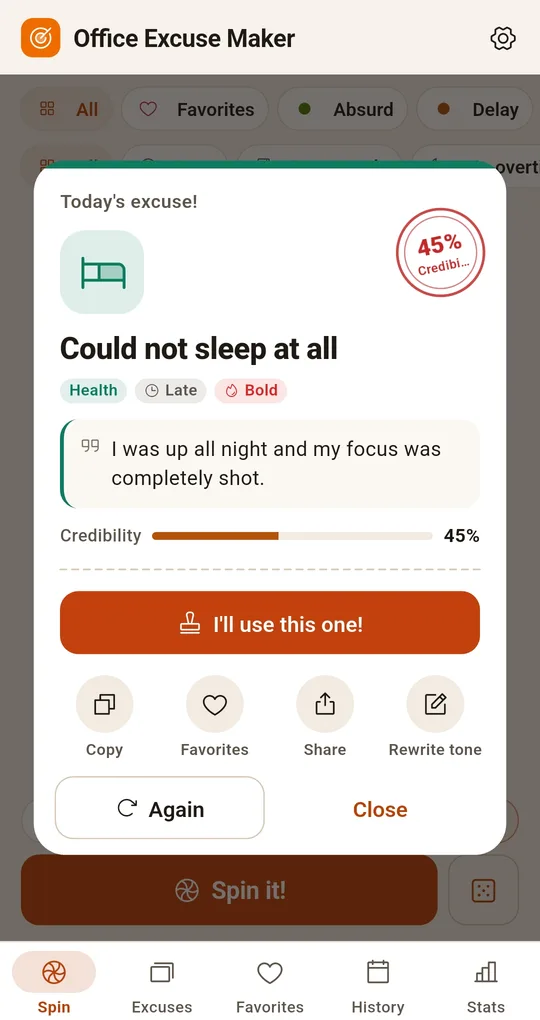
The app’s credibility %
1
Credibility and risk
Each result card in Excuse Maker shows a credibility percentage and a risk level: Safe, Risky or Bold. You can set credibility (0–100) for your own reasons too.
2
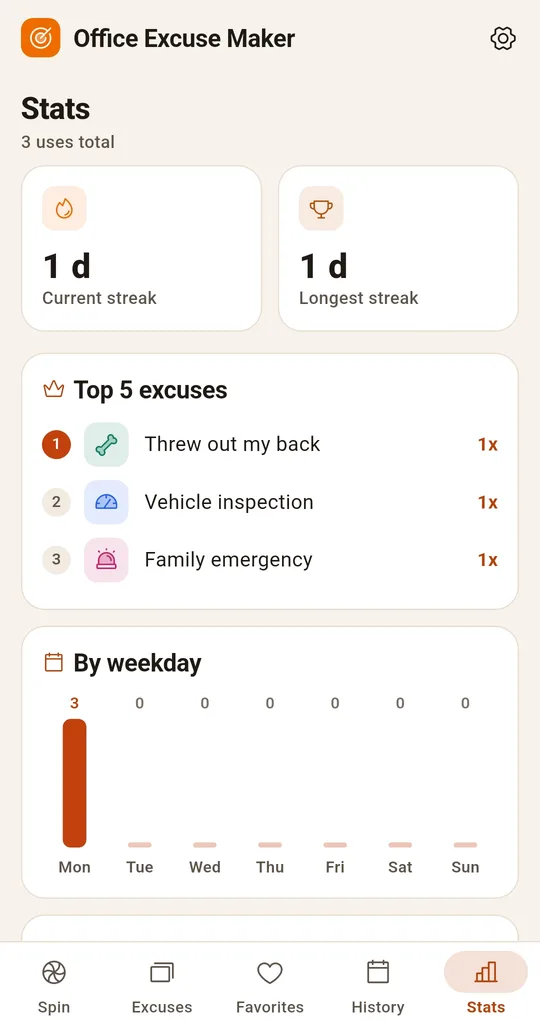
Calibrated by your record
Mark a reason "It worked" or "It flopped" at least three times and its credibility becomes an even blend of the base score and your success rate. See Best success rate on the Stats tab (detailed stats open for 24 hours per ad).
FAQ
What does Safe mode do?
It weights the wheel toward high-credibility reasons.
The same excuse keeps coming up.
Turn on Skip recently used to leave out the one you used last.
Office Excuse Maker Roulette
No sign-up, fully offline, made for fun. Free on Android.