The early drop
Your body stores carbohydrate as glycogen together with water. When you cut back, especially on carbs, glycogen and its water leave in the first week and the scale drops quickly. That part isn’t fat, so it doesn’t continue at the same speed, and it returns as soon as you eat more carbs again.
Smaller body, smaller TDEE
Weight is part of every BMR formula, so as weight falls, calculated TDEE falls too. With Mifflin, each kilogram lost lowers BMR by 10 kcal and TDEE (Light activity) by about 14 kcal. After 5 kg, the original "−500 kcal" is really about −430. Real bodies can adapt a little further than the formula predicts.
Limits of the static rule
| Approach | Assumption | Long-term prediction |
|---|---|---|
| 3,500 kcal per lb (7,700 per kg) | A 500 kcal deficit stays the same size forever | Straight-line loss over time — overpredicts |
| Dynamic model (Hall et al., 2011) | Burn drops as weight drops | Slows down and settles at a new balance |
Hall and colleagues estimated that for an adult with overweight, every 100 kJ (about 24 kcal) per day change in intake eventually changes body weight by about 1 kg, with half of that reached in about a year and 95% in about three years. The NIH Body Weight Planner is built on this model. The static rule is fine for a few weeks; stretched over months it predicts far more loss than happens.
Checklist
- Time frame — are you judging a 2–3 week average, not single days?
- Recalculate at today’s weight — are you still using the target set at your starting weight?
- Logging gaps — weekends, eating out and drinks (estimating restaurant meals)
- Activity level — was it set too high from the start?
The answer is rarely to cut further. Keep intake from dropping far below your BMR; 800 kcal a day or less is classed as a very low-calorie diet, done under medical supervision.
Checking in the app
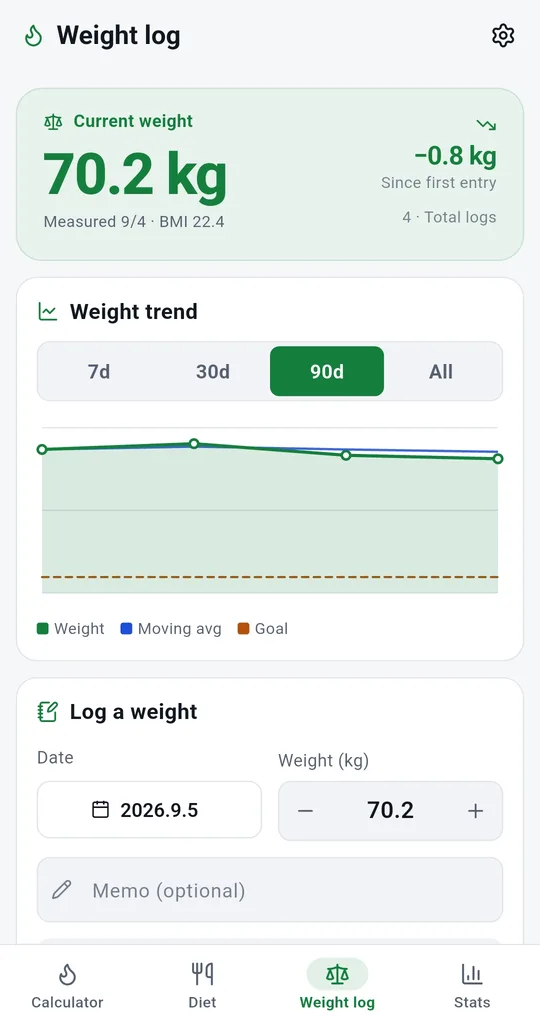
Use the moving average
The Weight log trend chart in Calorie Calculator draws your weight, a moving average and your goal line. If the moving average is still heading down, it isn’t a plateau.
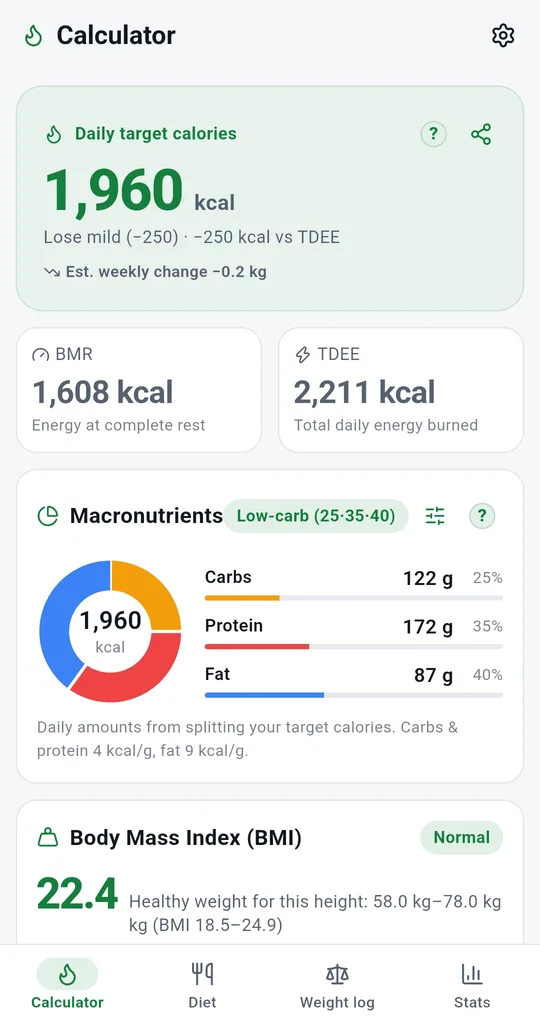
Recalculate at your current weight
Update your weight on the Calculator tab and BMR, TDEE and Daily target calories recalculate immediately.
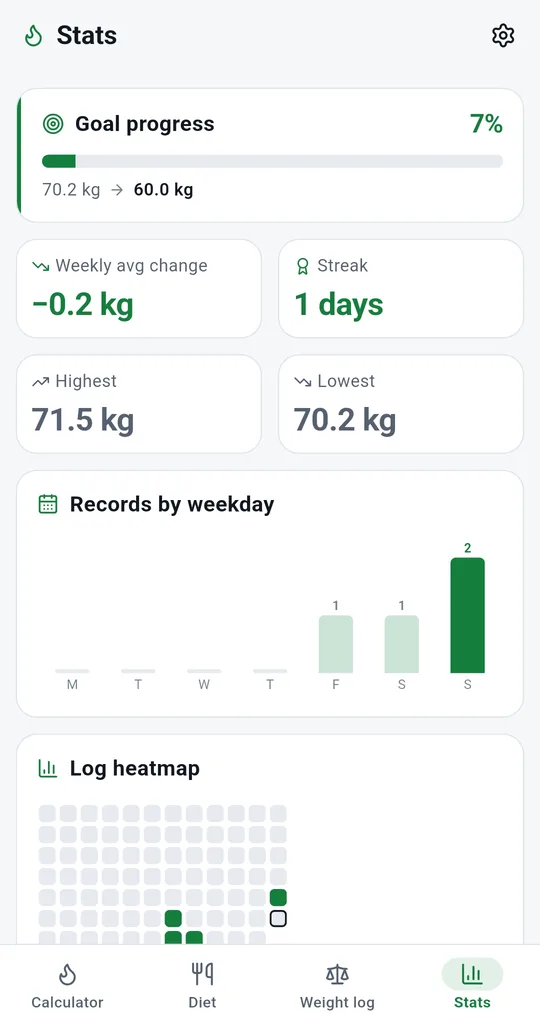
Weekly average change
"Weekly avg change" on the Stats tab shows how much you moved per week. The Stats tab opens for 24 hours after a rewarded ad.
FAQ
Will a cheat day break the plateau?
The swing after a big day is mostly water and food weight. There is no solid evidence it breaks a plateau.
How long before I change the plan?
There’s no fixed rule, but if logging is accurate and the average hasn’t moved for 3–4 weeks, recalculate. If you’re worn out, a stretch at maintenance is a valid option.
Sources: Kreitzman et al., Am J Clin Nutr 1992 · Hall et al., Lancet 2011 · NIH Body Weight Planner · NIDDK, very low-calorie diet
Calorie Calculator: BMR TDEE
No sign-up, and your body data and logs stay on your phone. Free on Android.