Why the same dish varies
Look up a dish in any calorie database and you will often find several entries with different serving weights and calories. They come from different restaurants, recipes and serving definitions. Rather than treating one number as the truth, ask whether what you ate was larger or smaller than that entry’s serving.
What swings the number
| Factor | Why it varies | Estimating tip |
|---|---|---|
| Rice | A standard bowl, a heaped bowl and a plate of fried rice are very different amounts | Weigh your usual bowl once |
| Oil and sauce | Stir-fries, fried chicken and jeon soak up different amounts of oil | Fat is 9 kcal per gram, more than twice carbs or protein |
| Broth | Ratio of solids to soup, and how much of the soup you drink | Leaving the broth cuts fat and sodium together |
| BBQ cut | Pork belly and brisket vs lean cuts | How many grams (servings) you ate is what matters |
| Alcohol | Alcohol itself is about 7 kcal per gram | A 360 ml bottle of 16% soju is about 320 kcal from alcohol alone |
The soju math: 360 ml × 16% × 0.789 (density of alcohol) ≈ 45 g, × 7 kcal ≈ 318 kcal. A US standard drink contains 14 g of alcohol, so a bottle of soju is roughly three standard drinks. With side dishes, the error on a Korean BBQ night comes more from drinks and sides than from the main dish.
Using a database
- USDA FoodData Central covers many ingredients; Korea’s MFDS Food Nutrient Database lists Korean dishes per serving and per 100 g.
- Check how many grams the listed serving is, then scale by how much you actually ate.
- For chain restaurants, the chain’s own published nutrition info is usually the closest.
Calibrating with a scale
You don’t need to weigh every meal. Weigh a handful of foods you eat often for a week or two, and you’ll learn whether your "one bowl" is bigger or smaller than the database serving. After that, eyeballing gets more accurate. If weighing starts to feel stressful, it is fine to put the scale away.
Logging it in the app
The Diet tab in the Android app "Calorie Calculator" has no food database; you type a food name and calories yourself, using estimates like the ones above.
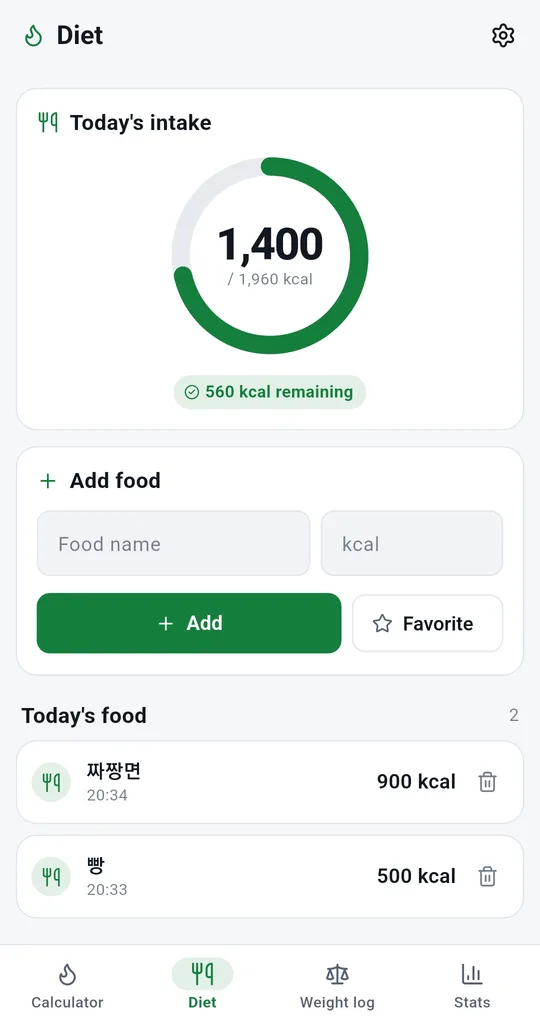
Enter the name and kcal
On the Diet tab, type a name and calories under "Add food" and tap Add. The ring at the top shows today’s intake against your daily target and what remains.
Save regulars as favorites
Once you have weighed your usual bowl of rice, save it with "Favorite" and add it in one tap next time. The food log keeps only today and resets at midnight.
Sample food names in the screenshots are in Korean; the app itself runs in English.
FAQ
Isn’t soup basically zero calories?
Clear soups are low, but bone broth, stews and ramyeon broth carry dissolved fat. Often sodium is the bigger issue than calories.
If my estimates are off, what’s the point?
If you estimate the same way every day, the error repeats too, so you can still adjust against your weight trend. See when the scale stops moving.
Sources: NIAAA, What is a standard drink? · USDA FoodData Central · Korea MFDS Food Nutrient Database
Calorie Calculator: BMR TDEE
No sign-up, and your body data and logs stay on your phone. Free on Android.