Lab reference values
Reaction-time research (mental chronometry) commonly cites, for college-age people, about 160 ms to detect a sound and about 190 ms to detect a visual stimulus. Sound is faster than sight. Many researchers also treat responses faster than somewhere between 100 and 200 ms as anticipation rather than a true reaction.
Source: Wikipedia, Mental chronometry (figures and lower limit above)
Why app results are slower
| What gets added | Details |
|---|---|
| Display | From “turn green” to pixels actually changing takes at least a frame (16.7 ms per frame at 60 Hz) |
| Touch | The time between your finger landing and the device registering a tap |
| Movement | Tapping a screen is a different motion from pressing a lab button |
| Environment | Posture, brightness, noise, tiredness |
So simple reaction time measured on a phone is usually tens of milliseconds slower than lab values. See why reaction time differs between phones.
Types of reaction
| Type | Example | Speed |
|---|---|---|
| Simple reaction | Tap when it turns green | Fastest |
| Auditory simple reaction | Tap when you hear a beep | Faster than visual in the lab |
| Choice / inhibition | Tap green, hold back on red | Slower, because a decision is involved |
The app’s baseline
A separate curve per difficulty
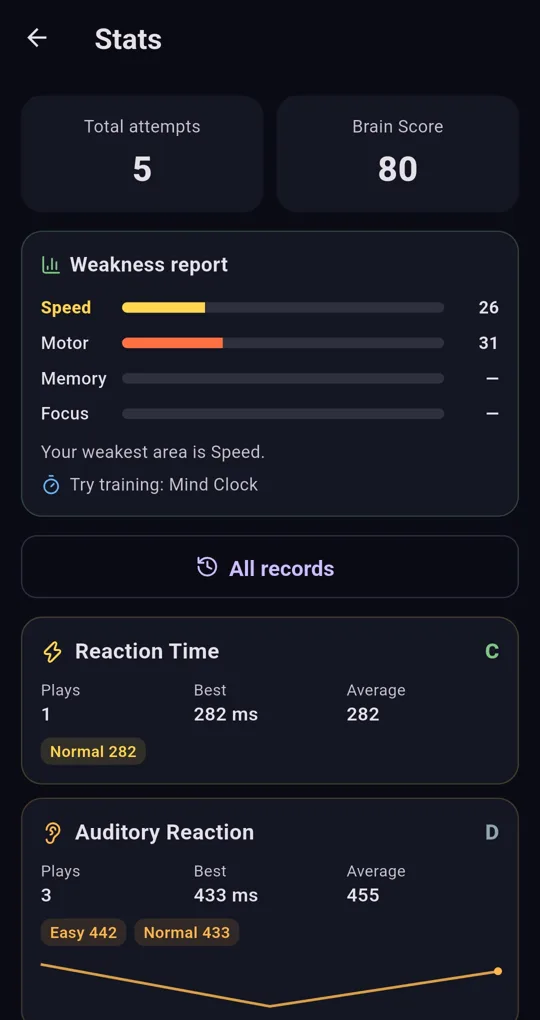
Reflex Lab places your reaction time on a normal distribution and shows a “Top X% of humans”. The curve is an approximation the app sets from published statistics, with separate curves for Easy, Normal and Hard. On Normal, the Reaction Time baseline mean is 284 ms (allowing for phone delay). The math is in how the top-% is calculated.
Auditory Reaction is separate
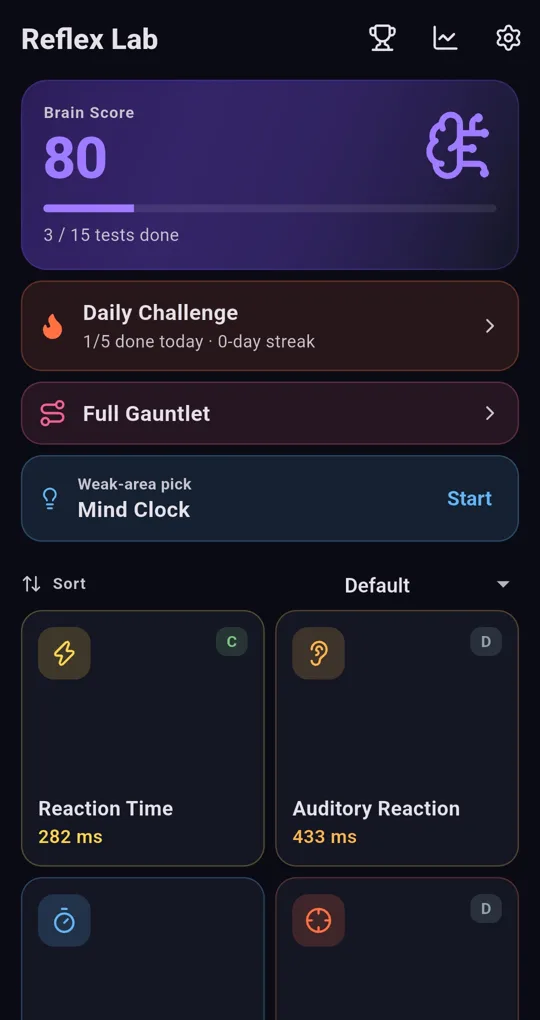
Auditory Reaction keeps the screen unchanged; you react to a beep only. In the lab sound is faster, but phones also delay audio output, so the app’s auditory baseline sits slightly slower than the visual one. Sound effects must be on to take this test.
FAQ
Is anything over 300 ms slow?
It depends on the method. Phone results include device delay, so don’t compare them directly with lab figures. Tracking how your own average changes on one device is more meaningful.
I got under 100 ms.
Research often treats sub-100 ms responses as anticipation. You were probably already pressing before green and got lucky. The 0.1-second false-start rule exists for the same reason.
Reflex Lab: Brain Speed Test
No sign-up, fully offline, records stay on your device. Free on Android.