Refresh rate and frames
A screen redraws a fixed number of times per second. Even when the app decides “green now”, you only see it at the next redraw. One frame lasts 1000 ÷ refresh rate milliseconds.
| Refresh rate | One frame | Possible extra wait |
|---|---|---|
| 60 Hz | 16.7 ms | a frame or more |
| 90 Hz | 11.1 ms | a frame or more |
| 120 Hz | 8.3 ms | a frame or more |
Some phones drop the refresh rate automatically in battery saver mode, so the same phone can vary with its settings.
Touch and sound
- Touch: there is a device-specific delay between your finger landing and the app receiving the tap.
- Sound: auditory tests add the delay before the sound actually leaves the speaker. Bluetooth earbuds add wireless transmission delay, so use the phone speaker or wired earphones.
- Screen protectors and gloves: weaker touch detection makes results erratic.
Comparing fairly
| Comparison | Valid? |
|---|---|
| Same phone, same settings, different days | Yes (the best way to see change) |
| Friends passing one phone around | Yes |
| Different phones | Only roughly (tens of ms may be the device) |
| Phone vs PC web test | No |
In the app
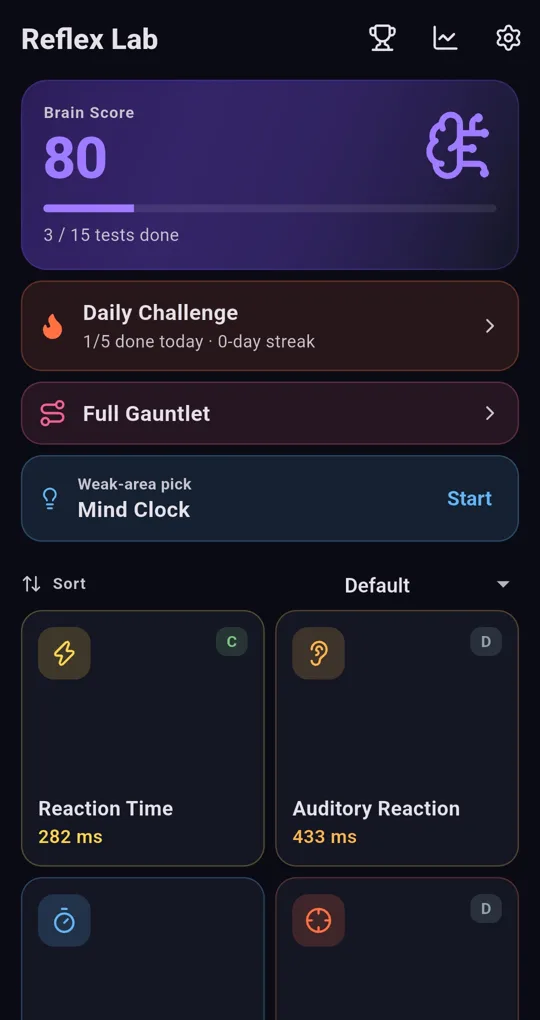
Check the audio path for Auditory Reaction
Reflex Lab’s Auditory Reaction needs sound effects turned on in Settings. If the cue fails to play, that round doesn’t count. The app’s auditory baseline was set from measurements through a phone speaker.
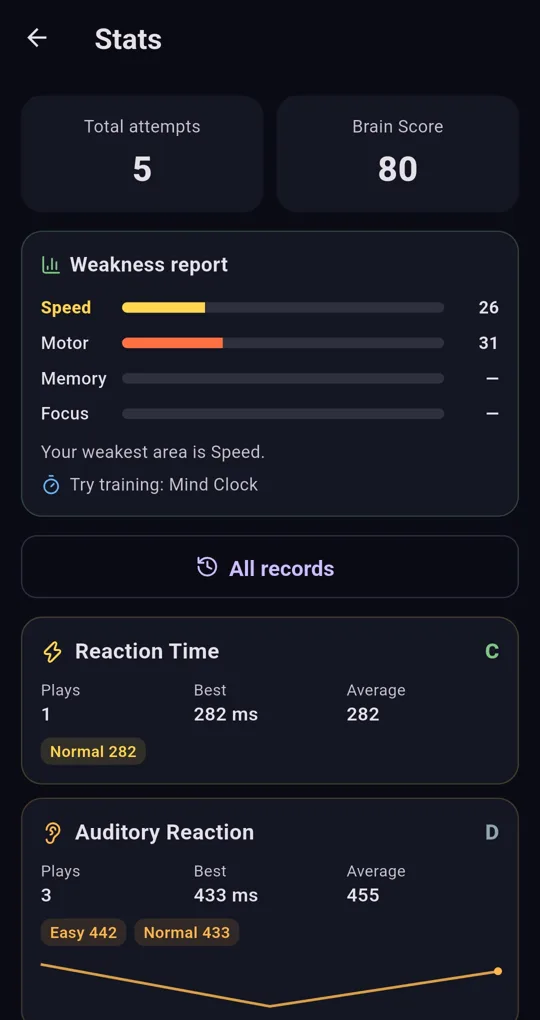
New phone, new baseline
After switching devices, treat the first few days as a new baseline. Don’t compare with the old phone until your Stats average settles. To carry your history over, see moving records to a new phone.
FAQ
Will a 120 Hz phone always make me faster?
It cuts frame wait time, but touch latency and other factors also vary, so how much it changes depends on the device.
Is a tablet or a phone more accurate?
Consistency matters more than either. Pick one device and stick with it.
Reflex Lab: Brain Speed Test
No sign-up, fully offline, records stay on your device. Free on Android.