Eight things to align
| Item | Question to ask | How to compare |
|---|---|---|
| Severance | Is severance included in the salary? | If yes, treat salary × 12/13 as wages |
| Incentives | Guaranteed or conditional? Recent payout rate? | Compare fixed pay first, variable separately |
| Bonuses | Included in the figure? When paid? | Compare regular-month pay |
| Non-taxable allowances | Is there a non-taxable meal allowance? | Enter it in the calculator |
| All-inclusive overtime | Is fixed overtime pay built in? | Compare hourly value using real hours |
| Probation | How long, and at what rate? | Calculate the first three months separately |
| Housing and relocation | Housing support, flights home, visa costs? | Write annual amounts on a separate line |
| Visa sponsorship | Who handles and pays for visa changes? | Note separately; it can outweigh a small raise |
Example: 50M vs 52M
A: 50M KRW, severance separate, 200,000 meal allowance. B: 52M KRW including severance (divided by 13), 200,000 meal allowance. App formula, no dependents.
| Company A | Company B | |
|---|---|---|
| Regular-month gross | about 4.17M | 4.0M |
| Monthly take-home | about 3.53M | about 3.41M |
| Severance | accrues separately | inside the salary (validity is a separate question) |
B’s headline is 2M higher, yet it pays about 126,000 KRW less each month. See salaries divided by 13.
Building the comparison sheet
- Work out regular-month gross for each offer (salary ÷ 12 or 13, no bonuses).
- Run each through a calculator and write down monthly take-home.
- Underneath, list incentives (gross), bonuses, housing and other cash benefits per year.
- Finally, divide take-home by real monthly hours for a real hourly wage. Long hours show up here.
Comparing take-home in the app
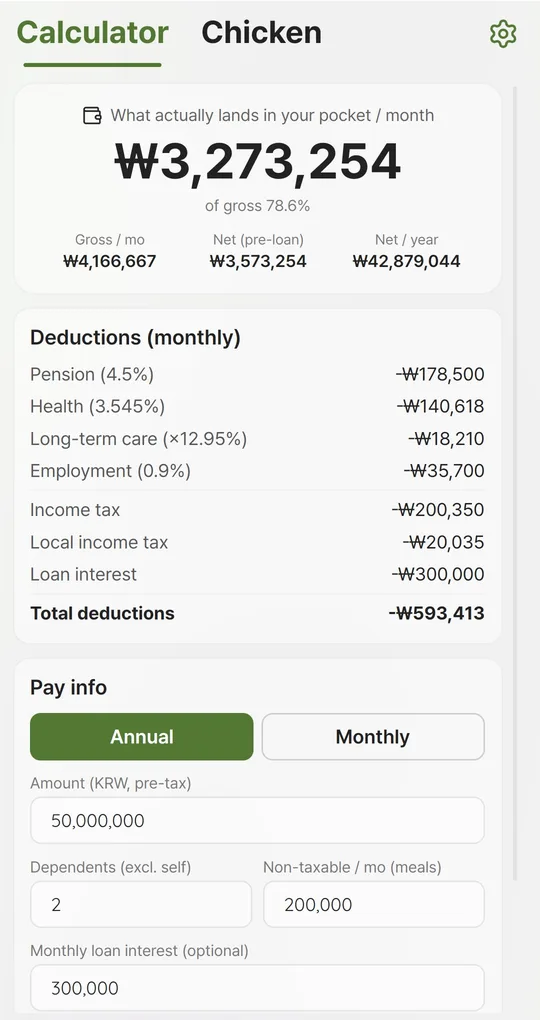
One Monthly calculation per offer
Choose “Monthly”, enter each offer’s regular-month gross and non-taxable amount, and note the result. The app keeps only one saved profile.
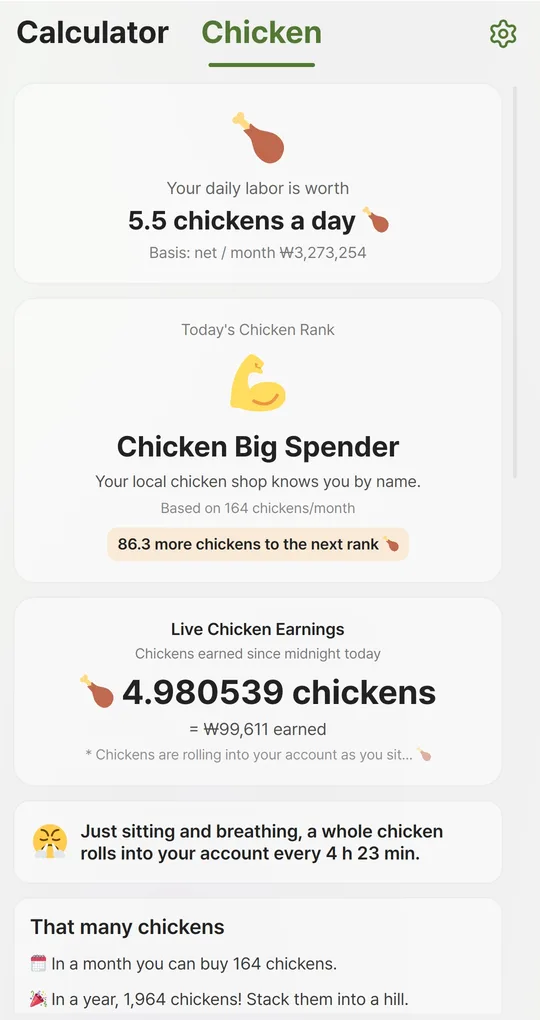
Compare the value of one work hour
On the Chicken tab, “Every work hour earns you N chickens” is take-home (after loan interest) ÷ 209 hours, converted at your chicken price. Set the price to 1 to read it in won.
FAQ
Should I ignore incentives completely?
Compare without non-guaranteed incentives first, then add them back based on what was actually paid in recent years.
If I am on the 19% flat rate, does the comparison change?
Yes. The flat rate taxes total pay including allowances, so allowance differences matter less. See the meal allowance and flat rate.
Sources: Easylaw, severance pay (Korean) · Newsis, meal allowance tax-free limit raised to 200,000 KRW (Korean)
Salary to Chicken: Take-Home
No sign-up, works offline, and your salary data stays on your phone. Free on Android, in English and Korean.