All 12 at a glance
Seasons are for evening viewing from northern mid-latitudes. In the Southern Hemisphere the seasons are reversed.
| Star | Constellation | Best evening season | In one line |
|---|---|---|---|
| Sirius | Canis Major | Winter | The brightest star in the night sky |
| Rigel | Orion | Winter | Orion’s foot, blue-white |
| Betelgeuse | Orion | Winter | Orion’s shoulder, a red supergiant |
| Aldebaran | Taurus | Winter | The bull’s eye, orange |
| Capella | Auriga | Winter | The yellow star high overhead in winter |
| Arcturus | Bootes | Spring | The brightest star of the northern celestial hemisphere |
| Spica | Virgo | Spring | Blue-white star of the southern spring sky |
| Vega | Lyra | Summer | The weaver of legend, Summer Triangle |
| Altair | Aquila | Summer | The herdsman of legend, Summer Triangle |
| Deneb | Cygnus | Summer to autumn | The swan’s tail, Summer Triangle |
| Antares | Scorpius | Summer | Heart of the scorpion, red, low in the south |
| Polaris | Ursa Minor | All year | Barely moves in the northern sky |
Polaris is not the brightest star
Polaris is special for its position, not its brightness. It sits close to the line of Earth’s axis, so it hardly moves all night. In brightness it ranks around 48th, far fainter than Sirius. To find it, follow the two stars at the end of the Big Dipper’s bowl about five times their separation.
Telling stars apart by colour
Visible colour comes from surface temperature. Betelgeuse and Antares lean red; Rigel and Spica are blue-white. On a winter night, compare Orion’s red shoulder (Betelgeuse) with its blue foot (Rigel) and the difference jumps out.
Guardian stars in the app
The sample name and journal text in these screenshots were typed in Korean; the app itself runs fully in English.
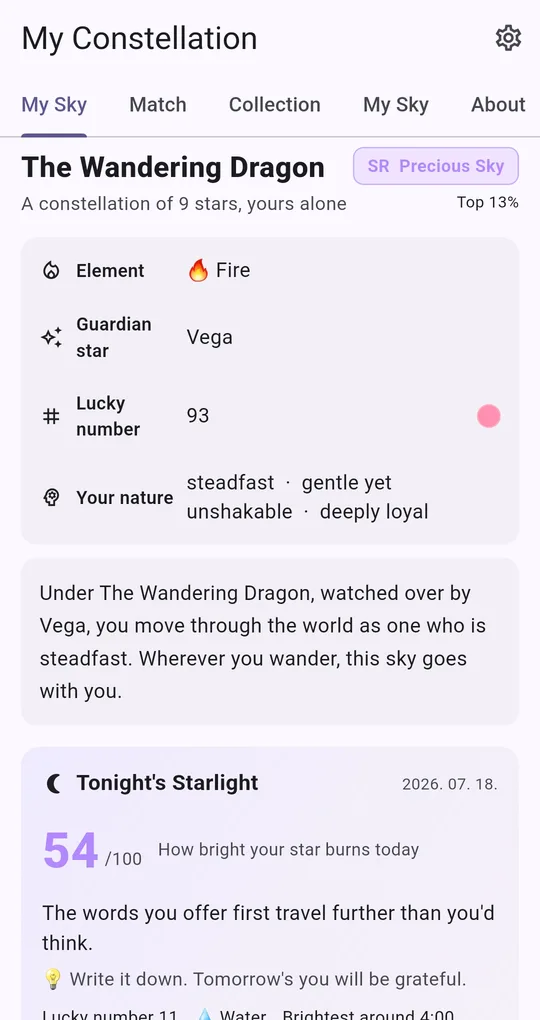
Check your guardian star
My Constellation gives every name-and-birthday constellation one of the 12 stars above as its Guardian star, shown under Element on the sign card. It doesn’t mean there is any astronomical link between you and that star; the name is borrowed for fun.
Go and find the real one
Got Vega? Look high overhead on a summer evening. Sirius? Look south on a winter night. The name in the app becomes a starting point for finding the real star.
FAQ
Is the dazzling point in the west after sunset Sirius?
More likely it is Venus. Bright points low in the west after sunset or in the east before dawn are often planets, which barely twinkle.
Isn’t Betelgeuse about to explode?
It is expected to go supernova one day, but in astronomy “soon” can mean far longer than a human lifetime.
My Constellation - Star Sign
One constellation drawn from your name and birthday. No sign-up, fully offline, free on Android.