Who actually sets a number
In many cities, neighbor noise is handled by quiet hours in a local ordinance, a lease or building rules, and by general "nuisance" laws that judge whether noise is unreasonable. Some ordinances do include decibel limits, usually measured at a property line and varying widely by city, so check your own local code rather than a number from the internet.
A worked example: Korea
South Korea is one of the few countries with a specific indoor limit for noise between apartments. Its rule (revised January 2023) sets these values; daytime is 06:00 to 22:00.
| Noise type | Measure | Day | Night |
|---|---|---|---|
| Impact noise (footsteps, running) | 1-minute equivalent level (Leq) | 39 dB(A) | 34 dB(A) |
| Impact noise | Maximum level (Lmax) | 57 dB(A) | 52 dB(A) |
| Airborne noise (TV, music) | 5-minute equivalent level (Leq) | 45 dB(A) | 40 dB(A) |
Two details matter. The 1-minute level is an energy average, and the loudest minute is used. The maximum level only counts as exceeded if it happens three or more times in an hour. Buildings approved before 30 June 2005 get 2 dB(A) added from 2025.
What the WHO recommends
The WHO’s Guidelines for Community Noise (1999) suggest that for good sleep, the level in a bedroom should stay around 30 dB(A) as an average through the night, with single events not exceeding about 45 dB(A). These are health guidance values, not laws, but they explain why a 34 dB(A) night limit is not as strict as it sounds.
Why a phone reading is not comparable
| Official measurement | Typical phone app (including this one) |
|---|---|
| A-weighted dB(A) | This app reads the raw microphone level without weighting, so thumping low sounds tend to read higher than dB(A) |
| Calibrated meter | Microphone sensitivity is approximated with one offset value |
| Energy average over a minute | This app’s "Avg" is a simple average of 0.2-second readings, which tends to be lower than Leq when loud bursts are mixed in |
| Set position, background correction | Wherever you put the phone, with household noise included |
What the app can log
The Android app Focus Noise Meter is not a verdict tool, but it can log patterns, which is what a landlord, building manager or mediator will ask about first.
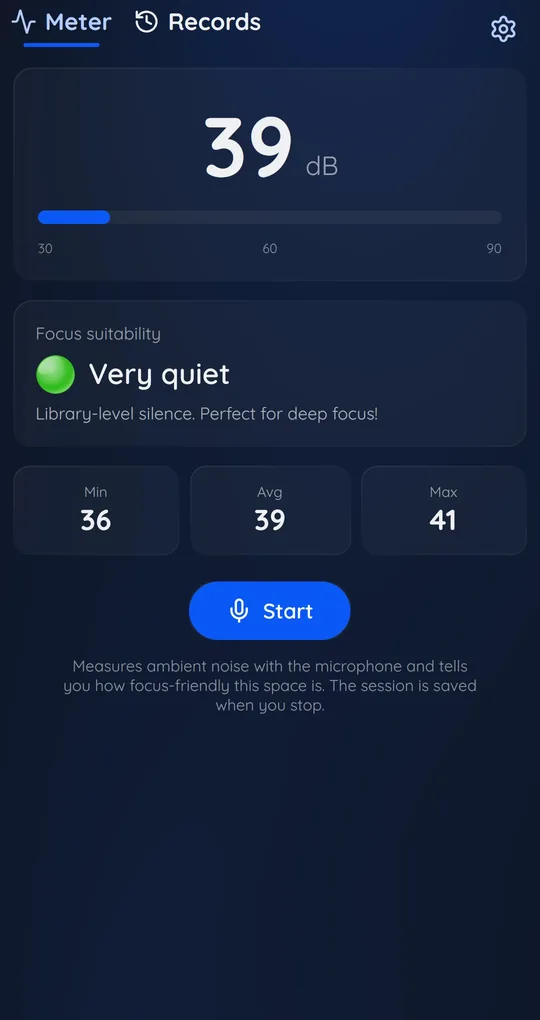
Start measuring when the noise starts
Tap Start. The reading updates every 0.2 seconds, and Min, Avg and Max build up underneath. The large number is smoothed; Max is the loudest 0.2-second reading.
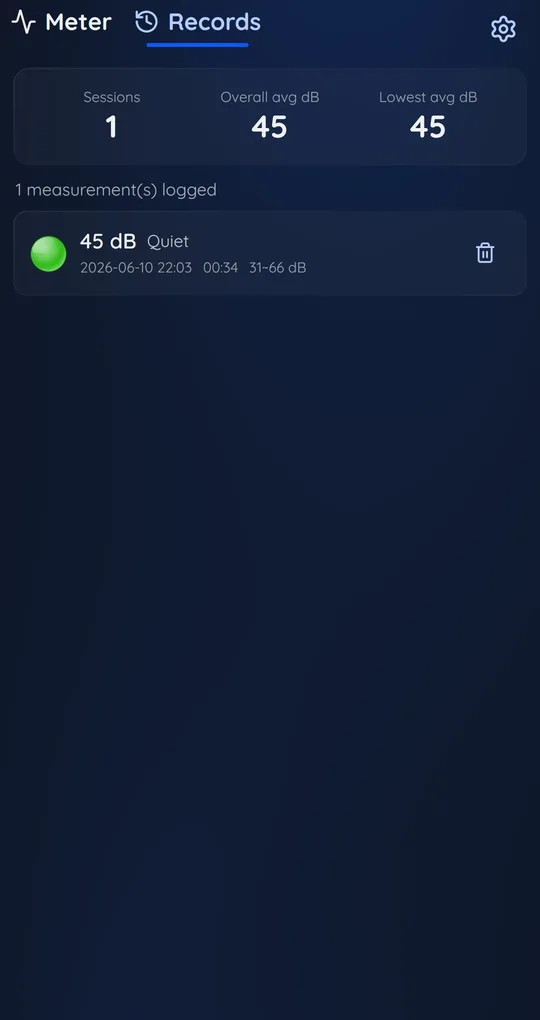
Stop, then check Records
Tap stop and the session saves automatically (sessions under 5 seconds are skipped). Records shows the date and time, duration and Min to Max range, so you can see whether noise repeats at the same times.
FAQ
My phone showed a max over 57. Is that a violation in Korea?
You cannot tell. The legal maximum is measured with an A-weighted, calibrated meter and must be exceeded three or more times in an hour.
What should I do before complaining?
Keep a log first. See how to document neighbor noise.
Focus Noise Meter - dB Sound Level
It never records audio, only calculates dB levels, and your history stays on your phone. Free on Android.