Roots: cellular automata
A cellular automaton is a grid where each cell decides its next state by looking only at its neighbors. The best-known example is the Game of Life, devised by mathematician John Conway in 1970 and popularized through a science magazine column. Falling-sand games take that idea and add gravity and material properties.
Timeline
| When | What happened |
|---|---|
| 1993 | An Atari ST game featured two-player falling snow, often cited as a distant ancestor |
| 2005 | A web Java applet on a Japanese blog became popular; an expanded version spread as the "falling sand game" and named the genre |
| 2006 | The first standalone Windows version appeared |
| 2007 | A web game added pressure-based fluid simulation and controllable characters |
| 2010 | An open-source sandbox added liquid simulation and Newtonian gravity |
| 2019–2020 | Browser sandboxes became popular again, and a commercial game combined pixel physics with roguelike action |
Source: Wikipedia, Falling-sand game (via HandWiki mirror)
How it works
| Part | Example rule (as in Sandlab) |
|---|---|
| Powders | Move down if empty, otherwise diagonally down |
| Liquids | Fall like powders, then flow sideways when blocked |
| Gases | Rise, and when their lifetime ends vanish (smoke) or condense (steam) |
| Density | Heavier materials swap places with lighter liquids and gases |
| Reactions | Touching cells have a chance to turn into another element |
The rules are simple, but with tens of thousands of cells moving at once you get scenes no one can predict. Complexity out of simple rules is the heart of the genre.
On mobile
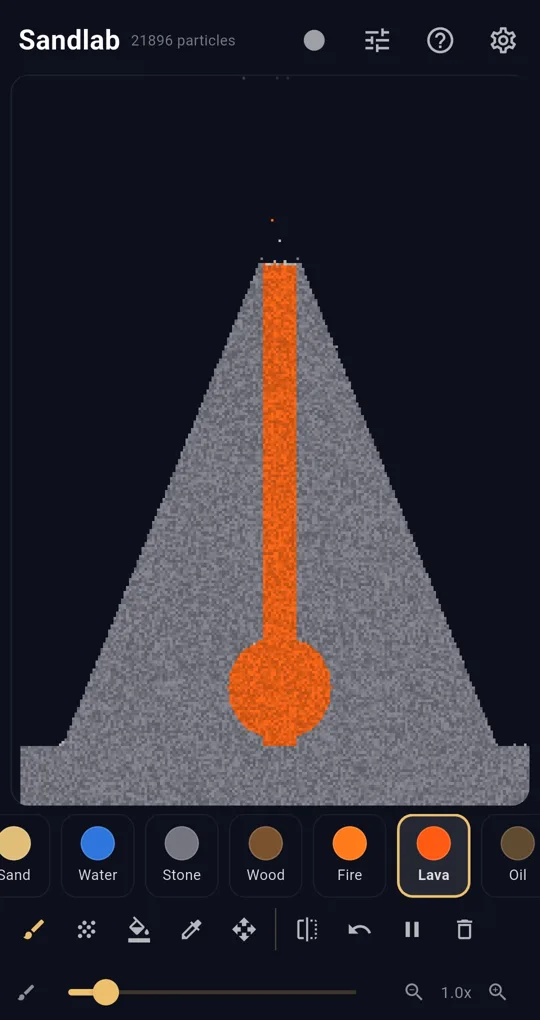
Fingers beat a mouse
On a PC you pour with a single cursor; on a phone you can pour with several fingers at once. In Sandlab, holding a finger down keeps pouring like a faucet, and Tilt gravity makes things flow the way you tip the device.
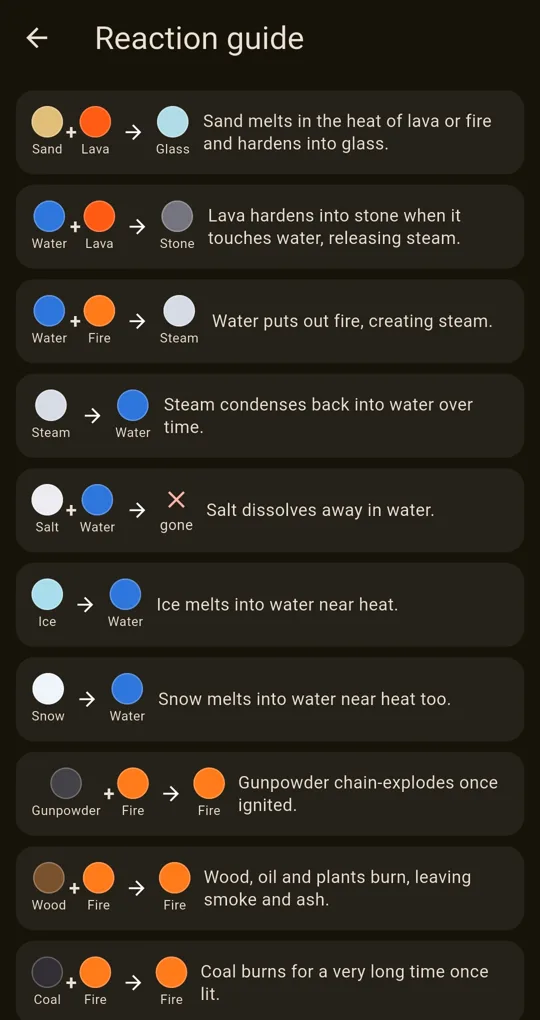
Reaction guide
The 23 elements and their reaction rules are shown with pictures in the in-app Reaction guide. Once you know the rules, designing contraptions becomes the game.
FAQ
Are “powder game” and “falling sand game” the same thing?
People often use "powder game" after an early hit, but the genre name is falling sand game.
Why are the pixels so chunky?
Each cell is one grain, and more cells mean more computation. Sandlab’s High-res canvas simulates with finer cells.
Sandlab - Falling Sand Physics
No sign-up, and the simulation runs fully offline. Your canvases stay on your device. Free on Android.