Textbook vs research
| Trait | Common claim | What is known |
|---|---|---|
| Dimples | Dominant | MedlinePlus (US National Library of Medicine) notes that some researchers say there is no proof dimples are inherited, and no gene has been identified. Dimples can also appear or fade with age. |
| Earlobes | Free is dominant | Many people have in-between shapes, so earlobes do not split cleanly into two types. |
| Tongue rolling | Roller is dominant | The researcher who proposed it later withdrew the idea, and identical twins have been reported to differ. |
| Bitter taste (PTC) | Taster is dominant | A major gene (TAS2R38) is involved, but sensitivity varies on a scale rather than in two clean groups. |
| Double eyelids | Dominant | A common example in East Asian classrooms, but not established as a single-gene trait, and eyelid shape can change with age. |
University of Delaware biologist John McDonald’s “Myths of Human Genetics” reaches the same conclusion: most visible traits used in classrooms do not follow simple one-gene, two-allele dominance.
Why simple dominance does not fit
- Many genes — several genes each add a small effect.
- Continuous variation — lots of in-between forms instead of yes or no.
- Age and environment — facial features change with growth, weight and aging.
- Judgment calls — whether a faint crease counts as a double eyelid depends on who is looking.
Why we still learn the model
Some traits really do follow clear dominance, like Mendel’s peas, and ABO blood type follows its rules well. The dominant/recessive model teaches the core idea that we carry two copies of each gene and pass on one. The mistake is using it to predict a real face.
Test the simple model in the app
The Android app Genetic Kids Lab deliberately uses the simple dominant/recessive model for eyelids, dimples, freckles, earlobes, tongue rolling and bitter taste. It is a teaching device, and the app’s About tab says real inheritance is more complex.
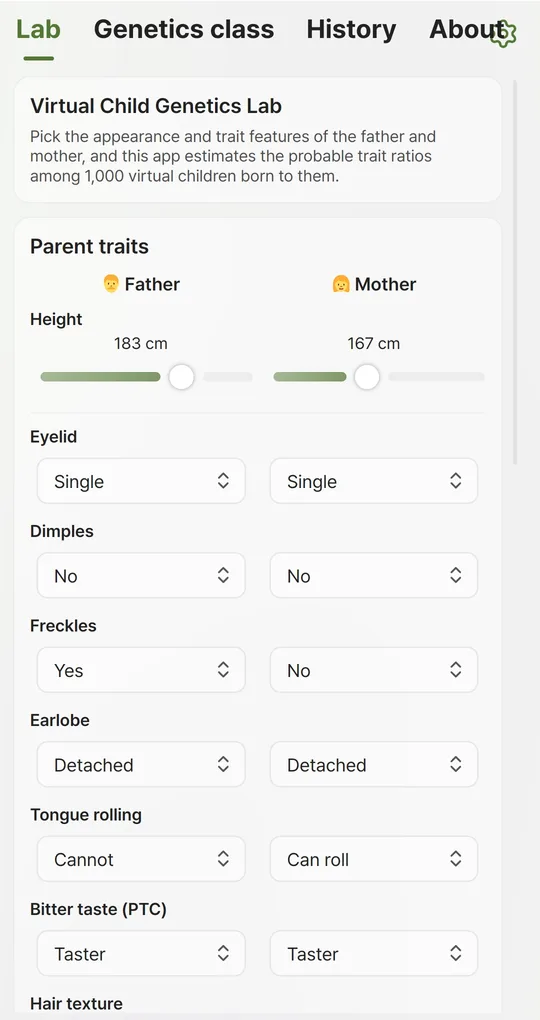
Give both parents the dominant type
Set both parents to Double eyelids and Dimples: Yes, then tap Simulate 1,000. Some children still come out with single eyelids or no dimples, because the app allows for the chance that each parent carries a hidden recessive copy.
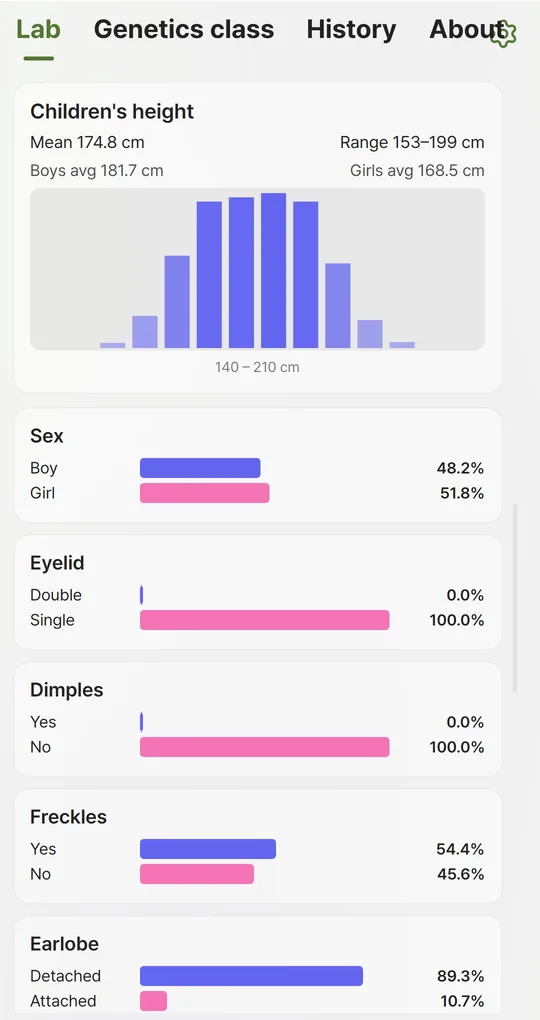
Both recessive gives 100%
If both parents have single eyelids, the model returns 100% single eyelids. Real families where that does not happen are exactly where the simple model breaks down.
FAQ
Both parents have no dimples, but our child does. How?
The simple model cannot explain it, yet it happens. It makes more sense to treat dimples as a trait that is not set by one gene pair.
So is school teaching it wrong?
The examples are useful for explaining the principle, but they become misleading if taken as how real human traits work. In homework, say clearly that you are using a simplified model.
How do I do a Punnett square assignment?
Genetic Kids Lab - Child Trait Simulator
Pick the parents’ traits and see trait ratios across 1,000 virtual children. An educational, just-for-fun simulator that works offline. Free on Android.