Step by step
- Decide each parent’s genotype, for example mother Ee and father Ee.
- Write the father’s possible alleles (E, e) across the top and the mother’s down the side.
- Fill each box by combining the letters: EE, Ee, Ee, ee.
- Write the genotype ratio 1:2:1 and the phenotype ratio (dominant:recessive) 3:1.
Four common mistakes
| Mistake | Correct version |
|---|---|
| Two parents with the dominant trait means 3:1 | Only if both are carriers (Ee). If either is EE, no recessive children appear. |
| Four children means exactly one recessive | Probability applies to each child separately. All four could be dominant. |
| Dimples and tongue rolling work this way | Research shows these are not simple dominant traits. Say you are using a simplified model. |
| Blood type is just another 2 × 2 | ABO has three alleles (A, B, O), so you must pick each parent’s genotype first. |
Traits that work well
- ABO blood type — follows its rules well. Check your answers against the parents’ blood type chart.
- Mendel’s pea traits — match the textbook exactly.
- Human facial traits (dimples, earlobes, tongue rolling, eyelids) — fine if you label them as a textbook model. See are dimples dominant?
For a family trait survey, ask family members first and label people by relationship (“Dad,” “Mom”) rather than by name.
Check it in the app
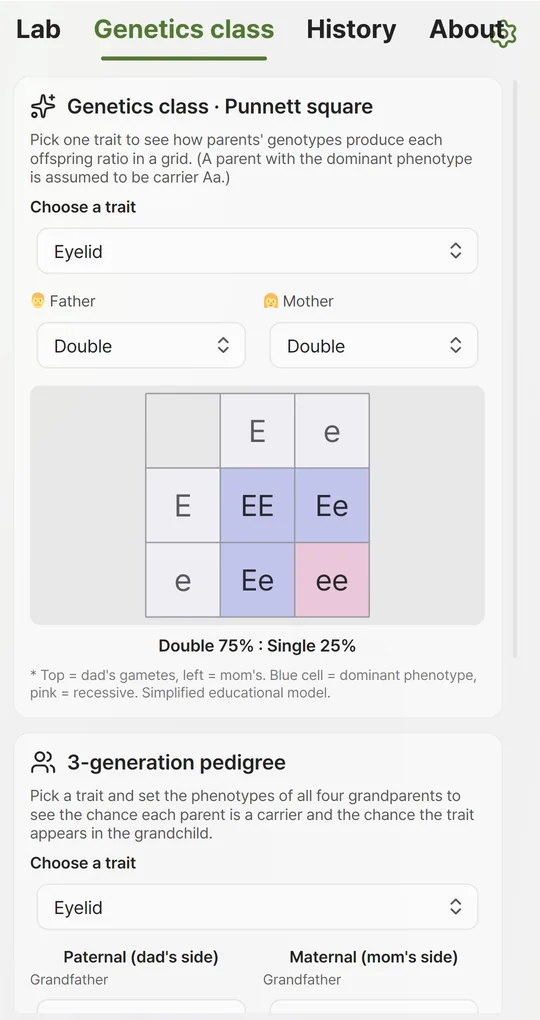
Genetics class tab → Punnett square
In the Genetics class tab of the Android app Genetic Kids Lab, choose a trait and each parent’s phenotype to see the 2 × 2 grid and ratio instantly. The top row is the father’s gametes, the left column the mother’s, and a parent with the dominant trait is assumed to be a carrier (Aa).
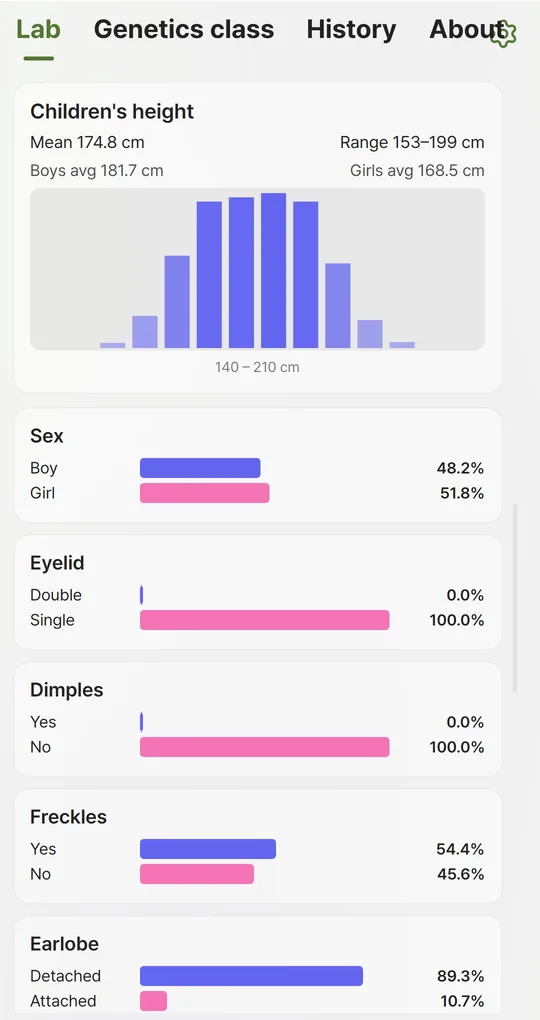
Compare with 1,000 children in the Lab
Enter the same parents in the Lab tab and run Simulate 1,000. The recessive share comes out below 25%, because the Lab also allows for the chance that a dominant-looking parent is EE, using population frequencies. Writing about that difference makes a strong “discussion” section.
FAQ
How do I write genotype and phenotype ratios?
For Ee × Ee, genotype EE:Ee:ee = 1:2:1 and phenotype dominant:recessive = 3:1.
What about traits with an in-between form, like curly hair?
As an incomplete dominance example, the genotype and phenotype ratios are both 1:2:1. The app’s Hair texture (curly, wavy, straight) uses this model.
Genetic Kids Lab - Child Trait Simulator
Pick the parents’ traits and see trait ratios across 1,000 virtual children. An educational, just-for-fun simulator that works offline. Free on Android.