The core idea
To follow a rounded crest, your body has to keep being pulled down toward the centre of that curve. The acceleration needed is v² ÷ r (v = speed, r = the radius of the crest if you treat it as part of a circle). The only thing pulling you down is gravity g. If the required value is larger than g, the ground drops away faster than you can follow, and you float.
Lift-off condition: v² ÷ r > g
Lift-off speed
Rearranged, the speed at which you start to float is v = √(g × r). With real gravity (g = 9.8 m/s²):
| Crest radius | Lift-off speed (approx.) |
|---|---|
| 5 m (16 ft) | 7.0 m/s (25 km/h, 16 mph) |
| 10 m (33 ft) | 9.9 m/s (36 km/h, 22 mph) |
| 20 m (66 ft) | 14 m/s (50 km/h, 31 mph) |
| 50 m (164 ft) | 22 m/s (80 km/h, 50 mph) |
The smaller the radius, the sharper the crest, and the lower the speed needed. That is why cars don’t leave the ground on long rolling hills but can bounce over a short, sharp hump.
Roller coaster airtime
Coaster fans call the floating moment “airtime”. As the train crests a hill and starts down, its downward acceleration can match gravity (zero g) or exceed it (negative g), and riders lift out of their seats. The train itself stays on the track because its wheels lock onto the rails; riders are held by the lap bar. Speed, gravity and the radius of the transition curve set the airtime, just like the formula above.
Reference: Wikipedia, Airtime (rides)
How games use it
| Element | Real world | Hill launch game |
|---|---|---|
| Take-off | When speed passes √(g×r) | The same test, checked every frame |
| Terrain | Irregular | Waves of different lengths layered to create rounded crests on purpose |
| Gravity | 9.8 m/s² | Often set higher for snappier control |
Stronger game gravity makes each flight shorter and punchier. The trade-off is that you need more speed to launch.
In WingBike
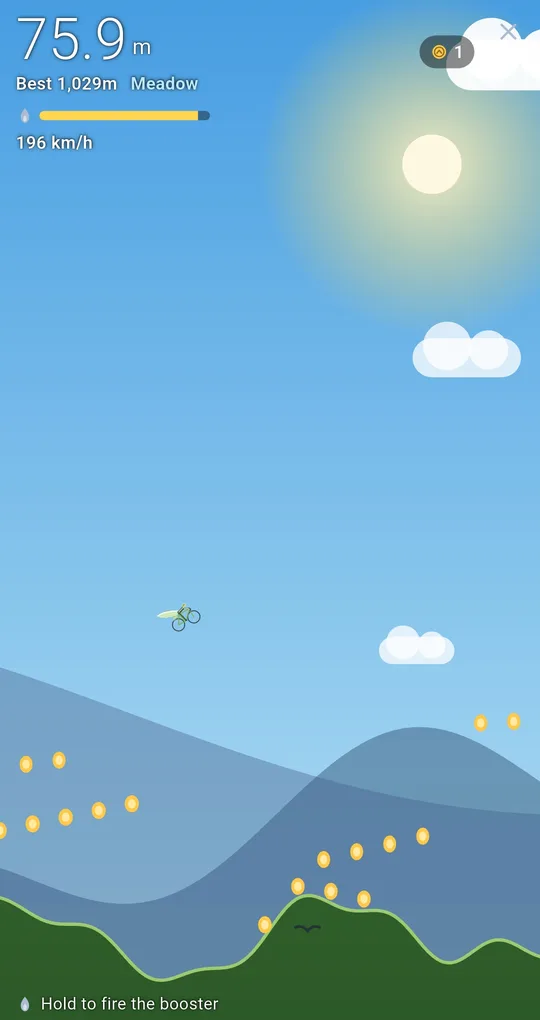
The take-off test
While you ride, WingBike launches you the moment “speed² × crest curvature” exceeds the part of gravity pressing you into the slope. It is the formula above. Game gravity is set to about twice the real value (20 m/s²) so the controls feel lively.
A launch ramp, then rounded crests
Every run starts with a 50 m downhill ramp. After that the ground is four layered waves of different lengths; the shortest, about 21 m apart, creates the rounded crests you launch from. For timing, see when to let go.
Numbers are from WingBike 1.0. Balance may change in later updates.
FAQ
Do heavier riders launch more easily?
Mass is not in the formula. Heavy or light, you lift off at the same speed over the same crest. A game may still model weight separately, for example as an upgrade that reduces gravity in flight.
Is a car bouncing over a speed bump the same thing?
Yes. A bump has a tiny radius, so wheels can leave the ground at fairly low speed. That is exactly why you are told to slow down for them.
WingBike: Fly and Jump Racer
No account, fully offline, played with one finger. Free on Android.