The basic rule
Rh+ and Rh− usually refer to whether the RhD antigen is present. For teaching, it is described as one gene where D (present) is dominant over d (absent).
| Genotype | Blood type |
|---|---|
| DD | Rh+ |
| Dd | Rh+ (a carrier of Rh−) |
| dd | Rh− |
If both parents are Dd, each child has a 1 in 4 chance of being dd. So an Rh− child from two Rh+ parents is fully consistent with the rule.
Why frequency differs by population
Rh− is far more common among people of European descent than in East Asia. In Korea, for example, only about 0.1 to 0.3% of people are Rh−. Where the d allele is rare, an Rh+ parent is less likely to be a carrier, and two carriers having children together is rarer still.
Results by combination
| Parents | Possible child Rh |
|---|---|
| Rh− × Rh− | Rh− |
| Rh+ × Rh− | Rh+ or Rh− (Rh− only if the Rh+ parent is Dd) |
| Rh+ × Rh+ | Mostly Rh+; 1 in 4 Rh− if both are Dd |
Real RhD typing also has variants such as weak D and partial D that can make results unclear. Those details belong to a medical lab.
Check it in the app
The Android app Genetic Kids Lab treats Rh as a simple dominant/recessive trait and estimates whether an Rh+ parent is a carrier from a population frequency. That frequency is a simplified teaching value, so the app shows Rh− children more often than a low-Rh− population would. Use it to see where the 1 in 4 comes from.
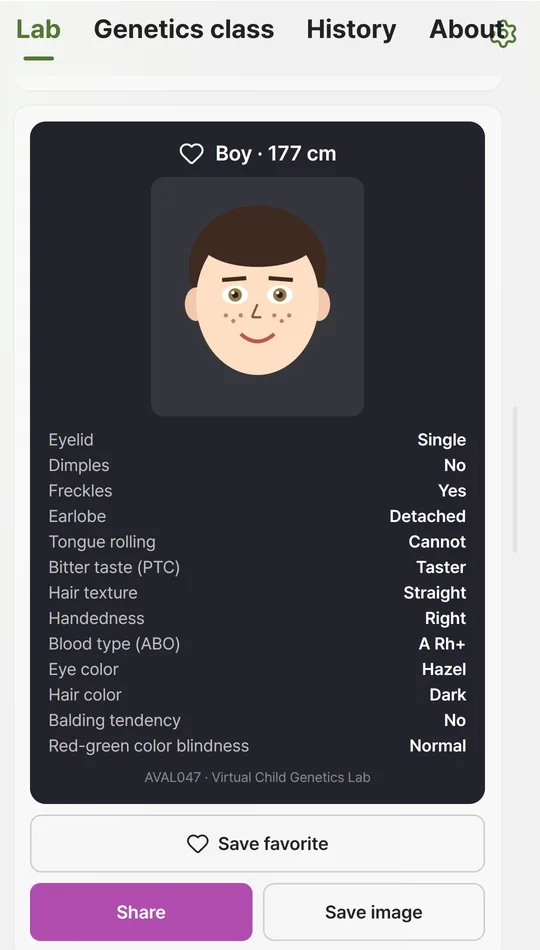
Draw one child and read the card
Tap Draw one child to get a random virtual child. The Blood type (ABO) line shows ABO and Rh together, such as “A Rh+.”
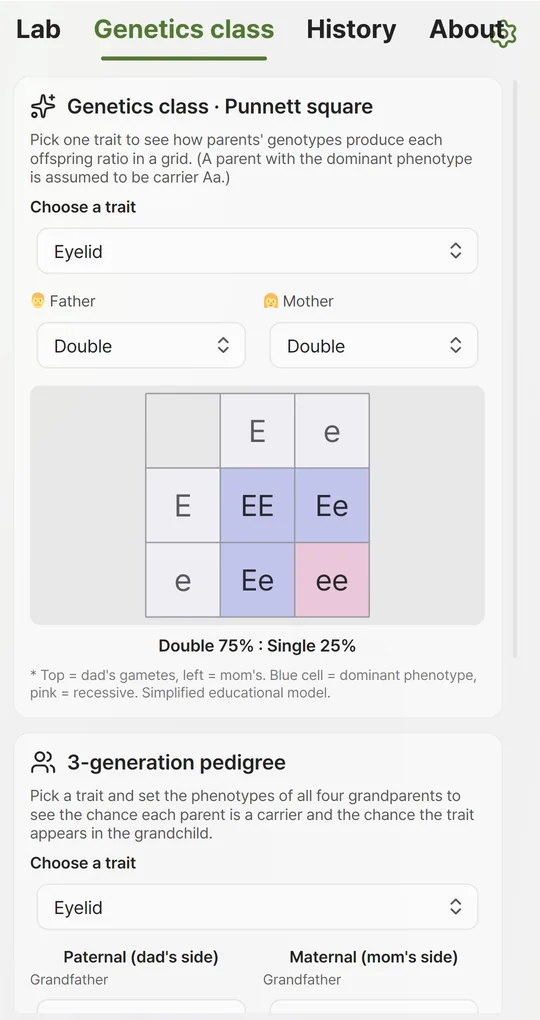
Rh in the Punnett square
In the Genetics class tab, switch the Punnett square trait to Rh factor to see the Dd × Dd grid and its 3:1 ratio. Here a parent with the dominant type is assumed to be a carrier.
FAQ
Is Rh inherited separately from ABO?
Yes. ABO and RhD are different genes and are inherited independently, which is why combinations like A− or O+ exist.
Is it strange for Rh+ parents to have an Rh− child?
No. If both carry a hidden d allele, it is expected. If you doubt a result, ask for a retest.
Genetic Kids Lab - Child Trait Simulator
Pick the parents’ traits and see trait ratios across 1,000 virtual children. An educational, just-for-fun simulator that works offline. Free on Android.