Split exactly first
$100 ÷ 3 doesn’t come out even. If everyone pays $33 the total is $99, so one person has to pay the extra unit.
| Person | Share | |
|---|---|---|
| First | $34 | +1 |
| Second | $33 | |
| Third | $33 | |
| Total | $100 | Exact |
With a remainder of 2, the first two people each pay one extra. Nobody ever carries more than one extra unit.
Rounding the transfers
Amounts like $38 or ₩38,333 are fiddly to send, so some groups round each person’s final balance to 10, 100 or 1,000 units. Round once, at the final balance, not on every expense, to keep the error small.
The gap rounding leaves
A paid $115, split between A, B and C.
| A | B | C | |
|---|---|---|---|
| Exact balance | +$76 | −$38 | −$38 |
| Rounded to 10 | +$80 | −$40 | −$40 |
| Actual transfers | receives $80 | sends $40 | sends $40 |
Once rounded, the balances no longer add up to zero. Here B and C each pay $2 extra; with other numbers the person being paid can end up short instead. The bigger the group, the bigger the gap can get, so say up front who absorbs it.
Setting it in the app
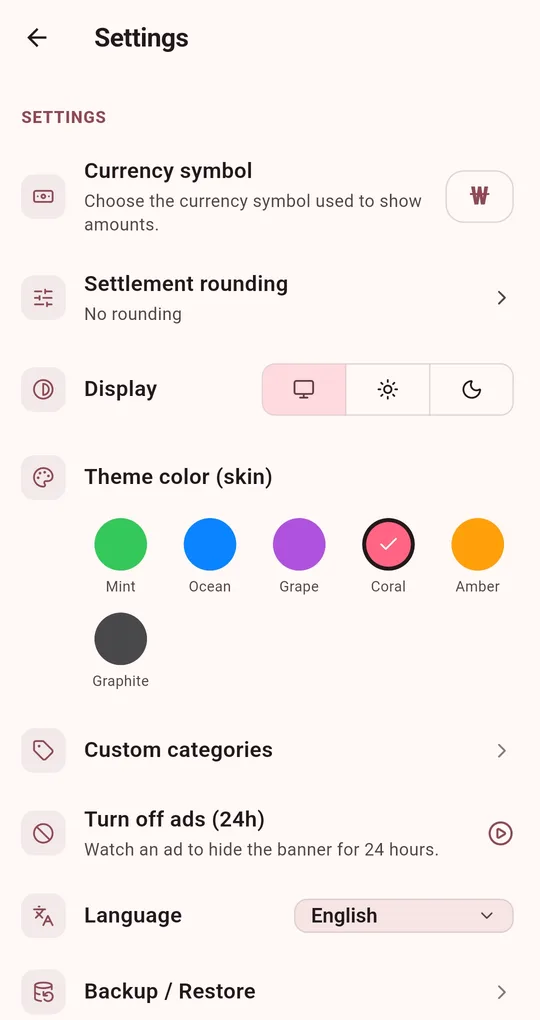
Choose settlement rounding
In Settings, Settlement rounding offers no rounding, or rounding to 10, 100 or 1,000 units. Expenses stay as entered; only the final transfer amounts change.
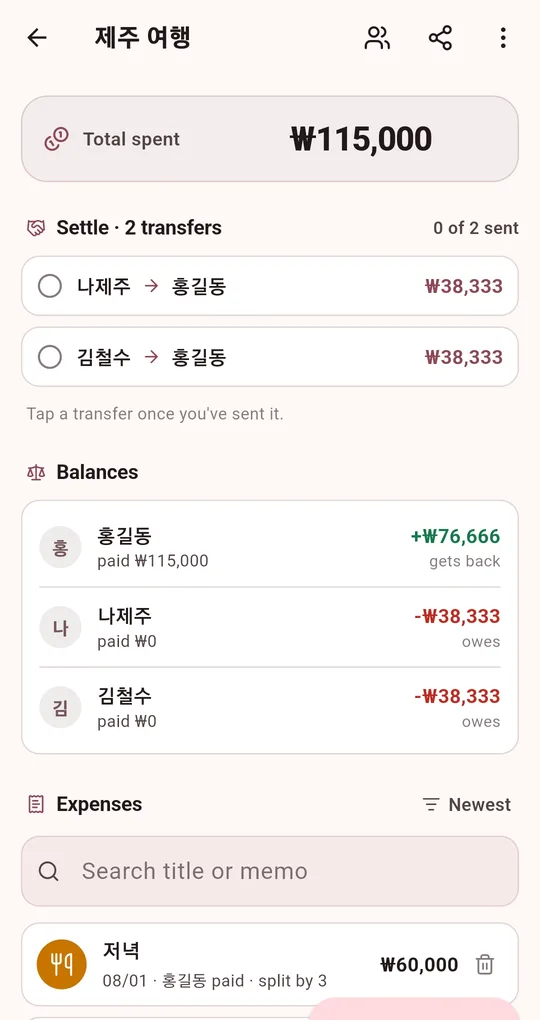
Remainders are handled for you
With rounding off, amounts are split exactly to the unit, and any remainder goes to the people first in the sharer list, one unit each.
FAQ
Can I choose who pays the extra unit?
With an equal split it follows the order of the sharers. If it matters, switch that expense to Exact and type the amounts.
Does changing the rounding change my records?
No. Expenses and balances stay the same; only the transfer list is recalculated.
Settle Up: Split the Bill
No sign-up, no internet, and your records stay on your phone. Free on Android.