Background
The Pregel river ran through Königsberg with the island of Kneiphof in the middle. Four land areas, the two banks, the island and the land between the river’s two branches, were linked by seven bridges. Euler presented the problem to the St. Petersburg Academy in 1735, and the paper was published in 1741.
The city is now Kaliningrad, Russia.
Why it was impossible
Euler turned each land area into a dot and each bridge into a line. The number of bridges touching an area becomes that dot’s degree.
| Land area | Bridges touching it | Odd or even |
|---|---|---|
| Kneiphof island | 5 | Odd |
| The other three | 3 each | Odd |
That is four odd dots. One-line drawing needs 0 or 2 odd dots (the odd-dot rule), so wherever you start, no walk crosses all seven bridges exactly once.
The bridges today
Two bridges were destroyed by bombing in the Second World War, and two more were later demolished to make way for a highway. Five bridges now stand at the original sites (two of them date from Euler’s time). In this layout two land areas have degree 2 and two have degree 3, so there are two odd dots. Start at one degree-3 area and you can cross every bridge once, ending at the other degree-3 area. Returning to where you started is still impossible.
Source: Wikipedia, Seven Bridges of Königsberg (bridge layout and dates). Check access to the bridges locally before planning a visit.
Turning a map into a drawing
- Put one dot on each piece of land. Its size and shape do not matter.
- Draw a line between two dots for every bridge. Two bridges between the same areas means two lines.
- Count the lines at each dot and see how many are odd.
You can try the same thing with a local river and its bridges, or the paths in a park. For a version to do with children, see a one-line drawing math game for kids.
In the app
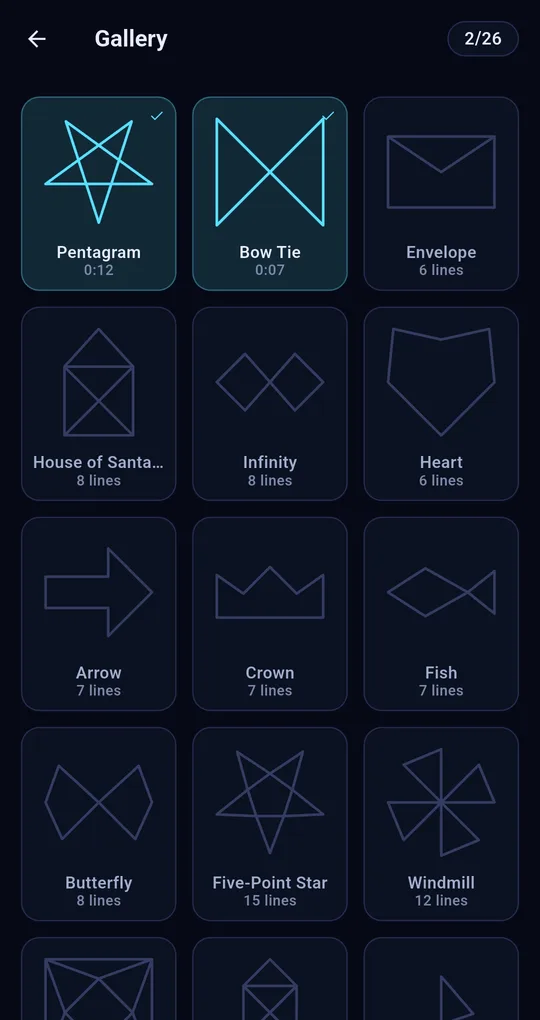
Bridges of Königsberg in the Gallery
OneTrail’s Gallery collects classic figures designed by hand and checked one by one, including Bridges of Konigsberg. Every Gallery figure has 0 or 2 odd dots so it can be solved, which means this one is not the original seven-bridge map but a 5-line figure with 2 odd dots. Its degree pattern (3, 3, 2, 2) is the same as today’s five-bridge layout.
FAQ
Would one extra bridge have solved the original?
Yes. Add a bridge between two of the four odd areas and both become even, leaving 2 odd dots, so a walk crossing each bridge once becomes possible. To end where you started, you would need two extra bridges to bring the odd dots down to 0.
Did Euler invent one-line drawing?
The pastime is older, but this paper is regarded as the first mathematical treatment of when such a drawing is possible.
OneTrail: One Line Draw Puzzle
No sign-up, fully offline, and every board is checked to be solvable before you see it. Free on Android.